Exness Account Types: Comparison and Key Differences
Compare Exness Standard, Standard Cent, Pro, Raw Spread and Zero accounts by spreads, commissions, minimum deposit, execution and trading platforms.
 Compare Exness accounts before choosing your trading setup:
- Open an Exness trading account
- Exness Islamic and swap-free account
- Exness VIP account features
- Exness minimum deposit by account type
- Exness leverage and margin rules
Exness account types: full comparison
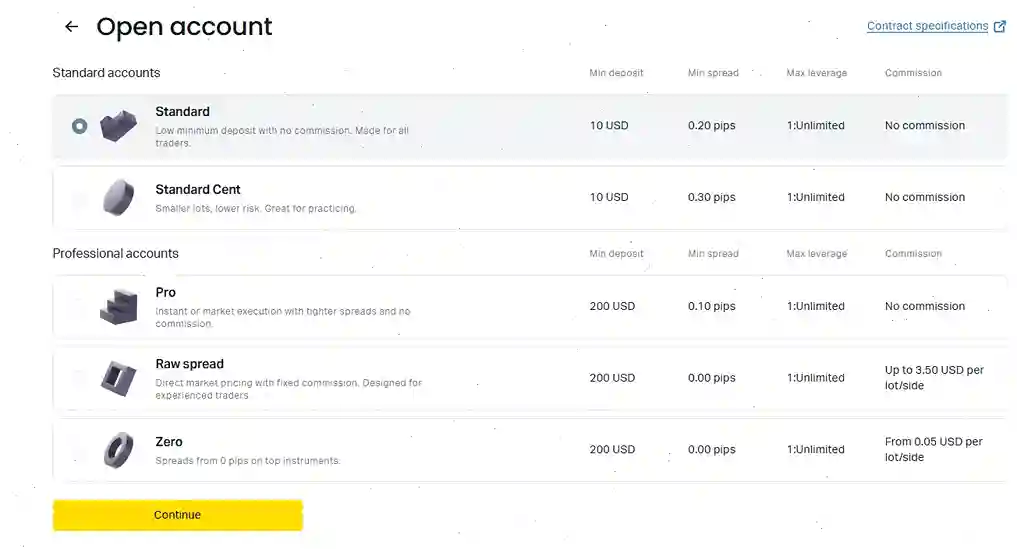
Exness offers five main trading account types: Standard, Standard Cent, Pro, Raw Spread and Zero. They are divided into Standard accounts and Professional accounts, with different pricing structures, execution methods and deposit requirements.
Standard and Standard Cent are generally simpler because there is no trading commission. Pro also has no trading commission but offers lower starting spreads and different execution conditions. Raw Spread and Zero use tighter spreads with a separate commission.
For traders in Tanzania, there is no need to choose an account type before visiting Exness. The safer approach is to go first to the official Exness website, register or sign in, and then compare the account types available in the Personal Area before creating a trading account.
| Account type | Minimum deposit | Spread | Commission | Execution |
|---|---|---|---|---|
| Standard | Depends on payment method and region | From 0.2 pips | No | Market execution |
| Standard Cent | Depends on payment method and region | From 0.3 pips | No | Market execution |
| Pro | Professional account requirement; region based | From 0.1 pips | No | Instant and market execution depending on instrument |
| Raw Spread | Professional account requirement; region based | From 0.0 pips | Up to $3.50 each side per lot | Market execution |
| Zero | Professional account requirement; region based | From 0.0 pips | From $0.02 each side per lot | Market execution |
The lowest spread does not automatically mean the lowest total trading cost. With Raw Spread and Zero, commission needs to be added to the spread when comparing the final cost of a trade.
Exness Standard account
The Exness Standard account is designed to provide straightforward trading conditions without a separate trading commission. Spreads start from 0.2 pips and orders use market execution.
The minimum first deposit is not one fixed amount for every user. It can depend on the payment method and geographic region registered on the account.
- Spreads from 0.2 pips
- No trading commission
- Market execution
- Minimum trade size from 0.01 lot
- Access to forex, commodities, cryptocurrencies, indices and stocks
- Available for real and demo trading
This account can be useful for traders who prefer to see most of the trading cost inside the spread rather than calculating a separate commission for every position.
Exness Standard Cent account
Standard Cent is another Standard-category account, but trading volume is measured in cent lots. This allows smaller position sizes than on a conventional Standard account and can make it useful for testing strategies with lower nominal exposure.
Spreads start from 0.3 pips and there is no trading commission. The minimum first deposit depends on the payment method and region rather than one universal amount.
| Feature | Standard | Standard Cent |
|---|---|---|
| Spread | From 0.2 pips | From 0.3 pips |
| Commission | No | No |
| Position sizing | Standard lots | Cent lots |
| Minimum deposit | Region/payment-method based | Region/payment-method based |
| Main use | General live trading | Smaller-volume live trading |
Standard Cent is not available in every region, so Tanzanian users should check whether it appears among the account options in their Exness Personal Area.
Exness Standard vs Pro account
One of the most useful comparisons is Exness Standard vs Pro because both accounts avoid a separate trading commission, but their pricing and execution conditions differ.
Standard starts with wider spreads from 0.2 pips and uses market execution. Pro starts from 0.1 pips and can use instant execution for many instruments, while market execution applies in some cases.
| Feature | Standard | Pro |
|---|---|---|
| Spread | From 0.2 pips | From 0.1 pips |
| Trading commission | No | No |
| Initial deposit | Depends on method and region | Higher Professional-account requirement |
| Execution | Market | Instant / market depending on instrument |
| Pricing style | Simpler spread-based structure | Lower spread without commission |
A trader who wants simpler entry conditions may prefer Standard, while someone placing more frequent trades may pay more attention to Pro because of its lower starting spreads.
Exness Pro account
The Pro account belongs to Exness Professional accounts. It combines spreads from 0.1 pips with no trading commission, making it structurally different from Raw Spread and Zero.
The account can use instant execution for many instruments. Instant execution can produce requotes when the requested price is no longer available, while some instruments use market execution.
- Spreads from 0.1 pips
- No trading commission
- Professional-account initial deposit requirement
- Instant and market execution depending on instrument
- Minimum trade volume from 0.01 lot
Pro can therefore appeal to traders who want lower spreads without adding a commission to every trade.
Exness Raw Spread account
The Raw Spread account is designed around very low spreads and a separate trading commission. Spreads can start from 0.0 pips, while commission can reach up to $3.50 each side per lot depending on the instrument.
This means the real cost of a Raw Spread trade should be calculated as spread plus commission rather than looking only at the quoted spread.
For example, a 0.0-pip spread does not mean the trade is free. The separate commission still needs to be included when comparing Raw Spread with Standard or Pro.

When Raw Spread can make sense
Raw Spread is often considered by active traders who value tighter bid/ask pricing and are comfortable calculating trading costs through both spread and commission.
Whether it is cheaper than another account depends on the instrument, position size, trading frequency and actual spread at the moment the order is opened.
Exness Zero account
The Zero account is another Professional account with spreads starting from 0.0 pips and a separate commission. Its main distinction is the zero-spread model available on selected instruments for substantial parts of the trading day, depending on market conditions.
The commission is instrument-specific and starts from $0.02 each side per lot. This differs from Raw Spread, where commission can be up to $3.50 each side per lot.
Zero is therefore not simply a cheaper version of Raw Spread. The two accounts use different pricing structures and can produce different total costs depending on the instrument.
Exness Raw Spread vs Zero
Raw Spread vs Zero is mainly a comparison of how spread and commission are combined.
| Feature | Raw Spread | Zero |
|---|---|---|
| Spread | From 0.0 pips | From 0.0 pips |
| Commission | Up to $3.50 each side per lot | From $0.02 each side per lot, instrument dependent |
| Execution | Market execution | Market execution |
| Deposit category | Professional account | Professional account |
| Main distinction | Raw spread plus fixed-style commission structure | Zero-spread conditions on selected instruments plus instrument-specific commission |
To compare the two properly, select the instrument you actually trade and calculate both the spread and commission. Looking only at the headline “0.0 pips” can give an incomplete picture.
Exness account types and minimum deposit
Minimum deposit is one of the biggest differences between Standard and Professional account categories.
Standard and Standard Cent use a minimum first deposit that depends on the payment method and geographic location. Professional accounts such as Pro, Raw Spread and Zero require a higher initial deposit, with the exact requirement depending on region.
Tanzanian users should check the current value inside the Personal Area instead of relying on a fixed amount published for another country.
For a detailed explanation, see the Exness minimum deposit guide.
Which Exness account has the lowest trading costs?
There is no single account that is cheapest for every instrument and trading style.
| Cost factor | Standard | Pro | Raw Spread | Zero |
|---|---|---|---|---|
| Starting spread | 0.2 pips | 0.1 pips | 0.0 pips | 0.0 pips |
| Separate commission | No | No | Yes | Yes |
| Simple cost structure | High | High | Lower | Lower |
| Requires spread + commission calculation | No | No | Yes | Yes |
For occasional trading, the simplicity of Standard or Pro may be easier to understand. For frequent trading, Raw Spread or Zero may become more relevant, but only after comparing the actual total cost for the instruments being traded.
Execution differences between Exness accounts
Execution is another important difference that was missing from many simple account comparisons.
Standard, Standard Cent, Raw Spread and Zero generally use market execution. Pro can use instant execution for many instruments, while some instruments use market execution.
| Execution type | What it means |
|---|---|
| Market execution | The order is executed at the available market price; slippage can occur when prices move |
| Instant execution | The requested price is used where available; a requote may occur if that price is no longer available |
Neither execution method guarantees a better trading result. The practical difference becomes more noticeable during fast markets, large orders or short-term strategies.
Which trading platforms work with Exness account types?
Exness supports different account setups across MetaTrader and its own platform environment. Platform availability can depend on the account type and region.
Before creating a trading account, first go to the official Exness website, register or sign in, and check the platform/account combinations currently available in your Personal Area.
| Platform | Typical use |
|---|---|
| MetaTrader 4 | Desktop, mobile and automated MT4 strategies |
| MetaTrader 5 | Desktop/mobile trading with additional analytical functions |
| Exness Terminal | Browser-based trading where supported |
| Exness Trade | Mobile account management and trading where supported |
If you plan to use Expert Advisors or an existing MetaTrader setup, check platform compatibility before selecting the account.
How to choose an Exness account type
Instead of asking which account is universally “best,” compare the account characteristics with the way you plan to trade.
| If you prefer… | Account worth comparing first | Why |
|---|---|---|
| Simple spread-only pricing | Standard | No separate commission and lower entry requirements |
| Smaller live position sizes | Standard Cent | Uses cent lots where available |
| Lower spreads without commission | Pro | Spreads from 0.1 pips with no trading commission |
| Raw pricing | Raw Spread | Spreads from 0.0 pips with separate commission |
| Zero-spread conditions on selected instruments | Zero | Instrument-specific zero-spread model with commission |
The account choice should also consider deposit requirement, instrument availability, platform compatibility, leverage and expected trading volume.
How to open the right Exness account from Tanzania
Start from the official Exness website rather than following a third-party registration or platform link.
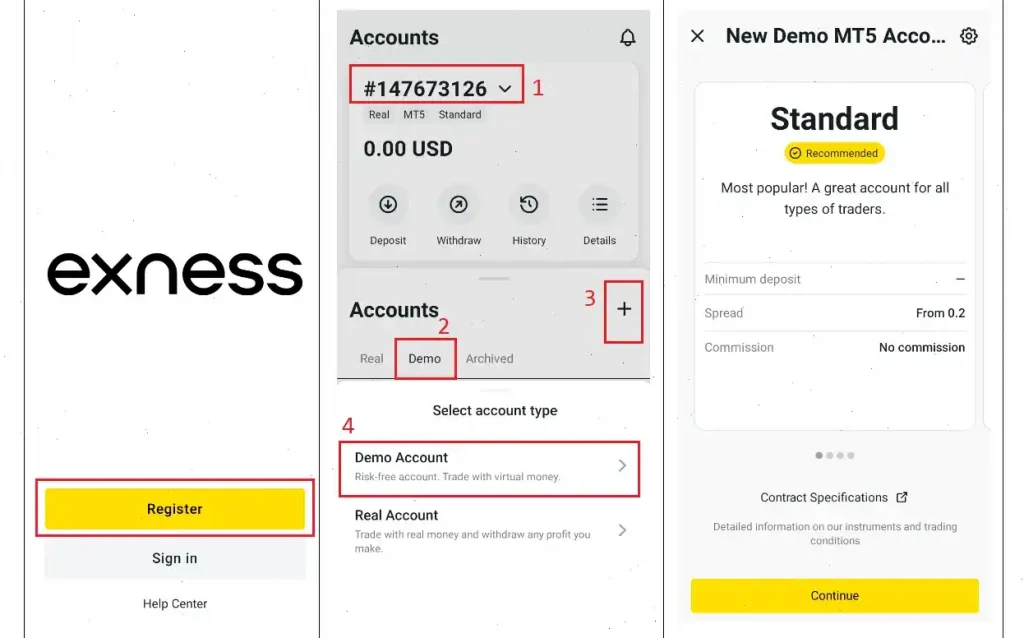
- Go to the official Exness website using the button on this page.
- Register a Personal Area or sign in to your existing account.
- Open the section for creating a new trading account.
- Compare Standard, Standard Cent, Pro, Raw Spread and Zero where available.
- Select MT4, MT5 or another supported platform option.
- Choose real or demo trading.
- Set the account currency and other available account parameters.
- Create the trading account.
You can create more than one trading account in the same Personal Area, so comparing two account types does not necessarily require closing the first account.

Deposits and withdrawals by account type
The account type primarily changes trading conditions such as spread, commission and execution. Available deposit and withdrawal methods are shown in the Exness Personal Area and can depend on region and the payment method available to the user.
This means there is little value in choosing Raw Spread, Pro or Standard based only on a specific mobile-money or bank method mentioned in an old article.
For Tanzanian users, sign in to the official Exness Personal Area and check the Deposit and Withdrawal sections for the current payment methods, limits and processing information associated with the account.
Leverage and risk across Exness account types
Maximum leverage can vary according to account conditions, equity, instrument and registered entity. It should not be treated as a fixed property that permanently separates Standard, Pro, Raw Spread and Zero.
A lower spread or higher available leverage does not automatically make an account more suitable. Position size, margin and potential loss still need to be considered for every trade.
See our Exness leverage guide for a detailed explanation of leverage limits and margin rules.
 FAQ
What account types does Exness offer?
Exness offers Standard, Standard Cent, Pro, Raw Spread and Zero trading accounts. Standard and Standard Cent belong to the Standard category, while Pro, Raw Spread and Zero are Professional accounts.
What is the difference between Exness Standard and Pro?
Standard has spreads from 0.2 pips, no commission and market execution. Pro has spreads from 0.1 pips, no trading commission and can use instant or market execution depending on the instrument.
What is the difference between Exness Raw Spread and Zero?
Both can offer spreads from 0.0 pips and both charge commission. Raw Spread charges up to $3.50 each side per lot, while Zero uses an instrument-specific commission starting from $0.02 each side per lot and offers zero-spread conditions on selected instruments.
Which Exness account has no commission?
Standard, Standard Cent and Pro do not charge a trading commission. Raw Spread and Zero charge trading commissions based on their pricing models.
Which Exness account has the lowest spread?
Raw Spread and Zero have spreads starting from 0.0 pips. Pro starts from 0.1 pips, Standard from 0.2 pips and Standard Cent from 0.3 pips.
What is the Exness Standard account minimum deposit?
The minimum first deposit for Standard depends on the payment method and geographic region. Check the amount displayed in your Exness Personal Area.
Which Exness account is better for beginners?
There is no account that is automatically best for every beginner. Standard has a simpler spread-based cost structure with no trading commission, while Standard Cent can provide smaller position sizing where it is available.
Can I have more than one Exness account type?
Yes. Multiple trading accounts can be created inside one Exness Personal Area, subject to the platform and account limits currently applied.
How do I choose an Exness account in Tanzania?
Go first to the official Exness website, register or sign in, then compare the account types available in your Personal Area. Check the current minimum deposit, platform, spreads, commission and execution before creating the trading account.