Techaisle sizes worldwide IT spending by firms with 1 to 4,999 employees at US$1.667 trillion in 2026, with services taking the majority. This is the primary driver of commercial IT growth globally. It is also the market IBM has historically reached through partners, priced for enterprises, and packaged for buyers who employ platform teams.
Whether IBM wants this segment is settled. It has said so plainly and has now moved headcount and compensation to back it up. What remains open is which parts of a portfolio assembled across two decades of enterprise engineering can be consumed by a firm with 400 employees, 6 people in IT, and no platform team.
The Absorption Test
A product fits the long tail when it absorbs operating complexity instead of offloading it onto a team the buyer does not have.
IBM has made a version of this case itself. Rob Thomas, IBM's Chief Commercial Officer, has framed the central AI question as how you operate AI across everything you already have, and calls the approach an AI operating model. He is describing enterprises. The same logic binds harder one tier down, where there is no one to do the operating.
Most enterprise software fails this test in three ways. It needs a standing platform team to run, a configuration project before the buyer sees any value, and a procurement cycle longer than the payback window a midmarket CFO will tolerate. Any one of those is disqualifying. The configuration project is the quiet one, because it arrives as a budget line nobody planned for.
All three assume an IT organization with people to spare. The midmarket carries enterprise-shaped problems on a small-business-shaped bench. Techaisle’s SMB and Midmarket Datacenter Solutions Adoption Trends study, 2026, N=2,857, puts the execution constraint at 85% for talent and 65% for facilities, with 88% of firms reporting a partner expertise deficit. Techaisle’s GenAI adoption research finds 37% to 45% of midsized firms still inside Pilot Purgatory, funded and committed but unable to reach production. Midmarket organizations are allocating 17% of IT budgets to GenAI and planning a 27% increase, so the constraint is not money.
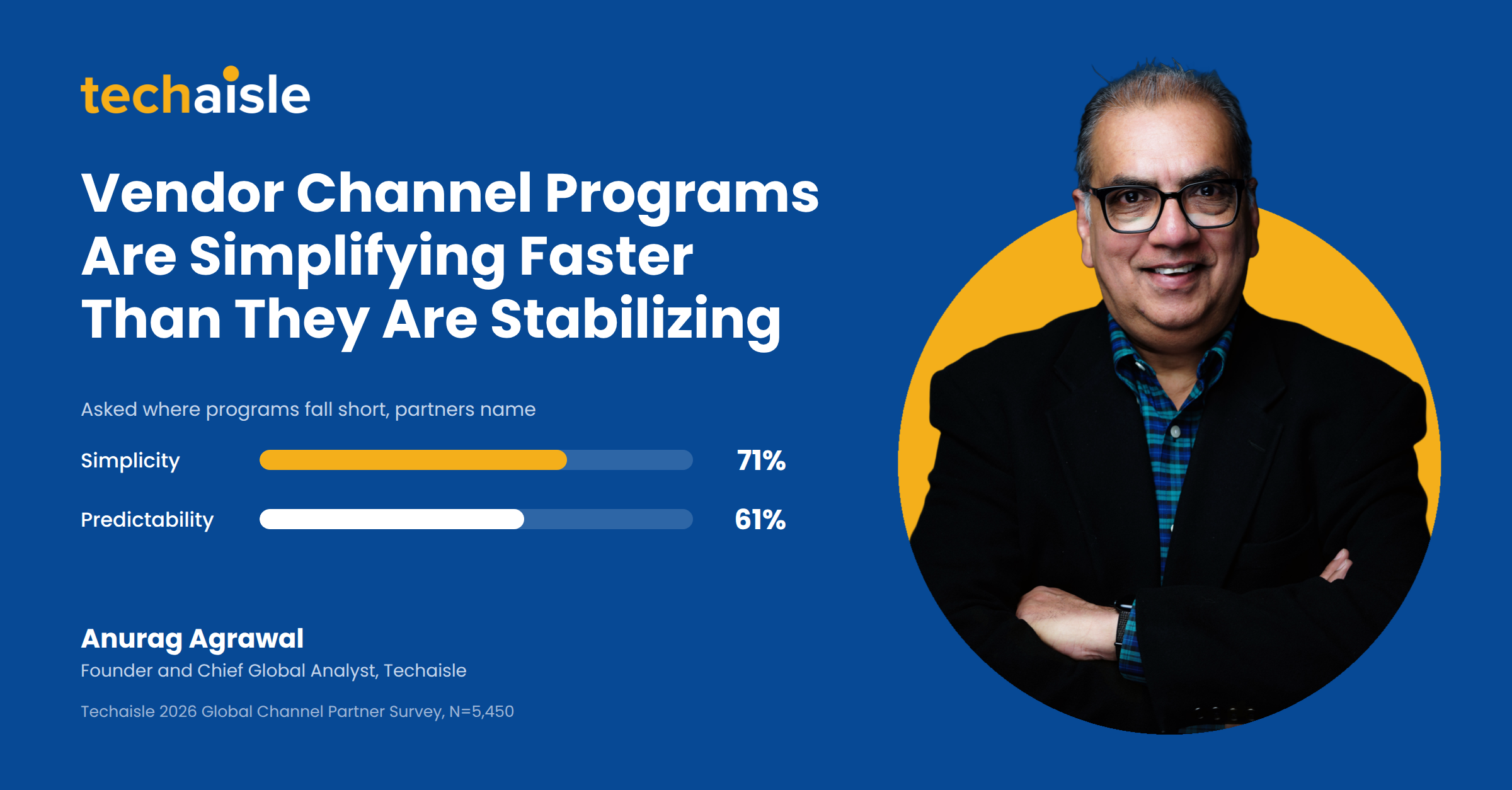
Many of the largest vendors have rebuilt their partner programs over the past 2 years. Some of those changes line up with what partners asked for, and a few work against it. Across the 2026 changes from AWS, Cisco, Microsoft, Google Cloud, Dell, HPE, Lenovo, Palo Alto Networks, and Broadcom, one pattern stands out: programs are getting simpler faster than they are getting predictable. Most of the work went into fewer tiers, merged incentives, and automated paperwork, while the changes that cost partners money came from timing.
Techaisle calls this gap the Incentive-Trust Deficit. Partners will accept thinner margins in exchange for rules that hold for a year. For a vendor, that makes predictability a cheaper lever than a richer rebate. For a partner, a vendor's record of program changes matters as much as its margin structure when deciding where to commit staff.
The contact center is the only function in a company that measures itself on how often it avoids its own work. Deflection rate counts how often customers are kept out of a live conversation. Containment rate counts how often they are held inside a self-service loop. Both metrics were rational under the old cost structure. Amazon Connect Customer treats them as the wrong measures and replaces them with a single question: whether the customer’s problem was solved.
Earlier this year I argued that Lenovo's real position in the agentic era is not any single device but the whole endpoint fleet, across commercial PCs, workstations, tablets, phones through Motorola, and wearables, paired with the largest commercial channel and a services business capable of operating all of it. That argument had a known weakness, and I said so at the time. Breadth of portfolio is copyable. What is not copyable is control at the system layer across every device type in the fleet, and until this event, that layer was a roadmap item.
Berlin is where it stopped being a roadmap item.
What matters, in order
- Motorola Qira is extending to the wearable and will take over from moto ai and AI Now, carrying the operating layer across four device types in software rather than only in hardware.
- The Workato collaboration lets Qira finish tasks rather than only answer questions, and it asks for approval before acting.
- Extending Lenovo Qira to eligible 16GB configurations determines whether any of this reaches fleet scale, and the download requirement determines whether it gets switched on.
- Lenovo announced everything from a mainstream consumer laptop to a cluster-ready AI desktop in the same room on the same day, which is the estate argument stated as a range.
- Local inference silicon moved onto the desk and into the notebook, and the channel has no motion for selling it, at least not yet.