Episode 1165 - What Jackie Chan Understands About Martial Arts That Many People Miss
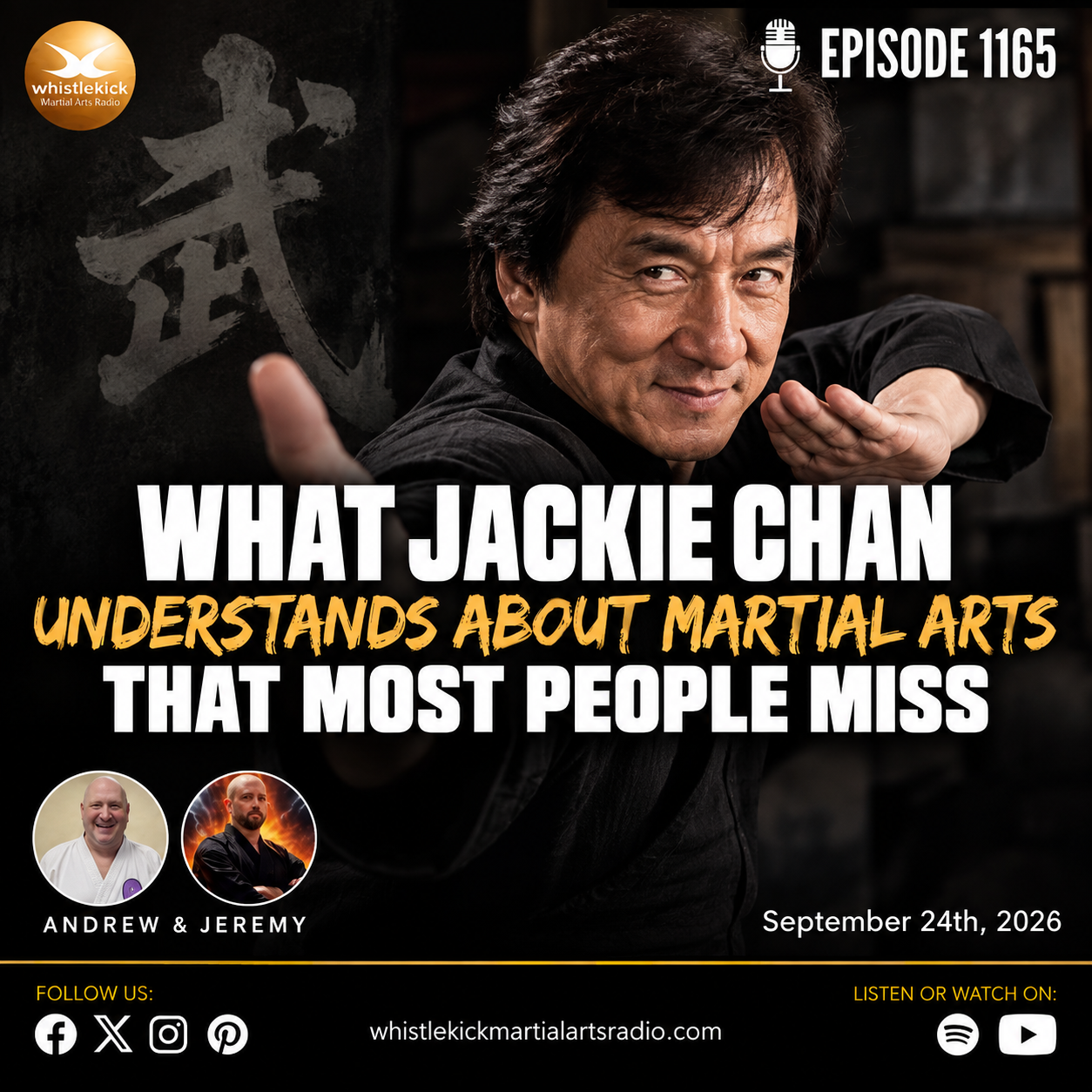
Jeremy and Andrew discuss what Jackie Chan knows about martial arts, but that a lot of people don’t pick up on.
What Jackie Chan Understands About Martial Arts That Many People Miss - Episode 1165
SUMMARY
In this episode, Jeremy and Andrew explore the unique contributions of Jackie Chan to martial arts cinema, emphasizing his creativity, humor, and innovative use of the environment in fight scenes. They discuss how these elements not only entertain but also enhance the learning experience in martial arts training. The conversation delves into the balance between performance and realism, highlighting the importance of making martial arts accessible and enjoyable for all audiences.
TAKEAWAYS
Jackie Chan's humor makes martial arts more relatable.
Creativity is essential for effective martial arts training.
Jackie Chan's fight scenes are characterized by harmony and timing.
Using the environment is a key aspect of Chan's fighting style.
Training should be enjoyable to enhance retention and effectiveness.
Humor can help engage students in martial arts classes.
Jackie Chan's movies are family-friendly and accessible to all.
The best way to avoid getting hit is to not be there.
Everyday items can be used as weapons in self-defense.
Jackie Chan's legacy emphasizes the importance of fun in training.
CHAPTERS
00:00 Introduction
00: 30 The Impact of Jackie Chan on Martial Arts Cinema
02:45 Creativity and Humor in Martial Arts
05:41 The Art of Movement and Environment
08:33 The Role of Humor in Martial Arts Training
11:44 Learning Through Laughter
15:51 Realism vs. Performance in Martial Arts
17:43 The Legacy of Jackie Chan's Philosophy
Join our EXCLUSIVE newsletter to get notified of each episode as it comes out!
Subscribe — whistlekick Martial Arts Radio
After listening to the episode, it would be exciting for us to know your thoughts about it.
SHOW TRANSCRIPT
Jeremy (00:32.979)
Hey, what's going on, everybody? Welcome or welcome back to another episode of Whistlekick Martial Arts Radio the World's number one traditional martial arts podcast, where we bring you stuff to think about. And today we're going to encourage you to think about Jackie Chan and what Jackie Chan understands about martial arts that most people miss. I'm Jeremy Lesniak, founder here at Whistlekick, with my good friend Andrew Adams, who co-hosts and produces.
And does so many other things with martial arts radio. Hi. Good. How you done?
Andrew Adams (01:04.354)
Hey, how's it going? I'm great.
Jeremy (01:09.331)
We did a whole detour on great not too long ago. We did.
Andrew Adams (01:11.182)
We did. We did. And as I'm saying it, I'm like, I'm not gonna make it as big as it I did a couple weeks ago.
Jeremy (01:15.615)
Those detours are part of what keep this show fun. If you're here expecting technical dissection of something, we do that once in a while, but we haven't done that in a long time. That's not really what we do. What do we do? We talk. We talk about martial arts. We talk about martial arts as people who love martial arts, but believe it is imperfect and can be improved. And that all of us as martial artists deserve that opportunity.
And should exert the effort to improve. We've been doing that for over ten years.
Andrew Adams (01:48.268)
Yep. And that's right. And that humor is something that our topic today uses quite often.
Jeremy (01:57.375)
That's right. Now if you're unfamiliar with Jackie Chan.
You're obviously not a fan of martial arts movies.
Andrew Adams (02:03.48)
Get out of
Or get out from underneath your rock.
Jeremy (02:09.948)
You know, I used to say things like that, but then but then people would mention martial arts actors to me that I I didn't know about. So I I I don't I don't quite wanna I don't quite quite wanna poop on people like that, but I think most people are f at least familiar with him. Now I I have to say I
Andrew Adams (02:20.012)
That's fair.
Jeremy (02:36.214)
This is fairly well established. I am not a huge fan of martial arts movies as a genre. I find them generally to be cheesy. That the plot is usually cheesy, the acting is usually cheesy, and the martial arts is often low quality.
Andrew Adams (02:42.051)
Mm-hmm.
Jeremy (02:59.09)
We've gotten better. In the modern era, the quality of the martial arts has gone up. And we do get some movies that are much better to watch. I I've I've said many times on this show, Crouching Tiger Hindragon is my favorite martial arts movie of all time. Why? Great story, great acting, and great martial arts.
Andrew Adams (03:00.462)
Mm-hmm.
Andrew Adams (03:20.493)
Mm-hmm.
Jeremy (03:24.008)
But the first martial arts movies I fell in love with were not old Bruce Lee movies. It was the new crop in the mid nineties of the Jackie Chan movies that came to the US.
Andrew Adams (03:35.734)
Yep. Yep. The the the rush hours and the you know, Operation Condors and Rumble in the Bronx. Yep, yep.
Jeremy (03:41.438)
Mm Rumble in the Bronx.
There were th what were the three? Rummel and the Bronx.
Andrew Adams (03:53.112)
People are screaming at their podcatchers right now.
Jeremy (03:55.302)
I hope so.
were the three. There were three I watched in in the theater. Rumble on the Bronx 95, First Strike 96, and then Mr. Nice Guy, I think it was in 97. It was it was that or maybe it was a different one. Anyway, it was Rumble and the Bronx. That's the one I remember the most.
Andrew Adams (04:02.381)
Okay.
Jeremy (04:24.774)
And I remember being in the theater and I was twitching.
Because what was happening on screen was that compelling that I wanted to get up and train. And that had never happened to me before with the movie.
Andrew Adams (04:39.82)
Yeah. And I think part of the reason is that his martial arts looks different from most on screen fighting.
Jeremy (04:48.6)
man, does it ever? The I think the things that people notice most are the creativity and the humor. I think those are the two biggies. Would you agree?
Andrew Adams (04:57.526)
Mm-hmm.
Yeah, no, I I think you're right. The creativity, the humor and and I think creativity is a legitimate martial arts skill.
Jeremy (05:10.268)
Yeah. If if you if you punch and kick the same way every time with your sparring, you know that the people that you train with know what you're gonna do. And that's not an effective sparring strategy. Maybe it'll work on the street. But your ability to adjust on the fly, that is creativity, that is improvisation, and that's pretty darn valuable.
Andrew Adams (05:36.556)
Yeah, absolutely. Absolutely.
Jeremy (05:41.287)
I think when we when we watch his movies, that all that all comes through. The use of the environment, the the the latter scene is probably the most iconic for the most of us. And I think that that's one of the things that I appreciate about his movies.
Andrew Adams (05:53.069)
Mm-hmm.
Jeremy (06:03.83)
Most martial arts movies could exist in any location and be the exact same thing. His movies, his fight scenes could not.
Andrew Adams (06:13.398)
Yeah. Yep. And I think it's the the the humor that he did and his strive for perfection in regards to timing, that just once like the his timing is impeccable. And and I know that he works really hard at that, right? It's not just it doesn't just happen, you know, it's something that he's he's worked really hard at getting. But if one thing goes wrong
In a fight sequence, they have to start over because everything is strung together in a way that it the timing has to be perfect.
Jeremy (06:53.756)
I I was looking something up because there's something I want I wanna bring up as we keep going. I'll come back to it in a second.
Jeremy (07:03.908)
his his movement, and I'm not quite sure how I want to say this, he moved differently. He moves differently. He is a he is a
Jeremy (07:18.94)
When I think about most martial arts fight scenes.
It is
I'm I'm gonna Andrew, I'm gonna need your help because I'm gonna try to borrow a musical metaphor here. I'm gonna try to make one up in fact. When I think about a fight scene in most martial arts movies.
It's a guitar solo. It might be really good. Or pardon me. It's a drum solo. Could be really good. Could be somebody incredibly competent, somebody who who is an absolute master with that instrument, and you're in awe.
But Jackie Chan's fight scenes, especially the ones that have multiple attackers, that's a full band. And all the instruments are playing together. You don't have a drummer over here playing, you know, their set of sheet music and an unrelated guitar solo going over there. We and and that's what a lot of martial arts fight scenes are. It's chaos.
Andrew Adams (08:23.767)
Mm-hmm, mm-hmm.
Jeremy (08:30.866)
But there's harmony in a Jackie Chan fight scene.
Andrew Adams (08:34.22)
Yeah, yeah. And I think because he uses such humor, it makes it relatable on a different level for people that are not martial artists.
Jeremy (08:48.028)
There's there's something that you know, if we if we go back, we know, and and I don't want to name names in part because I don't want to get them wrong, but there are some prominent martial artists from the 60s that we have talked about on this show, maybe even a few that we've had on the show, who no, I don't think we had any of them on the show, but we've talked about them. Who had opportunities at TV and movie, but they didn't want to lose.
They didn't want to be the bad guy. They didn't want to get beat up.
Andrew Adams (09:20.866)
Mm-hmm, mm-hmm.
Jeremy (09:23.102)
So they miss those opportunities. Jackie Chan has no problem getting beat up. In fact, Jackie Chan, his on screen fight scenes are not the typical formula of you punch me, I punch you, you punch me, I punch you, there's some blocking involved, I hurt you, you hurt me, and through attrition, I ultimately win.
Andrew Adams (09:27.628)
Yeah. Yep.
Andrew Adams (09:48.684)
Yeah, yeah.
Jeremy (09:50.793)
There's a lot of raw movement. And and that's what I was looking up. 'cause it reminds me, if you watch most Jackie Chan fight scenes, it reminds me, and I bet most of you out there have seen this clip, of Muhammad Ali dodging twenty-one punches in ten seconds.
Andrew Adams (10:07.726)
Hmm.
Jeremy (10:09.618)
He's he, if you haven't seen it, he fights Michael Dokes from 1977, and he just moves and he's just getting out of the way. And it's it's incredibly impressive. But that movement as defense is something that I think a lot of us talk about in our training. And the best place I've seen it on screen is how Jackie Chan uses his environment.
Andrew Adams (10:29.806)
Mm-hmm.
Jeremy (10:39.46)
And avoids such a significant amount of what comes out of it.
Andrew Adams (10:43.244)
Yeah, yeah. And I I use this I I say this quote in my classes that I teach often, which is, you know, what's the best way to not get hit by this overhead strike? And you know, the beginners in the room like, Well, you do an over you do an overhead block, you block it with your arm, like, that is a good way to not get hit by it, but there's a better way, and the best way to not get hit by something is to not be there.
Jeremy (11:06.622)
Yeah, what's the what's the karate kid two quote best block? Nobody there.
Andrew Adams (11:10.616)
Don't be there. Yeah. So you know, he was in exceptionally good at that, at at using the environment and his body movement to just get out of the way.
Jeremy (11:26.108)
Andrew, what's the biggest difference that you have when you work with kid teach material to kids versus teaching adults?
Andrew Adams (11:35.948)
With the technique or them understanding it.
Jeremy (11:38.536)
Could be anything. Could be drumming, could be martial arts, could be
Andrew Adams (11:43.71)
I mean I tend to find that it's the understanding of the why.
Jeremy (11:44.318)
How to drive a car.
Jeremy (11:53.136)
I I was gonna say the priority on h on humor and fun.
Andrew Adams (11:56.717)
Hm. Yeah, that's fair. In how I teach. That's that's true.
Jeremy (11:59.569)
Yeah. Yeah. And and maybe maybe that maybe that wouldn't be your your first adjustment. It tends to be my first adjustment adjustment. If I'm working with kids, I want to make sure that they're finding the material approachable. So I'll default to significant amounts of of fun. And you know, we we kind of move that bar around to make sure that they're able to receive the material.
When you look at some of the modern day martial arts movies that are are held up as great examples like The Raid or John Wick, that are great movies with wonderful martial arts, they're incredibly violent. And not everyone can handle that.
Andrew Adams (12:35.31)
Yeah. Yep.
Jeremy (12:42.088)
But everybody can handle a Jackie Chan movie.
Andrew Adams (12:44.76)
Hm. That humor changes things.
Jeremy (12:46.726)
Because the humor changes things. People's tolerance of martial arts, of violence specifically, changes when we can bring humor into it. If you've ever taught a self-defense class, if you make it too real, people check out. You can't give them the good stuff. But if you can wrap the material in some laughter,
They're going to be more engaged. And then you can kind of sprinkle in some of that reality, or maybe leave it at the end. And I think that that's one of the things that he and that Jackie Chan understands. Because I I don't know his material deep enough to say this definitively, but he does have his own stunt team. And through at least many of his movies, it is his stunt team that is involved in those fight scenes.
Andrew Adams (13:15.662)
Mm-hmm.
Andrew Adams (13:34.028)
Mm-hmm. Yep.
Jeremy (13:44.498)
His stunt team, he puts together a lot of the choreography, he's involved in this process. And we know what a Jackie Chan fight scene is gonna feel like, even if we don't know what it looks like. And that humor is core.
Andrew Adams (13:55.597)
Yeah. Yep, absolutely, absolutely. And you know, we've talked about this at great length in other episodes. We don't need to get into it now, but people learn better when they're laughing. Everybody understands humor, whether they have different senses of humor, but everybody understands humor. And I think that that's one of the things that certainly sets his stuff apart.
Jeremy (14:05.384)
For sure.
Jeremy (14:15.368)
Yeah. I I think that's one of the biggest lessons that we take from his material is that if it is enjoyable, it is more effective. I don't mean effective in terms of the application, but effective in terms of the retention, the learning, the the the educational side of martial arts works better when there is another reason to engage with it beyond.
Andrew Adams (14:26.382)
Mm-hmm.
Jeremy (14:44.894)
practicality.
Andrew Adams (14:47.18)
Yeah. Yep. And his ability to use everyday household items as weapons, I think, has influenced a lot of how people, martial artists, look at being able to utilize stuff.
Jeremy (15:06.02)
If we think about self-defense through these lenses, my goal, I'm not simply fighting my opponent. I'm fighting my environment. My opponent is part of my environment. I can use my opponent and/or my environment to my benefit. But if I am not aware of my environment, slippery floors, furniture in the way, I'm wearing the wrong shoes to be able to do these maneuvers, whatever it is, that puts me in a disadvantage.
Andrew Adams (15:35.597)
Mm-hmm.
Jeremy (15:43.138)
Is there at all a downside between the the let's say the performance of his on screen fight scenes and the reality of the movements?
Andrew Adams (15:57.327)
maybe.
I mean may maybe. You you could make the argument that it makes it less quote realistic, but the fact that he's really doing it makes it hard to hard to say that, you know?
Jeremy (16:16.39)
I I think obviously it's a movie. No no no martial arts fight scene is real. It's a scene. It's orchestrated. It's it's made up.
Andrew Adams (16:26.316)
Yeah, good point.
Jeremy (16:30.824)
But I think what I love about one of the other things I love about his spike scenes is you can look at what he's doing. You can look at the creative side, the performative side, the humorous side, and you can see threaded throughout things that make sense.
Jeremy (16:53.102)
Go back to that ladder scene. There were there were points where he had to he I'm trying to remember it. It's been a little bit, I've got to rewatch it. He didn't have use of his arms. He had to move, he had to dodge, right? And he got he got hit, if I remember correctly. That's real. You're gonna get hit. You're not going to you're not gonna fight your fight. You're gonna fight the fight that the opponent brings to you.
Andrew Adams (17:09.154)
Yep. Yep.
Jeremy (17:22.75)
Because you didn't start the fight.
Andrew Adams (17:27.202)
Yeah, yep, very true.
Jeremy (17:33.698)
If if Jackie Chan was here, and we would love him to be, if anyone can get us Jackie Chan, I would love to talk to him. I would even let him sing a little, if that's what it took. For those of you who don't know, he is actually a musician and has albums and not my style of music, but he is skilled.
If he was here, or
What do you think he would tell people? You know, kind of in the way that we close our interview episodes, what do you think he would want our audience to walk away with?
Andrew Adams (18:12.556)
I mean, obviously we're conjecturing, but I think humor would be a big part of it. I really do. Cause I you know, it he's talked about in interviews that that's an important part for him because it makes it family friendly. It makes it accessible. Like, let's face it, his movies are violent. Right? It's a different kind of violence, but it is violence, but it makes it more accessible to everyone. And I think that's what I think.
Jeremy (18:15.015)
Yeah.
Jeremy (18:30.095)
Yeah.
Andrew Adams (18:40.354)
That that is something that he would want to make sure the audience likes.
Jeremy (18:46.738)
I think you'd also want people to have fun. To enjoy their training. If you enjoy your training, you're more likely to train. You're gonna train longer, you're gonna get more out of it. And
Having fun doesn't mean it can't be serious. You can do both. You can find ways to do both. We've talked about that on the show quite a bit.
Andrew Adams (19:05.74)
Absolutely.
Jeremy (19:07.868)
Well, thank you to our imagination of Jackie Chan for being on the show today. And thank you to all of you for being here and talking through some of this with us. If you have feedback, we'd love to hear it. The best place, the Facebook page, martial arts radio. Not the old group. That group's closed. But you can also email us, Jeremy at Android Whistlekick.com. And if you're watching,
Andrew Adams (19:15.864)
Yeah.
Jeremy (19:37.83)
Leave us comments on the the YouTube page is really the best place for that, but you can also check out Spotify. We do the video versions on there. And if you want every episode, the easiest thing to do, just sign up for the newsletter. We're going to send you two emails each week, one with each episode, the audio and the video. Sometimes there's outtake, sometimes there's other fun stuff. We appreciate that. Those it's it's a little convoluted how, but
Bottom line, those emails help make sure more people watch early on, because we send you the emails right when the episodes are released. And you watching or listening earlier helps helps algorithms. We'll just we'll kind of leave it at that.
Cool, cool, cool.
one, two, three. Until next time, train hard and have a great day. We'll see how that one came out.
Andrew Adams (20:26.071)
Yeah, yeah, okay.
Andrew Adams (20:29.646)
Smile and have a great day.