Articles Posted in Domestic Violence

Fort Lauderdale domestic violence defense often turns on on the question of whether the State charges the defendant misdemeanor or a felony. Most domestic arrests in Broward County begin with an allegation of simple battery or simple assault. A weapon, a serious injury, a pregnancy, or a prior record can turn the same allegation into a felony with years of prison exposure. A new Florida law that took effect July 1, 2026, raises the stakes further for anyone with a prior domestic violence offense.Fort Lauderdale domestic violence defense attorney

Domestic Violence Is a Label, Not a Specific Type of Crime

Florida has no standalone crime called “domestic violence.” Section 741.28 defines the term as a list of offenses committed by one family or household member against another. That list includes assault, aggravated assault, battery, and aggravated battery. The domestic label brings no-contact orders, batterers’ intervention programs, and other consequences. The underlying charge sets the penalty.

Simple battery is a first-degree misdemeanor under section 784.03, punishable by up to one year in jail. Simple assault is a second-degree misdemeanor under section 784.011, punishable by up to 60 days. Neither carries state prison time. The aggravated offenses do.

Aggravated Assault Under Section 784.021

Assault is a threat, not a touch. Under section 784.011, assault is an intentional, unlawful threat by word or act to do violence. The person making the threat must have the apparent ability to carry it out. The threat must create a well-founded fear that violence is about to happen. No one has to actually be hurt.

Section 784.021 makes an assault aggravated in two situations. The first is an assault with a deadly weapon without intent to kill. The second is an assault with intent to commit a felony. Aggravated assault is a third-degree felony. It carries up to five years in prison and a $5,000 fine.

The deadly weapon element drives most domestic aggravated assault charges. A person who picks up a kitchen knife during an argument faces a felony even if the knife never touches anyone. The same is true for a person who displays a handgun during a dispute. Florida law looks at how an object was used or threatened to be used, not at what the object is. A frying pan, a screwdriver, or a car can qualify when used in a way likely to cause death or great bodily harm.

Firearms add a mandatory minimum. Florida’s 10-20-Life law, section 775.087(2), requires a three-year minimum prison sentence for aggravated assault when the accused actually possessed a firearm.

Aggravated Battery Under Section 784.045

Battery requires an actual and intentional touching or striking against the other person’s will, or intentionally causing bodily harm. Section 784.045 makes a battery aggravated in three ways. The accused intentionally or knowingly caused great bodily harm, permanent disability, or permanent disfigurement. The accused used a deadly weapon. Or the person struck was pregnant, and the accused knew or should have known it. Continue reading


The primary purpose of a Florida domestic violence injunction is to protect people, but attacks on pets were considered part of the court’s equation under F.S. 741.30(6)(b). But now, pet protections have been strengthened as of July 1, 2026, following the passage of CS/CS/HB 277. Now, the statute not only allows courts weighing domestic violence injunction petitions to assess whether a a respondent intentionally injured or killed a family pet, but also whether respondent merely threatened to do so.

Fort Lauderdale domestic violence injunctionWhy That Distinction Matters to Domestic Violence Defendants

Proving intentional injury or death of  a pet typically requires some combination of veterinary record, video evidence, witness testimony, digital message exchanges, or a confession. Proving a threat, meanwhile, may only require testimony about words. Obviously, video, audio, or digital evidence would strengthen the allegation, but it may not be necessary. Florida injunction hearings are generally civil proceedings, held on short notice, decided by a judge without a jury, and often resolved on the basis of which party the court finds more credible.

It should be noted that F.S. 741.30(6)(b) does not limit courts to consideration of the enumerated factors listed in the law. So a judge in Broward could already have weighed a threat against a dog under that catchall language. But the statute did provide a checkbox on the form and a talking point at the hearing, so it is likely we’ll see this point increasingly argued at injunction hearings.

Respondents should know such an allegation is a possibility and prepare to directly and with careful consideration rather than dismissing it as unserious.

The Research to Which Lawmakers Were Responding

The enumerated factor exists because the evidence behind it is substantial, and a respondent who treats it as a joke in front of a judge will lose ground. A systematic review published in Research in Veterinary Science examined 30 studies and found animal abuse prevalence in households with intimate partner violence ranging from 21 to 89 percent, with a significant relationship between the two. Research using the 2014 Canadian General Social Survey, a nationally representative sample rather than a shelter population, found that actual and threatened abuse of pets by a romantic partner significantly predicted that partner also perpetrating intimate partner violence, particularly physical and severe abuse. Continue reading

Most domestic violence cases in Broward County involve two people, one version of events each, and no independent witnesses. Prosecutors fill that gap with evidence, which increasingly, is digital. Screenshots of text threads, doorbell camera clips, and cell phone location records now drive more domestic violence prosecutions in Fort Lauderdale than physical injuries do. Each of those categories carries a legal requirement that the State frequently overlooks, and every Fort Lauderdale domestic violence attorney should be testing those requirements before trial.Fort Lauderdale domestic violence lawyer

Screenshots Do Not Authenticate Themselves

A text message is a writing. Section 90.901, Florida Statutes, requires authentication as a condition precedent to admissibility, which means the proponent must produce evidence sufficient to support a finding that the item is what it claims to be. A printed screenshot showing a name and a phone number does not satisfy that burden by itself.

The Fourth District Court of Appeal, which governs Broward County, made the point directly in the civil case of Walker v. Harley-Anderson, 301 So. 3d 299 (Fla. 4th DCA 2020). (Note that domestic violence injunctions often arise from criminal cases, but they can be filed independently in the civil justice system as well.) The petitioner in that Florida stalking injunction case offered threatening text messages she attributed to the respondent. The messages were not recovered from the respondent’s phone under a search warrant, and no circumstantial evidence tied her to their authorship. The Fourth DCA held that the trial court abused its discretion in admitting them.

Authentication can be established through distinctive characteristics, contextual detail, or extrinsic evidence, as the court explained in Symonette v. State, 100 So. 3d 180 (Fla. 4th DCA 2012). Where the State cannot make that showing, the consequence is severe. The text messages in Walker were the only evidence supporting the injunction, so the appellate court reversed and ordered the petition dismissed. Continue reading

Most people first hear the words “Marsy’s Law” from the side of a victim. The headlines, the campaign ads, and the rights forms all speak to people who have allegedly been harmed by violent crime. Far fewer people understand what Marsy’s Law means from the vantage point of the accused. For anyone facing charges in South Florida, that gap is worth closing early, ideally with help from an experienced Fort Lauderdale criminal defense attorney.Fort Lauderdale domestic violence defense lawyer

What Marsy’s Law Actually Is

Florida voters approved Marsy’s Law in November 2018 as Amendment 6. It took effect in January 2019 and now lives in Article I, Section 16 of the Florida Constitution, a section pointedly titled “Rights of accused and of victims.” Its companion statute, Section 960.001 of the Florida Statutes, fills in much of the day-to-day detail.

The law hands crime victims a broad set of enforceable rights. A victim can be notified of court dates, be present at hearings, be heard on bond and plea and sentencing, confer with the prosecutor, seek restitution, and keep certain identifying information private. These rights are self-executing, which means a victim can assert them in court without waiting on the Legislature to act.

Why It Matters to a Defendant

Here is the part that often surprises people: The earlier version of this constitutional section said victims’ rights applied only so far as they did not interfere with the constitutional rights of the accused. Marsy’s Law removed that language. The protections for the accused did not vanish. Due process, the presumption of innocence, and the right to confront witnesses all remain. But the explicit tiebreaker that once favored the accused is gone, and that shift plays out in real cases. Continue reading

Florida domestic violence laws are written in such a way that almost always: someone is going to jail. Understanding what happens next can determine everything about how this ends.

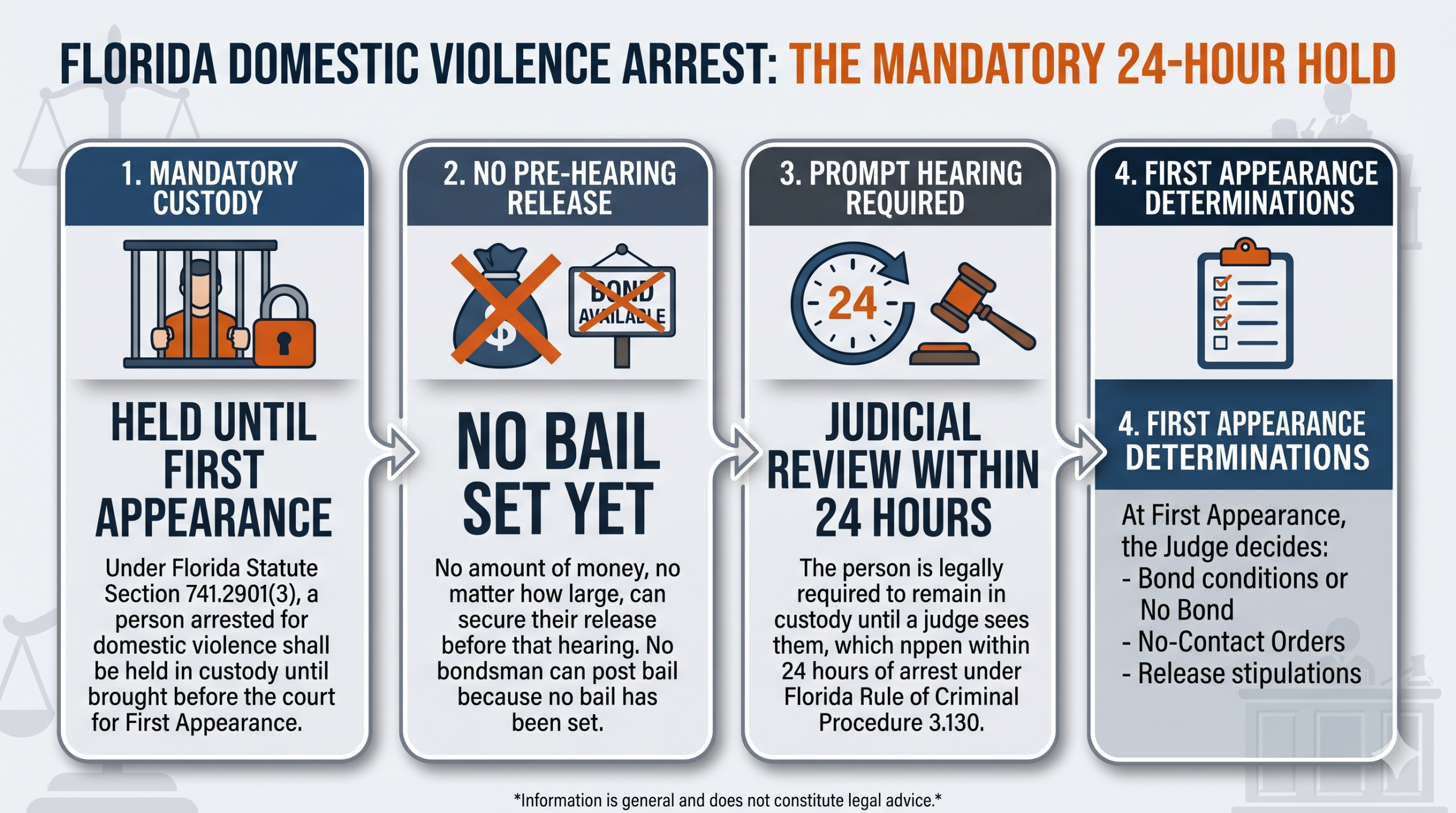
Florida’s domestic violence statutes mean anyone arrested on such charges cannot be released on bond before their First Appearance hearing — no matter how much money you have, no matter how mild the incident. That hearing happens within 24 hours of arrest. As a Fort Lauderdale domestic violence defense lawyer, I emphasize to anyone facing charges that the decisions you make before and during that hearing can shape the entire case. Your wisest course of action is to hire an experienced lawyer to help you through it.Fort Lauderdale criminal defense lawyer

Why Florida Officers Almost Always Arrest Someone

Florida Statute Section 741.2901 sets out one of the most aggressive domestic violence enforcement frameworks in the United States. It does not merely permit arrest; it creates a presumption that arrest is appropriate whenever an officer has probable cause to believe domestic violence has occurred, even if the alleged victim does not want anyone arrested, even if no visible injury exists, and even if the incident appears minor by any objective measure.

The statute explicitly instructs that “it is the intent of the Legislature that domestic violence be treated as a criminal act rather than a private family matter.” That legislative intent has real-world consequences:

  • The victim cannot “drop the charges.” Charges are brought by the State of Florida, not by the alleged victim. Even if the complaining party recants entirely, the prosecution can proceed (and often does) on other evidence including 911 recordings, officer observations, and photographs
  • Officer discretion is severely limited. If an officer has probable cause — meaning they believe domestic battery is more likely than not to have occurred — arrest is the required response in most circumstances. Mediating and leaving is generally not an option
  • Both parties can be arrested. Florida law allows for dual arrests when officers find mutual aggression. Both people in the home can be taken into custody simultaneously
  • Prior relationship matters, not current status. Florida’s domestic violence statutes cover current and former spouses, people who share a child, current or former household members, and people in dating relationships — regardless of whether they still live together

The practical effect is that a call to 911, made in anger, made by a neighbor, or made in a moment that quickly de-escalated, can trigger an arrest that neither party wants and that cannot be undone by the time cooler heads prevail. Understanding this is the first step to navigating what comes next.

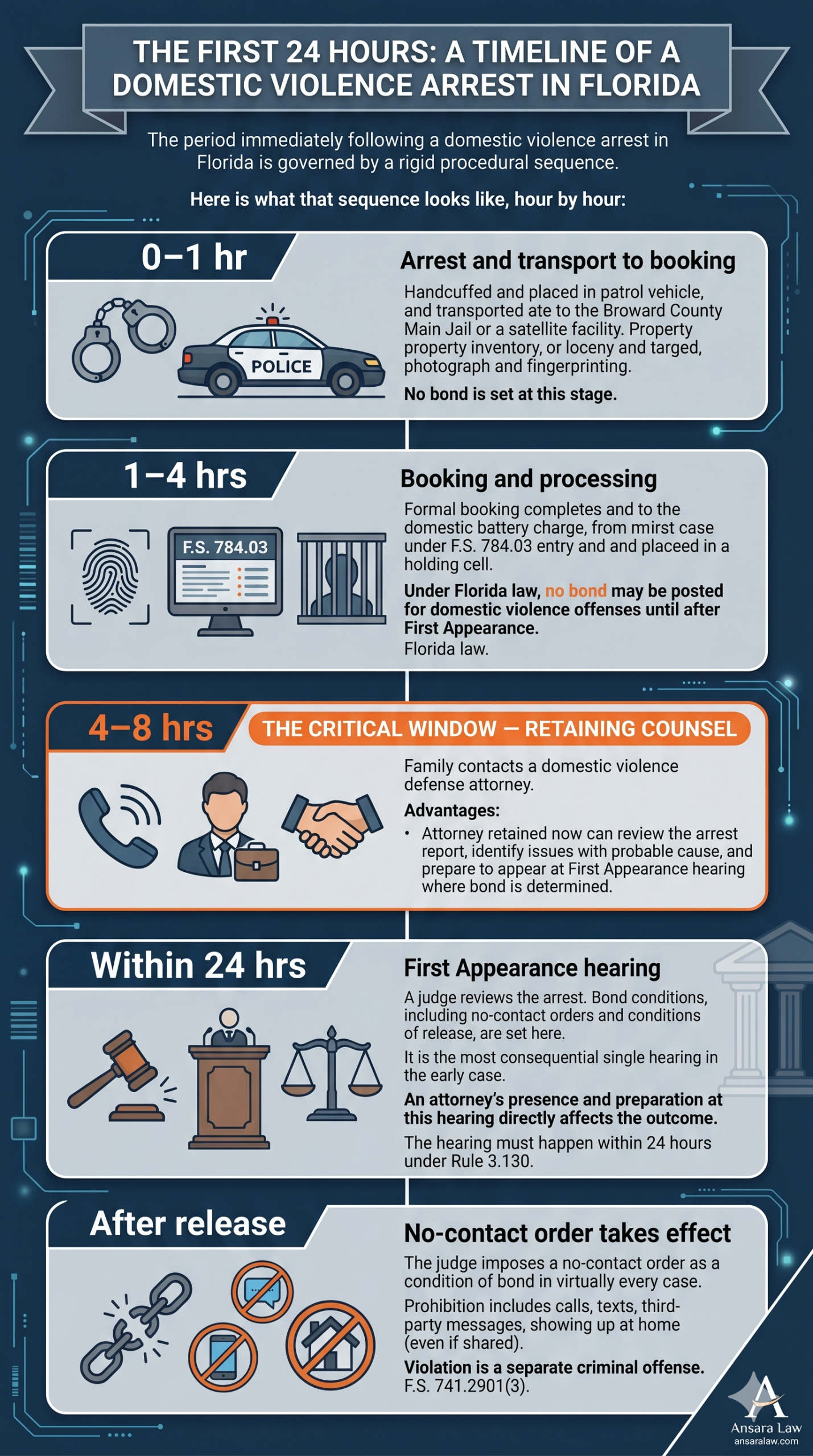
The First 24 Hours: A Timeline

The period immediately following a domestic violence arrest in Florida is governed by a rigid procedural sequence.

Fort Lauderdale domestic violence lawyer criminal defense Ansara Law


The No-Bond Hold: Why You Cannot Just Post Bail

This is the piece that catches families most off guard. In most criminal arrests in Florida, a bond amount is set at booking, and the arrested person can be released within hours by paying that bond or using a bondsman. Domestic violence arrests do not work this way.

Under Florida Statute Section 741.2901(3), a person arrested for domestic violence shall be held in custody until brought before the court for First Appearance. No amount of money, no matter how large, can secure their release before that hearing. No bondsman can post bail because no bail has been set. The person is legally required to remain in custody until a judge sees them, which must happen within 24 hours of arrest under Florida Rule of Criminal Procedure 3.130.

Fort Lauderdale domestic violence defense

What this means practically: if someone is arrested at 11 PM on a Friday, they will almost certainly spend the weekend in jail before seeing a judge, because “within 24 hours” in practice can stretch to the next available First Appearance docket. First Appearance hearings in Broward County occur daily, including weekends, but the timing depends on when in the day the arrest occurred and how quickly booking is processed.

What Happens at First Appearance

Continue reading

A domestic violence allegation is one of the most serious and disorienting experiences a person can face. In a matter of hours, you can go from living your normal life to standing before a judge, subject to a no-contact order, separated from your home, and — under Florida’s sweeping new legislation — potentially facing a GPS ankle monitor strapped to your leg before you have ever been convicted of anything. If you or someone you care about is navigating this, you need to understand what has changed, why it matters, and what a skilled Fort Lauderdale criminal defense lawyer can do to protect you.Florida domestic violence defense lawyer

What Is HB 277 and What Does It Actually Do?

House Bill 277, passed unanimously by both chambers of the Florida Legislature in March 2026 and is set to take effect July 1, 2026. It is one of the most comprehensive overhauls of Florida’s domestic violence statutes in recent memory. Formally titled the “Domestic Violence and Protective Injunctions” Act, the bill enhances criminal penalties for repeat domestic violence offenders, reclassifying offenses to higher-degree crimes when a prior conviction exists. It expands the statewide injunction verification system maintained by the Florida Department of Law Enforcement. It increases relocation assistance for victims from $1,500 to $2,500 per claim. And, most significantly for the person facing a fresh accusation, it dramatically expands the use of GPS electronic monitoring.

Under HB 277, courts are now authorized, and in certain circumstances required, to order electronic monitoring supervision when a person is found guilty of, or has adjudication withheld on, a domestic violence offense under Florida Statute § 741.281. The bill also establishes a pilot electronic monitoring program in Pinellas County for misdemeanor domestic violence offenders placed on probation with a no-contact order, and a separate pilot in the Sixth Judicial Circuit for felony offenders — both programs running from July 1, 2026 through June 30, 2028. When a court orders electronic monitoring, it must establish GPS exclusion zones and, critically, the respondent is responsible for paying for the monitoring services.

The law also further expands the factors a judge may consider when determining whether to grant a domestic violence injunction, adding threatening to harm or kill a family pet and the existence of a military protective order to the list of relevant circumstances a court may weigh.

The Electronic Monitoring Reality: What It Means for You

In practice, having a GPS ankle monitor means that every geographical movement you make is recorded and transmitted in real time. It means there are exclusion zones, which are geographic areas you are forbidden to enter. These can include your own neighborhood, your child’s school, or your place of work. It means monitoring fees paid out of your own pocket, often ranging from $5 to $15 per day. It means the constant, visible reminder on your ankle of a legal proceeding that has not yet resulted in a conviction.

For many people, the practical consequences of GPS monitoring can be as devastating as the charge itself. Employers notice. Colleagues ask questions. Professional licenses are scrutinized. The presumption of innocence, a cornerstone of our legal system, feels hollow when you are physically tethered to a monitoring device while awaiting trial.

This is why the first conversation with a Fort Lauderdale criminal defense lawyer matters so much — and why that conversation needs to happen immediately.

The Law Has Not Stripped You of Rights: Understanding “Least Restrictive Means”

One important point to make here is that a Fort Lauderdale no-contact order does not automatically mean GPS monitoring. A Broward County domestic violence charge does not automatically mean the most restrictive conditions of release. The law still requires courts to impose the least restrictive conditions that will reasonably accomplish the legitimate goals of the pretrial system. Continue reading

If you’ve just been served with a temporary injunction in Broward County, you’re probably feeling a mixture of shock, anger, confusion, and fear — and that’s completely understandable. Being told you may have to leave your own home, that you can’t contact someone you care about, or that a judge made a serious legal decision about your life without you even being in the room is disorienting. You are not alone, and you are not without rights.Fort Lauderdale restraining order defense

As a Fort Lauderdale defense attorney who has represented countless clients in the injunction process, I want to walk you through exactly what is happening, what the critical 15-day window means for you, and what you absolutely must — and must not — do right now.

What Is a Florida Restraining Order (Injunction for Protection)?

In Florida, what most people call a “restraining order” is formally known as an Injunction for Protection. These are civil orders, but make no mistake: violating one is a criminal offense under Florida law.

Florida recognizes several types of injunctions for protection, governed primarily by Chapter 741, Florida Statutes (domestic violence) and Chapter 784, Florida Statutes (repeat violence, dating violence, sexual violence, and stalking). The most common type encountered in Broward County is the Domestic Violence Injunction, defined under § 741.30, Fla. Stat.

When a petitioner (the person requesting the order) files a petition, a judge reviews it ex parte — meaning without you present — and decides whether to issue a Temporary Injunction. That decision can be made in minutes, based entirely on the petitioner’s account of events.

The 15-Day Window: Understanding the Timeline That Will Shape Your Future

Here is where things get critically important.

Under § 741.30(5)(c), Fla. Stat., when a court issues a temporary injunction, it must schedule a full hearing within 15 days. This hearing is your first real opportunity to appear before a judge, present your side of the story, challenge the petitioner’s allegations, and argue against the entry of a Final Injunction — which can last indefinitely.

This 15-day window is not a formality. It is the most important legal moment you will face in this process.

If you do nothing — if you fail to appear, fail to prepare, or fail to retain a Fort Lauderdale defense attorney — the court can and very likely will enter a permanent injunction against you by default. That order can:

  • Permanently bar you from your own home
  • Prohibit you from contacting your children
  • Prevent you from owning or possessing firearms under both Florida and federal law (18 U.S.C. § 922(g)(8))
  • Affect your employment, professional licensing, and housing applications
  • Follow you on background checks for the rest of your life

Can They Really Kick Me Out of My Own Home?

Yes — at least temporarily, and potentially permanently if you don’t act.

Under § 741.30(6)(a)(2), Fla. Stat., a court issuing a temporary injunction may order the respondent (that’s you) to vacate the shared residence, regardless of who owns or leases the property. This is one of the most jarring aspects of the law for clients to accept. Even if your name is on the mortgage or the lease, the temporary injunction can require you to leave immediately.

The court can also award the petitioner temporary exclusive use and possession of the home, make temporary child custody determinations, and issue other emergency relief — all before you’ve had a chance to say a single word.

This is why what happens at that 15-day hearing is so consequential.

Your Rights as a Respondent

Despite how powerless the initial service of a temporary injunction can make you feel, you have important legal rights throughout this process: Continue reading

If you’re involved in a domestic dispute in Southeast Florida, you’ll need to understand that a number of the questions police ask at the scene are part of a risk assessment that is mandated by law. The answers could determine whether you spend the night in jail, are granted bond, and how aggressively prosecutors pursue your case. Florida Senate Bill 1224, known as the Gabby Petito Act, went into effect last year. It requires law enforcement officers conduct a standardized lethality assessments at every domestic violence scene. While these protocols are designed with victim safety in mind, they create a minefield for anyone accused of domestic violence, and most people don’t realize their answers are being scored until it’s too late. police badge Fort Lauderdale criminal defense lawyer

Fort Lauderdale criminal defense lawyers serving Broward County and surrounding areas have seen firsthand how these assessments to build stronger prosecution cases and justify harsher bond conditions. Understanding what’s at stake and when to exercise your constitutional right to remain silent could be the difference between walking away from charges and facing years of legal consequences.

What Is the Lethality Assessment Program?

The Lethality Assessment Program (LAP) is a standardized screening tool that law enforcement officers use to evaluate the risk of future violence or homicide in domestic violence situations. Originally developed by the Maryland Network Against Domestic Violence, LAP has been adopted by 33 states, including Florida, where it became mandatory statewide following its passage in 2024.

Named after Gabby Petito, the 22-year-old woman whose 2021 death brought national attention to domestic violence warning signs, the Gabby Petito Act requires all Florida law enforcement agencies to implement LAP or a similar evidence-based lethality assessment tool. The law changed how domestic violence calls are handled across the state.

The assessment consists of about a dozen standardized questions that officers ask the alleged victim at the scene. These questions are designed to identify risk factors associated with domestic violence homicide, including strangulation, threats with weapons, escalating violence, stalking behavior, and access to firearms. Based on the alleged victim’s responses, officers assign a risk score that categorizes the situation as high danger or lower risk.

While the stated purpose is victim protection, connecting high-risk victims with domestic violence advocates and resources. However, the practical effect extends far beyond support services. These assessments are documented in police reports, shared with prosecutors, and frequently referenced at bond hearings and pretrial proceedings.

Florida Lethality Assessment Questions

Understanding what police are actually assessing during these encounters is crucial. While the exact wording may vary slightly between jurisdictions, the Maryland LAP, which serves as the model for Florida’s implementation, includes questions such as:

  • Has the violence increased in severity or frequency over the past year?
  • Has the alleged abuser ever used a weapon against you or threatened you with a weapon?
  • Do you believe the alleged abuser is capable of killing you?
  • Has the alleged abuser ever tried to choke or strangle you?
  • Is the alleged abuser violently or constantly jealous, or does he/she control most of your daily activities?
  • Have you left or separated from the alleged abuser after living together?
  • Is the alleged abuser unemployed?
  • Has the alleged abuser ever tried to kill himself/herself?
  • Does the abuser have a gun or can he/she get one easily?
  • Has the abuser ever threatened or tried to kill your children?
  • Do you have a child with someone other than the alleged abuser?

These aren’t casual questions. Each one corresponds to validated risk factors for intimate partner homicide identified through extensive research. A yes answer to even a few of these questions can elevate the case to “high danger,” triggering immediate intervention, mandatory advocacy referrals, and, critically, documentation that will follow the accused throughout the criminal justice process.

How Lethality Scores Impact Your Case

Continue reading

Facing a Broward domestic violence arrest is one of the most stressful and consequential situations a person can encounter. The allegations alone can upend your life, threatening your freedom, your reputation, your career, and your relationships with your children. In many cases, the accusations are the primary evidence against you. When the credibility of the accuser becomes central to your defense, you need a criminal defense attorney who understands not just the law, but the delicate balance required to challenge testimony while maintaining the respect and sensitivity these cases demand.Broward domestic violence arrest lawyer

At The Ansara Law Firm, we recognize that domestic violence allegations in Broward County require a defense strategy that is both aggressive and tactful. Our approach combines comprehensive legal knowledge with a deep understanding of local court procedures, and perhaps most importantly, the ability to navigate the emotional and evidentiary complexities that define these cases.

Understanding Domestic Violence Charges in Florida

Florida takes domestic violence seriously, and the legal consequences reflect that commitment. Under Florida Statute § 741.28, domestic violence is defined as any assault, aggravated assault, battery, aggravated battery, sexual assault, sexual battery, stalking, aggravated stalking, kidnapping, false imprisonment, or any criminal offense resulting in physical injury or death of one family or household member by another.

The term “family or household member” includes:

  • Spouses or former spouses
  • Persons related by blood or marriage
  • Persons who are presently residing together or who have resided together in the past
  • Persons who are parents of a child in common (regardless of whether they have been married or lived together)

Even a misdemeanor domestic battery charge under Florida Statute § 784.03 carries serious consequences:

  • Up to one year in jail
  • Up to one year of probation
  • Up to $1,000 in fines
  • Mandatory completion of a Batterer’s Intervention Program (26 weeks minimum)
  • Permanent criminal record
  • Loss of firearm rights
  • Immigration consequences for non-citizens

Felony domestic violence charges carry even harsher penalties, including years in state prison, substantial fines, and lifelong collateral consequences.

The Challenge: When the Accuser’s Statement Is the Primary Evidence

In many domestic violence cases, the prosecution’s case rests heavily—sometimes entirely—on the alleged victim’s testimony. Unlike other criminal cases where physical evidence, surveillance footage, or independent witnesses may be abundant, domestic violence incidents often occur in private settings. This means that the credibility of the accuser becomes the linchpin of the prosecution’s case.

The High Stakes of Credibility

Continue reading

When law enforcement responds to a domestic violence call in Fort Lauderdale, FL, officers often have no choice but to make an arrest — even if the alleged victim doesn’t want to press charges. This is due to Florida’s mandatory arrest statute, one of the most stringent in the nation. Understanding how this law works is critical if you or someone you love faces domestic violence allegations.Fort Lauderdale criminal defense lawyer domestic violence

As a Fort Lauderdale criminal defense lawyer with extensive experience in domestic violence cases, I’ve seen firsthand how these mandatory arrest laws can transform a family dispute into a criminal case with serious, long-lasting consequences. Here, we’ll explain Florida’s mandatory arrest requirements, what they mean for those accused, and why experienced legal representation is essential.

What Is Florida’s Mandatory Arrest Law?

Florida Statute § 741.29 establishes the state’s mandatory arrest policy for domestic violence incidents. This law doesn’t remove the probable cause requirement, but it does compel officers with probable cause to believe an act of domestic violence has been committed to make an arrest, regardless of whether the alleged victim wants to pursue charges.

The statute defines domestic violence under Florida Statute § 741.28 as any assault, aggravated assault, battery, aggravated battery, sexual assault, sexual battery, stalking, aggravated stalking, kidnapping, false imprisonment, or any criminal offense resulting in physical injury or death of one family or household member by another.

“Family or household members” includes:

  • Spouses or former spouses
  • Persons related by blood or marriage
  • Persons currently residing together as a family or who have resided together in the past
  • Persons who are parents of a child in common, regardless of whether they have been married or have lived together

When Must Officers Make an Arrest?

Under Florida Statute § 741.29(2), a law enforcement officer must arrest and take a person into custody when:

  • The officer has probable cause to believe that the person has committed an act of domestic violence
  • The officer reasonably believes that the person poses a threat to the victim or others

Importantly, the officer does not need to witness the violence firsthand. The statute specifically states that the arrest may be made even if the violence did not occur in the officer’s presence, provided probable cause exists. This is a significant departure from arrest requirements for many other types of misdemeanor offenses.

The “Primary Aggressor” Determination

One of the most critical aspects of Florida Statute § 741.29 is the requirement that officers identify the “primary aggressor” rather than simply arresting both parties when mutual violence is alleged. Florida law recognizes that in some domestic disputes, both parties may have engaged in physical contact, but one person is the predominant aggressor.

Florida Statute § 741.29(4) requires officers to consider several factors when determining the primary aggressor:

  • The history of domestic violence between the parties
  • The relative severity of injuries inflicted on each person
  • The likelihood of future injury to each person
  • Whether one of the parties acted in self-defense
  • Prior calls for assistance from the household

As a Broward criminal defense lawyer, I’ve handled numerous cases where the “wrong” person was arrested because officers were flawed in their primary aggressor analysis. This is why it’s critical to have an experienced domestic violence defense attorney who can challenge the basis for the arrest and investigate what really happened. Continue reading

Contact Information