1<!DOCTYPE html><html lang="en" class="ibm_plex_sans_949af5b-module__Xd9jba__variable ibm_plex_mono_1396f621-module__yAoysW__variable"><head><meta charSet="utf-8"/><meta name="viewport" content="width=device-width, initial-scale=1"/><link rel="preload" href="/_next/static/media/03fc1b4a8d284b5e.p.0wiir8udbzjvx.woff2" as="font" crossorigin="" type="font/woff2"/><link rel="preload" href="/_next/static/media/99e609270109b47d.p.40sczeszzbjw1.woff2" as="font" crossorigin="" type="font/woff2"/><link rel="preload" href="/_next/static/media/effe91970fc4db64.p.0oace-s_gkfks.woff2" as="font" crossorigin="" type="font/woff2"/><link rel="preload" as="image" imageSrcSet="/_next/image?url=https%3A%2F%2Fpub-30c11acc143348fcae20835653c5514d.r2.dev%2Fcard_Bg4_09c37060fc.png&w=384&q=75 1x, /_next/image?url=https%3A%2F%2Fpub-30c11acc143348fcae20835653c5514d.r2.dev%2Fcard_Bg4_09c37060fc.png&w=640&q=75 2x"/><link rel="preload" as="image" imageSrcSet="/_next/image?url=https%3A%2F%2Fpub-30c11acc143348fcae20835653c5514d.r2.dev%2Fcard_Bg4_09c37060fc.png&w=640&q=75 1x, /_next/image?url=https%3A%2F%2Fpub-30c11acc143348fcae20835653c5514d.r2.dev%2Fcard_Bg4_09c37060fc.png&w=1080&q=75 2x"/><link rel="stylesheet" href="/_next/static/chunks/0x7kcn5crc1vz.css" data-precedence="next"/><link rel="stylesheet" href="/_next/static/chunks/2lqvm_7bnpo4s.css" data-precedence="next"/><link rel="stylesheet" href="/_next/static/chunks/3o9ndxbclbhv4.css" data-precedence="next"/><link rel="preload" as="script" fetchPriority="low" href="/_next/static/chunks/1qt6pht_u0de1.js"/>
1<script src="/_next/static/chunks/2ul8ophnk13y-.js" async="" type="1832f25453b266f6f89fd57e-text/javascript"></script>
1<script src="/_next/static/chunks/3sr9j71te8kyd.js" async="" type="1832f25453b266f6f89fd57e-text/javascript"></script>
1<script src="/_next/static/chunks/2-rtuqsgzmno4.js" async="" type="1832f25453b266f6f89fd57e-text/javascript"></script>
1<script src="/_next/static/chunks/turbopack-41818_pseh4aj.js" async="" type="1832f25453b266f6f89fd57e-text/javascript"></script>
1<script src="/_next/static/chunks/1pz8nl2fwrd8r.js" async="" type="1832f25453b266f6f89fd57e-text/javascript"></script>
1<script src="/_next/static/chunks/43nnncnxzxrsc.js" async="" type="1832f25453b266f6f89fd57e-text/javascript"></script>
1<script src="/_next/static/chunks/1h5wk3de-b3gy.js" async="" type="1832f25453b266f6f89fd57e-text/javascript"></script>
1<script src="/_next/static/chunks/1l452285ljiry.js" async="" type="1832f25453b266f6f89fd57e-text/javascript"></script>
1<script src="/_next/static/chunks/0xvt93wodqzki.js" async="" type="1832f25453b266f6f89fd57e-text/javascript"></script>
1<script src="/_next/static/chunks/0-fbly-mdk3ec.js" async="" type="1832f25453b266f6f89fd57e-text/javascript"></script>
1<script src="/_next/static/chunks/41s986c8g8a7i.js" async="" type="1832f25453b266f6f89fd57e-text/javascript"></script>
1<script src="/_next/static/chunks/00w9d_di6xdy5.js" async="" type="1832f25453b266f6f89fd57e-text/javascript"></script>
1<script src="/_next/static/chunks/1k7v0ctpni0yl.js" async="" type="1832f25453b266f6f89fd57e-text/javascript"></script>
1<script src="/_next/static/chunks/0z6vkd_78x7_j.js" async="" type="1832f25453b266f6f89fd57e-text/javascript"></script>
1<link rel="preload" href="https://cdnjs.cloudflare.com/ajax/libs/github-markdown-css/5.5.0/github-markdown.min.css" as="style" crossorigin="anonymous" integrity="sha512-h/laqMqQKUXxFuu6aLAaSrXYwGYQ7qk4aYCQ+KJwHZMzAGaEoxMM6h8C+haeJTU1V6E9jrSUnjpEzX23OmV/Aw==" referrerPolicy="no-referrer"/><link rel="preload" href="/_next/static/chunks/2z7egligy77ig.js" as="script" fetchPriority="low"/><meta name="theme-color" content="#4F21EA"/><title>Blog | PipeOps</title><meta name="description" content="All the stories we have to share."/><meta name="keywords" content="devops, cloud infrastructure, cloud, cloud infra, deployment, heroku, gcp, google cloud services, azure, aws, amazon, cloud services, heroku alternative, pass, pass platforms, pipeops Blog"/><meta name="robots" content="index, follow"/><meta name="googlebot" content="index, follow, max-video-preview:-1, max-image-preview:large, max-snippet:-1"/><link rel="canonical" href="https://pipeops.io/blog"/><meta property="og:title" content="Blog | PipeOps"/><meta property="og:description" content="All the stories we have to share."/><meta property="og:url" content="https://pipeops.io/blog"/><meta property="og:site_name" content="Blog | PipeOps"/><meta property="og:image" content="https://pipeops.io/og/pipeops-og.png"/><meta property="og:image:type" content="image/png"/><meta property="og:image:width" content="1200"/><meta property="og:image:height" content="630"/><meta property="og:image:alt" content="PipeOps: cyber defence and sovereignty for critical infrastructure"/><meta property="og:type" content="website"/><meta name="twitter:card" content="summary_large_image"/><meta name="twitter:site" content="@pipeopshq"/><meta name="twitter:creator" content="@pipeopshq"/><meta name="twitter:title" content="Blog | PipeOps"/><meta name="twitter:description" content="All the stories we have to share."/><meta name="twitter:image" content="https://pipeops.io/og/pipeops-og.png"/><meta name="next-size-adjust" content=""/><link rel="stylesheet" href="https://cdnjs.cloudflare.com/ajax/libs/github-markdown-css/5.5.0/github-markdown.min.css" integrity="sha512-h/laqMqQKUXxFuu6aLAaSrXYwGYQ7qk4aYCQ+KJwHZMzAGaEoxMM6h8C+haeJTU1V6E9jrSUnjpEzX23OmV/Aw==" crossorigin="anonymous" referrerPolicy="no-referrer"/>
1<script src="/_next/static/chunks/0cz1d0mv5g_q7.js" noModule="" type="1832f25453b266f6f89fd57e-text/javascript"></script>
1<style data-styled="" data-styled-version="5.3.11">.bla-dLT{width:100%;margin-bottom:1.5em;position:relative;z-index:9;}/*!sc*/
2.bla-dLT label{display:-webkit-box;display:-webkit-flex;display:-ms-flexbox;display:flex;grid-gap:0.5em;-webkit-align-items:center;-webkit-box-align:center;-ms-flex-align:center;align-items:center;font-weight:400;font-size:0.875rem;line-height:1.25rem;-webkit-letter-spacing:0px;-moz-letter-spacing:0px;-ms-letter-spacing:0px;letter-spacing:0px;color:#fff;margin-bottom:0.5em;}/*!sc*/
3.bla-dLT label.floating-label{position:absolute;z-index:3;background:#18181A 0% 0% no-repeat padding-box;border-radius:4px;font-size:0.75rem!important;color:#D8D8D899;padding:0px 0.5em;-webkit-transform:translate(1rem,-50%);-ms-transform:translate(1rem,-50%);transform:translate(1rem,-50%);}/*!sc*/
4.bla-dLT div.btn-select{width:100%;height:100%;display:-webkit-box;display:-webkit-flex;display:-ms-flexbox;display:flex;-webkit-align-items:center;-webkit-box-align:center;-ms-flex-align:center;align-items:center;-webkit-box-pack:justify;-webkit-justify-content:space-between;-ms-flex-pack:justify;justify-content:space-between;border-radius:3rem;text-align:left;-webkit-letter-spacing:0.14px;-moz-letter-spacing:0.14px;-ms-letter-spacing:0.14px;letter-spacing:0.14px;padding:0 0.8rem 0 1em;font-size:0.875rem;font-weight:400;color:rgba(255,255,255,0.64);-webkit-letter-spacing:0.14px;-moz-letter-spacing:0.14px;-ms-letter-spacing:0.14px;letter-spacing:0.14px;position:relative;}/*!sc*/
5.bla-dLT div.btn-select:active,.bla-dLT div.btn-select:focus{outline:none;background:#18181a;}/*!sc*/
6.bla-dLT div.btn-select:invalid:not([value='']){border:1.5px solid #c12020;}/*!sc*/
7.bla-dLT div.btn-select input{position:absolute;width:0px;height:0px;z-index:-99;visibility:hidden;pointer-events:none;}/*!sc*/
8.bla-dLT div.btn-select.has-error:after{content:attr(data-error);position:absolute;top:3.125rem;margin:0px;margin-top:0.5em;font-size:0.8125rem;-webkit-letter-spacing:0.008125rem;-moz-letter-spacing:0.008125rem;-ms-letter-spacing:0.008125rem;letter-spacing:0.008125rem;color:#ff5e5e;opacity:1;}/*!sc*/
9.bla-dLT div.btn-select.disabled-item{-webkit-filter:blur(0.5px);filter:blur(0.5px);}/*!sc*/
10.bla-dLT div.btn-select.disabled-item:hover,.bla-dLT div.btn-select.disabled-item:focus,.bla-dLT div.btn-select.disabled-item{cursor:no-drop!important;}/*!sc*/
11.bla-dLT div.filterTextActive{padding:0 0.8rem 0 4em;}/*!sc*/
12.bla-dLT .error{border:1.5px solid #c12020!important;}/*!sc*/
13.bla-dLT div.select-list_cover{position:relative;}/*!sc*/
14.bla-dLT div.select-input_container{position:relative;cursor:pointer;width:100%;height:3rem;border-radius:4rem;background-image:linear-gradient(#0e0e0f,#0e0e0f),linear-gradient(143deg,rgba(255,255,255,0.26) 0%,rgba(255,255,255,0.14) 46%,rgba(255,255,255,0.01) 100%);background-origin:border-box;background-clip:padding-box,border-box;border:2px double transparent !important;}/*!sc*/
15.bla-dLT div.select-input_container .placeholder{color:#757575;}/*!sc*/
16.bla-dLT div.select-input_container input,.bla-dLT div.select-input_container button{width:100%;height:100%;height:3rem;width:100%;border-radius:10px;background:#18181a;text-align:left;border:1.4px solid #18181a;-webkit-letter-spacing:0.14px;-moz-letter-spacing:0.14px;-ms-letter-spacing:0.14px;letter-spacing:0.14px;padding:0px 1em;font-size:0.875rem;font-weight:400;color:#ffffff;-webkit-letter-spacing:0.14px;-moz-letter-spacing:0.14px;-ms-letter-spacing:0.14px;letter-spacing:0.14px;}/*!sc*/
17.bla-dLT div.select-input_container input:active,.bla-dLT div.select-input_container button:active,.bla-dLT div.select-input_container input:focus,.bla-dLT div.select-input_container button:focus{outline:none;border:1.4px solid #4F21EA;background:#18181a;border-color:#4F21EA;}/*!sc*/
18.bla-dLT div.select-input_container input:invalid:not([value='']),.bla-dLT div.select-input_container button:invalid:not([value='']){border:1.4px solid #18181a;}/*!sc*/
19.bla-dLT div.select-input_container input:disabled,.bla-dLT div.select-input_container button:disabled{-webkit-filter:blur(0.5px);filter:blur(0.5px);border:1.4px solid #18181a;}/*!sc*/
20.bla-dLT div.select-input_container .filterText{color:rgba(255,255,255,0.48);position:absolute;
20left:0.8rem;font-weight:300;}/*!sc*/
21.bla-dLT div.select-input_container span.svg-container{width:1.5rem;display:-webkit-box;display:-webkit-flex;display:-ms-flexbox;display:flex;-webkit-box-pack:center;-webkit-justify-content:center;-ms-flex-pack:center;justify-content:center;-webkit-align-items:center;-webkit-box-align:center;-ms-flex-align:center;align-items:center;height:1.5rem;border-radius:50%;background:#1f1f21;}/*!sc*/
22.bla-dLT div.select-input_container input.button-input{width:0px;height:0px;position:absolute;visibility:hidden;}/*!sc*/
23.bla-dLT div.select-input_container input.error + button.btn-select{border:1.4px solid #c12020;}/*!sc*/
24.bla-dLT div.custom-input_container{position:relative;}/*!sc*/
25.bla-dLT div.custom-input_container div.spinner-container{position:absolute;top:50%;-webkit-transform:translateY(-50%);-ms-transform:translateY(-50%);transform:translateY(-50%);right:1.5em;}/*!sc*/
26.bla-dLT div.select-lists{margin-top:1em;}/*!sc*/
27.bla-dLT div.select-lists .container{background:linear-gradient(-84deg,rgba(255,255,255,0.72) 0%,rgba(255,255,255,0.24) 51%,rgba(255,255,255,0.48) 100%);border-radius:1rem;position:absolute;overflow:hidden;box-shadow:0px 0px 20px #00000066;width:100%;background-image:linear-gradient(#0e0e0f,#0e0e0f),linear-gradient(-84deg,rgba(255,255,255,0.72) 0%,rgba(255,255,255,0.24) 51%,rgba(255,255,255,0.48) 100%);background-origin:border-box;background-clip:padding-box,border-box;border:2px double transparent !important;opacity:0;visibility:hidden;display:none;height:0px;z-index:-1;-webkit-transition:all 0.5s;transition:all 0.5s;pointer-events:none;max-height:60vh!important;height:3rem;border-radius:0.95rem;}/*!sc*/
28.bla-dLT div.select-lists .container{overflow-y:overlay;}/*!sc*/
29.bla-dLT div.select-lists .container::-webkit-scrollbar{width:8px;margin-top:0.5em;margin-bottom:0.5em;height:80%;border-radius:40px;}/*!sc*/
30.bla-dLT div.select-lists .container::-webkit-scrollbar-track{background:#eaeaea;background:transparent;}/*!sc*/
31.bla-dLT div.select-lists .container::-webkit-scrollbar-thumb{background:#c4c4c4;border-radius:40px;background:transparent;}/*!sc*/
32.bla-dLT div.select-lists .container:hover::-webkit-scrollbar-thumb{background:#c4c4c4;border-radius:40px;}/*!sc*/
33.bla-dLT div.select-lists div.optionLists-item{padding:1em 1.5em;display:grid;grid-template-columns:1fr auto;grid-gap:0.5em;cursor:pointer;}/*!sc*/
34.bla-dLT div.select-lists div.optionLists-item *{pointer-events:none !important;}/*!sc*/
35.bla-dLT div.select-lists div.optionLists-item div.optionSub-cover{text-transform:capitalize;}/*!sc*/
36.bla-dLT div.select-lists div.optionLists-item div.optionSub-cover,.bla-dLT div.select-lists div.optionLists-item div.optionSub-cover *{pointer-events:none !important;}/*!sc*/
37.bla-dLT div.select-lists div.optionLists-item span.radio-container{-webkit-flex-shrink:0;-ms-flex-negative:0;flex-shrink:0;display:-webkit-box;display:-webkit-flex;display:-ms-flexbox;display:flex;-webkit-align-items:center;-webkit-box-align:center;-ms-flex-align:center;align-items:center;-webkit-box-pack:center;-webkit-justify-content:center;-ms-flex-pack:center;justify-content:center;}/*!sc*/
38.bla-dLT div.select-lists div.optionLists-item span.radio-container svg{font-size:1rem;}/*!sc*/
39.bla-dLT div.select-lists div.optionLists-item.default-option_item{width:100%;font-size:0.9rem;}/*!sc*/
40.bla-dLT div.select-lists div.optionLists-item:hover,.bla-dLT div.select-lists div.optionLists-item:focus{outline:none;background:#18181a;}/*!sc*/
41.bla-dLT div.select-lists.active-menu{margin-top:0;-webkit-transform:translateY(10px);-ms-transform:translateY(10px);transform:translateY(10px);}/*!sc*/
42.bla-dLT div.select-lists.active-menu .container{opacity:1;visibility:visible;pointer-events:auto;z-index:22;display:block;height:auto;}/*!sc*/
43.bla-dLT div.loading-container{text-align:center;}/*!sc*/
44.bla-dLT p.error-msg{text-align:left;margin:0px;margin-top:0.5em;font-size:0.8125rem;-webkit-letter-spacing:0.008125rem;-moz-letter-spacing:0.008125rem;-ms-letter-spacing:0.008125rem;letter-spacing:0.008125rem;color:#ff5e5e;opacity:1;}/*!sc*/
45.bla-dLT div.placeholder-item{cursor:no-drop!important;color:#757575;font-size:0.9rem;}/*!sc*/
46.bla-dLT div.placeholder-item:active,.bla-dLT div.placeholder-item:focus,.bla-dLT div.placeholder-item:hover{outline:none;background:transparent!important;}/*!sc*/
47.bla-dLT div.after-container{padding-top:1em;}/*!sc*/
48.bla-dLT div.active-label *{position:relative;z-index:4;}/*!sc*/
49data-styled.g7[id="style-sc-84abca05-0"]{content:"bla-dLT,"}/*!sc*/
50.lEtcI{display:-webkit-box;display:-webkit-flex;display:-ms-flexbox;display:flex;-webkit-align-items:center;-webkit-box-align:center;-ms-flex-align:center;align-items:center;margin:0 auto;width:-webkit-fit-content;width:-moz-fit-content;width:fit-content;grid-gap:0.5em;}/*!sc*/
51.lEtcI button{width:1.5rem;height:1.5rem;overflow:hidden;font-size:0.75rem;display:-webkit-box;display:-webkit-flex;display:-ms-flexbox;display:flex;-webkit-align-items:center;-webkit-box-align:center;-ms-flex-align:center;align-items:center;-webkit-box-pack:center;
51-webkit-justify-content:center;-ms-flex-pack:center;justify-content:center;cursor:pointer;border-radius:8px;border:none;color:#d8d8d8;-webkit-transition:all 0.25s ease-in-out;transition:all 0.25s ease-in-out;background:#111111;}/*!sc*/
52.lEtcI button.active-btn,.lEtcI button:focus,.lEtcI button:hover{color:#fff;font-weight:500;background:#2b2b2d;}/*!sc*/
53.lEtcI button:disabled{cursor:not-allowed;}/*!sc*/
54.lEtcI button svg{-webkit-transform:scale(2.5);-ms-transform:scale(2.5);transform:scale(2.5);}/*!sc*/
55data-styled.g10[id="style-sc-2116ace3-0"]{content:"lEtcI,"}/*!sc*/
56.fbLphr{position:relative;border:2px double transparent;border-radius:4rem;width:100%;background-image:linear-gradient(#0e0e0f,#0e0e0f),linear-gradient(185deg,rgba(255,255,255,0.4) 0%,rgba(255,255,255,0.14) 37%,rgba(255,255,255,0.04) 100%);background-origin:border-box;background-clip:padding-box,border-box;}/*!sc*/
57.fbLphr input{background:#0e0e0f;border:none;border-radius:3rem;height:3rem;width:100%;padding-left:1em;padding-right:3em;outline:none;font-size:0.9rem;color:#ffffff;}/*!sc*/
58.fbLphr input:active,.fbLphr input:focus,.fbLphr input:hover{background:#18181A;}/*!sc*/
59.fbLphr input:disabled{cursor:not-allowed;}/*!sc*/
60.fbLphr input:-webkit-autofill,.fbLphr input:-webkit-autofill:hover,.fbLphr input:-webkit-autofill:focus,.fbLphr input:-webkit-autofill:active{color:#ffffff !important;
60-webkit-box-shadow:0 0 0 30px #18181a inset !important;}/*!sc*/
61.fbLphr input:-webkit-autofill{-webkit-text-fill-color:#ffffff !important;}/*!sc*/
62.fbLphr button.search-btn,.fbLphr button.customIconBtn{position:absolute;display:-webkit-box;display:-webkit-flex;display:-ms-flexbox;display:flex;-webkit-align-items:center;-webkit-box-align:center;-ms-flex-align:center;align-items:center;cursor:pointer;outline:none;-webkit-box-pack:center;-webkit-justify-content:center;-ms-flex-pack:center;justify-content:center;border:none;padding:0px;background:transparent;border-radius:10px;position:absolute;top:50%;right:0.6em;-webkit-transform:translateY(-50%);-ms-transform:translateY(-50%);transform:translateY(-50%);}/*!sc*/
63.fbLphr button.search-btn svg.close,.fbLphr button.customIconBtn svg.close{font-size:1.93rem;}/*!sc*/
64data-styled.g12[id="styles-sc-b372e225-0"]{content:"fbLphr,"}/*!sc*/
65html{line-height:1.15;-webkit-text-size-adjust:100%;text-size-adjust:100%;}/*!sc*/
66body{margin:0;}/*!sc*/
67main{display:block;}/*!sc*/
68h1{font-size:2em;margin:0.67em 0;}/*!sc*/
69hr{box-sizing:content-box;height:0;overflow:visible;}/*!sc*/
70pre{font-family:monospace,monospace;font-size:1em;}/*!sc*/
71a{background-color:transparent;}/*!sc*/
72abbr[title]{border-bottom:none;-webkit-text-decoration:underline;text-decoration:underline;}/*!sc*/
73b,strong{font-weight:bolder;}/*!sc*/
74code,kbd,samp{font-family:monospace,monospace;font-size:1em;}/*!sc*/
75small{font-size:80%;}/*!sc*/
76sub,sup{font-size:75%;line-height:0;position:relative;vertical-align:baseline;}/*!sc*/
77sub{bottom:-0.25em;}/*!sc*/
78sup{top:-0.5em;}/*!sc*/
79img{border-style:none;}/*!sc*/
80button,input,optgroup,select,textarea{font-family:inherit;font-size:100%;line-height:1.15;margin:0;}/*!sc*/
81button,input{overflow:visible;}/*!sc*/
82button,select{text-transform:none;}/*!sc*/
83button,html [type="button"],[type="reset"],[type="submit"]{-webkit-appearance:button;}/*!sc*/
84button::-moz-focus-inner,[type="button"]::-moz-focus-inner,[type="reset"]::-moz-focus-inner,[type="submit"]::-moz-focus-inner{border-style:none;padding:0;}/*!sc*/
85button:-moz-focusring,[type="button"]:-moz-focusring,[type="reset"]:-moz-focusring,[type="submit"]:-moz-focusring{outline:1px dotted ButtonText;}/*!sc*/
86fieldset{padding:0.35em 0.625em 0.75em;}/*!sc*/
87legend{box-sizing:border-box;color:inherit;display:table;max-width:100%;padding:0;white-space:normal;}/*!sc*/
88progress{vertical-align:baseline;}/*!sc*/
89textarea{overflow:auto;}/*!sc*/
90[type="checkbox"],[type="radio"]{box-sizing:border-box;padding:0;}/*!sc*/
91[type="number"]::-webkit-inner-spin-button,[type="number"]::-webkit-outer-spin-button{height:auto;}/*!sc*/
92[type="search"]{-webkit-appearance:textfield;outline-offset:-2px;}/*!sc*/
93[type="search"]::-webkit-search-decoration{-webkit-appearance:none;}/*!sc*/
94::-webkit-file-upload-button{-webkit-appearance:button;font:inherit;}/*!sc*/
95details{display:block;}/*!sc*/
96summary{display:list-item;}/*!sc*/
97template{display:none;}/*!sc*/
98[hidden]{display:none;}/*!sc*/
99abbr[title]{-webkit-text-decoration:underline dotted;text-decoration:underline dotted;}/*!sc*/
100*{box-sizing:border-box;}/*!sc*/
101html,body{padding:0px;margin:0px;font-family:"Niveau Grotesk";max-width:100vw;overflow-x:hidden;background:#0E0E0F;color:#D8D8D8B3;}/*!sc*/
102@media(max-width:992px){html,body{font-size:95%;}}/*!sc*/
103@media(max-width:576px){html,body{font-size:92%;}}/*!sc*/
104html{overflow-y:overlay;-webkit-scroll-behavior:smooth;-moz-scroll-behavior:smooth;-ms-scroll-behavior:smooth;scroll-behavior:smooth;}/*!sc*/
105html{overflow-y:overlay;}/*!sc*/
106html::-webkit-scrollbar{width:8px;margin-top:0.5em;margin-bottom:0.5em;height:80%;border-radius:40px;}/*!sc*/
107html::-webkit-scrollbar-track{background:#eaeaea;background:transparent;}/*!sc*/
108html::-webkit-scrollbar-thumb{background:#c4c4c4;border-radius:40px;background:transparent;}/*!sc*/
109html:hover::-webkit-scrollbar-thumb{background:#c4c4c4;border-radius:40px;}/*!sc*/
110html.disable-scroll{overflow:hidden;}/*!sc*/
111html div#root{max-width:100vw;overflow-x:hidden;}/*!sc*/
112html button,html a{cursor:pointer;-webkit-user-select:none;-moz-user-select:none;-ms-user-select:none;user-select:none;}/*!sc*/
113html hr{border:none;border-bottom:1px solid #EEF0F9;}/*!sc*/
114html h1{font-size:clamp(3rem,6vw,4.875rem);font-weight:400;line-height:110%;}/*!sc*/
115html h2{font-size:clamp(2.3rem,5vw,3.2rem);}/*!sc*/
116html h1,html h2,html h3,html h4,html p{margin:0px;padding:0px;color:#D8D8D8B3;}/*!sc*/
117html .dot{margin:auto 0.5em;display:-webkit-inline-box;display:-webkit-inline-flex;display:-ms-inline-flexbox;display:inline-flex;-webkit-align-self:center;-ms-flex-item-align:center;align-self:center;justify-self:center;width:0.5em;height:0.5em;border-radius:50%;background:#fff;}/*!sc*/
118html img{max-width:100%;}/*!sc*/
119@media(max-width:992px){html img.float-img{display:none;}}/*!sc*/
120html .appContentContainer{padding-top:4.5rem;width:90%;max-width:1300px;margin:0px auto;}/*!sc*/
121html .u-color_primary{color:#4F21EA!important;}/*!sc*/
122html .u-color_orange{color:#E6BA00;}/*!sc*/
123html .u-color_yellow{color:#E6BA00;}/*!sc*/
124html .u-color_green{color:#3DBA55;}/*!sc*/
125html .u-color_brown{color:#BA5F3D;}/*!sc*/
126html .u-typo_underline{-webkit-text-decoration:underline;text-decoration:underline;}/*!sc*/
127html .u-typo_title{font-weight:400;font-size:3rem;line-height:120%;}/*!sc*/
128@media(max-width:576px){html .u-typo_title{font-size:1.8rem;}}/*!sc*/
129html .toast-container{font-family:var(--font-plex-sans),'IBM Plex Sans',system-ui,sans-serif;}/*!sc*/
130html .toast-container .Toastify__toast{border-radius:15px;background:#111111 0% 0% no-repeat padding-box;box-shadow:0px 20px 20px #00000033;border:2px solid #4F21EA;border-radius:12px;padding-left:1.5em;}/*!sc*/
131html .dash{display:block;width:1.8rem;height:0.3rem;
131background:#3DBA55 0% 0% no-repeat padding-box;border-radius:4px;}/*!sc*/
132html .u-typo_section_label{-webkit-letter-spacing:3.2px;-moz-letter-spacing:3.2px;-ms-letter-spacing:3.2px;letter-spacing:3.2px;font-size:1rem!important;color:#D8D8D899;line-height:130%;margin-bottom:0.8em;font-weight:300;}/*!sc*/
133html .u-typo_primaryDot:after{content:".";font-size:inherit;color:#4F21EA;}/*!sc*/
134html .u-primary_last_letter::last-letter{color:#4F21EA;}/*!sc*/
135html strong{font-weight:500;}/*!sc*/
136html div.appContent-container{padding-top:4.5rem;width:90%;max-width:1300px;margin:0 auto;margin:0 auto;}/*!sc*/
137html div.appContent-container p{font-size:0.9rem;}/*!sc*/
138body{overflow-x:unset;}/*!sc*/
139h1,h2{-webkit-letter-spacing:-1.5px;-moz-letter-spacing:-1.5px;-ms-letter-spacing:-1.5px;letter-spacing:-1.5px;}/*!sc*/
140h2{color:#FFFFFF;font-weight:400;font-size:clamp(2.3rem,5vw,3.2rem);background:linear-gradient(106deg,#FFFFFFD8 0%,#FFFFFF55 61%,#FFFFFF9B 100%);background-clip:text;-webkit-background-clip:text;-webkit-text-fill-color:transparent;}/*!sc*/
141.rec-arrow{width:50px;min-width:50px;height:50px;display:-webkit-box;display:-webkit-flex;display:-ms-flexbox;display:flex;-webkit-align-items:center;-webkit-box-align:center;-ms-flex-align:center;align-items:center;-webkit-box-pack:center;-webkit-justify-content:center;-ms-flex-pack:center;justify-content:center;font-size:1.6rem;line-height:unset;border:2px solid rgba(255,255,255,0.48) !important;background:#0e0e0f;background-color:none;}/*!sc*/
142.rec-arrow:hover,.rec-arrow:hover:enabled,.rec-arrow:focus,.rec-arrow:focus:enabled{background-color:none;}/*!sc*/
143.reviews{width:95%;max-width:90rem;margin:0 auto;}/*!sc*/
144.reviews h2{text-align:center;font-size:clamp(2.3rem,5vw,3.2rem);}/*!sc*/
145.reviews h2{max-width:34rem;width:100%;margin:0 auto !important;}/*!sc*/
146.reviews .reviewContainer{position:relative;}/*!sc*/
147.reviews .reviewContainer:after{content:'';position:absolute;width:100%;height:100%;top:0;-webkit-filter:blur(2.8rem);filter:blur(2.8rem);left:0;background:url(https://pub-950943fa1bc54978bed46ef104f9d81a.r2.dev/discoverTwoPattern.svg) no-repeat center center;background-size:57rem;}/*!sc*/
148@media (max-width:767px){.reviews .reviewContainer:after{background-size:37rem;}}/*!sc*/
149.reviews .reviewContainer .review{background:transparent linear-gradient(180deg,#FFFFFFD8 0%,#FFFFFF62 61%,#FFFFFF9B 100%) 0% 0% no-repeat padding-box;background:transparent linear-gradient(180deg,#FFFFFFD8 0%,#FFFFFF62 61%,#FFFFFF9B 100%) 0% 0% no-repeat padding-box;background-clip:text;-webkit-background-clip:text;-webkit-text-fill-color:transparent;text-align:left;font-weight:300;line-height:160%;font-size:clamp(1.8rem,5vw,2.5rem);}/*!sc*/
150.reviews .reviewContainer .userDetails{margin-top:0.5em;display:-webkit-box;display:-webkit-flex;display:-ms-flexbox;display:flex;gap:0.3em;-webkit-align-items:center;-webkit-box-align:center;-ms-flex-align:center;align-items:center;}/*!sc*/
151.reviews .reviewContainer .userDetails .userImg{padding:2px;background:linear-gradient(180deg,#ffeb00 0%,#9fffd6 61%,#b098ff 100%);overflow:hidden;height:3.56rem;width:3.56rem;border-radius:50%;}/*!sc*/
152.reviews .reviewContainer .userDetails .userImg .screen{background:#0e0e0f;overflow:hidden;display:-webkit-box;display:-webkit-flex;display:-ms-flexbox;display:flex;-webkit-align-items:center;-webkit-box-align:center;-ms-flex-align:center;align-items:center;-webkit-box-pack:center;-webkit-justify-content:center;-ms-flex-pack:center;justify-content:center;height:100%;width:100%;border-radius:50%;}/*!sc*/
153.reviews .reviewContainer .userDetails p{text-align:left;}/*!sc*/
154.reviews .reviewContainer .userDetails p:first-child{font-weight:400;font-size:1.7rem;background:transparent linear-gradient(148deg,#FFFFFFD8 0%,#FFFFFF62 61%,#FFFFFF9B 100%) 0% 0% no-repeat padding-box;background-clip:text;-webkit-background-clip:text;-webkit-text-fill-color:transparent;}/*!sc*/
155.reviews .reviewContainer .userDetails p:last-child{font-size:1rem;font-weight:300;color:#D8D8D8B3;}/*!sc*/
156@media (max-width:767px){.userDetails p:first-child{font-size:1.37rem !important;}.userDetails p:last-child{font-size:1rem !important;}}/*!sc*/
157@media (max-width:1023px){.reviews{max-width:60rem;width:100%;}.reviews .reviewContainer .userImg{width:3rem !important;height:3rem !important;}}/*!sc*/
158@media (max-width:1023px){.luma-checkout--overlay{height:100vh !important;width:100vw !important;position:fixed !important;top:0 !important;left:0 !important;background:rgba(75,101,132,.467) !important;right:0 !important;bottom:0 !important;z-index:999999999 !important;}.luma-checkout--overlay .luma-checkout--close-btn{position:absolute !important;right:1rem !important;top:1rem !important;background:none !important;background-color:hsla(0,0%,100%,.533) !important;border:none !important;border-radius:100px !important;cursor:pointer !important;line-height:0 !important;padding:.25rem !important;position:absolute !important;right:1rem;top:1rem;-webkit-transition:all .3s cubic-bezier(.4,0,.2,1) !important;transition:all .3s cubic-bezier(.4,0,.2,1) !important;z-index:100 !important;}.luma-checkout--overlay .luma-checkout--close-btn img{height:1rem;width:1rem;}.luma-checkout--modal{position:absolute !important;top:0 !important;left:0 !important;width:100% !important;max-width:600px !important;height:100vh !important;max-height:100% !important;overflow:auto !important;}svg.luma-spinner{-webkit-animation:luma-rotator 1.4s linear infinite !important;animation:luma-rotator 1.4s linear infinite !important;height:40px !important;left:calc(50% - 20px) !important;position:absolute !important;top:calc(50% - 20px) !important;width:40px !important;}}/*!sc*/
159data-styled.g38[id="sc-global-iRhmrs1"]{content:"sc-global-iRhmrs1,"}/*!sc*/
160.kGizPY{display:-webkit-inline-box;display:-webkit-inline-flex;display:-ms-inline-flexbox;display:inline-flex;-webkit-flex-direction:column;-ms-flex-direction:column;flex-direction:column;-webkit-align-self:flex-start;-ms-flex-item-align:start;align-self:flex-start;width:-webkit-fit-content;width:-moz-fit-content;width:fit-content;gap:0.6rem;padding:0.7rem 1rem 0.8rem;background:#111;border:2px solid #1f1f21;border-radius:15px;}/*!sc*/
161.kGizPY .label{font-size:10px;font-weight:500;-webkit-letter-spacing:0.2em;-moz-letter-spacing:0.2em;-ms-letter-spacing:0.2em;letter-spacing:0.2em;text-transform:uppercase;color:#cbcbcb;line-height:1;}/*!sc*/
162.kGizPY .logos{display:-webkit-box;display:-webkit-flex;display:-ms-flexbox;display:flex;-webkit-flex-direction:column;-ms-flex-direction:column;flex-direction:column;-webkit-align-items:flex-start;-webkit-box-align:flex-start;-ms-flex-align:flex-start;align-items:flex-start;gap:0.85rem;}/*!sc*/
163.kGizPY.kGizPY img{width:auto;display:block;object-fit:contain;}/*!sc*/
164data-styled.g39[id="BackedBy__Box-sc-71d769d-0"]{content:"kGizPY,"}/*!sc*/
165.cQbHsq{width:90%;max-width:1300px;margin:0 auto;position:relative;padding-top:15em;font-family:var(--font-plex-sans),'IBM Plex Sans',system-ui,sans-serif;-webkit-font-smoothing:antialiased;}
165/*!sc*/
166@media (max-width:560px){.cQbHsq{padding-top:5rem;}}/*!sc*/
167.cQbHsq.homeFooter{padding-top:5rem;}/*!sc*/
168.cQbHsq.homeFooter::before{content:'';position:absolute;top:0;left:50%;width:100vw;height:100%;-webkit-transform:translateX(-50%);-ms-transform:translateX(-50%);transform:translateX(-50%);background:#111111;border-top:1px solid rgba(255,255,255,0.12);z-index:0;pointer-events:none;}/*!sc*/
169.cQbHsq.homeFooter > *{position:relative;z-index:1;}/*!sc*/
170@media (max-width:560px){.cQbHsq.homeFooter{padding-top:3.5rem;}}/*!sc*/
171.cQbHsq div.soc-container{width:-webkit-fit-content;width:-moz-fit-content;width:fit-content;display:-webkit-box;display:-webkit-flex;display:-ms-flexbox;display:flex;-webkit-align-items:baseline;-webkit-box-align:baseline;-ms-flex-align:baseline;align-items:baseline;gap:2.5em;}/*!sc*/
172.cQbHsq div.help-container{display:-webkit-box;display:-webkit-flex;display:-ms-flexbox;display:flex;-webkit-box-pack:end;-webkit-justify-content:flex-end;-ms-flex-pack:end;justify-content:flex-end;}/*!sc*/
173@media(max-width:992px){.cQbHsq div.help-container{-webkit-box-pack:center;-webkit-justify-content:center;-ms-flex-pack:center;justify-content:center;margin-bottom:2em;}}/*!sc*/
174.cQbHsq div.help-container div.help-row{cursor:pointer;grid-gap:1em;display:-webkit-box;display:-webkit-flex;display:-ms-flexbox;display:flex;-webkit-align-items:center;-webkit-box-align:center;-ms-flex-align:center;align-items:center;position:-webkit-sticky;position:sticky;bottom:2em;background:#1f1f21 0% 0% no-repeat padding-box;box-shadow:0px 8px 20px #00000029;border-radius:15px;opacity:1;padding:1em;padding-right:2em;width:-webkit-fit-content;width:-moz-fit-content;width:fit-content;}/*!sc*/
175.cQbHsq div.help-container div.help-row img{width:3.5rem;}/*!sc*/
176.cQbHsq div.help-container div.help-row div.content-container p{color:#d8d8d8;}/*!sc*/
177.cQbHsq div.help-container div.help-row div.content-container h2{font-size:1rem;font-weight:400;}/*!sc*/
178.cQbHsq div.help-container div.help-row:hover h2,.cQbHsq div.help-container div.help-row:focus h2{-webkit-text-decoration:underline;text-decoration:underline;}/*!sc*/
179.cQbHsq div.top-container{display:-webkit-box;display:-webkit-flex;display:-ms-flexbox;display:flex;-webkit-box-pack:justify;-webkit-justify-content:space-between;-ms-flex-pack:justify;justify-content:space-between;-webkit-align-items:start;-webkit-box-align:start;-ms-flex-align:start;align-items:start;-webkit-flex-wrap:wrap;-ms-flex-wrap:wrap;flex-wrap:wrap;position:relative;padding:1.5em 0px 4em;}/*!sc*/
180@media (max-width:561px){.cQbHsq div.top-container{-webkit-flex-direction:column;-ms-flex-direction:column;flex-direction:column;}.cQbHsq div.top-container nav{margin-bottom:3rem;gap:0px !important;}}/*!sc*/
181.cQbHsq div.top-container *{position:relative;z-index:2;}/*!sc*/
182.cQbHsq div.top-container div.col-1{display:-webkit-box;display:-webkit-flex;display:-ms-flexbox;display:flex;grid-gap:2em;-webkit-flex-direction:column;-ms-flex-direction:column;flex-direction:column;color:#d8d8d8;font-weight:300;font-size:0.9rem;}/*!sc*/
183.cQbHsq div.top-container div.col-1 svg{font-size:2.5rem;}/*!sc*/
184.cQbHsq div.top-container div.col-1 img{width:100%;}/*!sc*/
185@media (max-width:941px){.cQbHsq div.top-container div.col-1{-webkit-flex-basis:100%;-ms-flex-preferred-size:100%;flex-basis:100%;margin-bottom:3rem;}}/*!sc*/
186.cQbHsq div.top-container label{text-transform:uppercase;-webkit-letter-spacing:2.4px;-moz-letter-spacing:2.4px;-ms-letter-spacing:2.4px;letter-spacing:2.4px;color:#cbcbcb99;font-size:12px;}/*!sc*/
187.cQbHsq div.top-container nav{display:-webkit-box;display:-webkit-flex;display:-ms-flexbox;display:flex;-webkit-flex-direction:column;-ms-flex-direction:column;flex-direction:column;-webkit-box-pack:center;-webkit-justify-content:center;-ms-flex-pack:center;justify-content:center;gap:0.8em;}/*!sc*/
188@media (max-width:561px){.cQbHsq div.top-container nav .partnership{margin:1.8rem 0 0.5rem;}}/*!sc*/
189.cQbHsq div.top-container nav a{font-size:1rem !important;}/*!sc*/
190.cQbHsq div.top-container nav ul{padding:0;list-style-type:none;}/*!sc*/
191.cQbHsq div.top-container nav ul li{padding-bottom:1rem;}/*!sc*/
192.cQbHsq div.top-container nav ul li:last-of-type{padding-bottom:0;}
192/*!sc*/
193.cQbHsq div.top-container nav ul li a{text-transform:capitalize;font-size:1rem;outline:none;}/*!sc*/
194.cQbHsq div.top-container nav a{color:#d8d8d8;outline:none;font-size:0.9rem;font-weight:400;-webkit-text-decoration:none;text-decoration:none;}/*!sc*/
195.cQbHsq div.top-container nav a:hover,.cQbHsq div.top-container nav a.active,.cQbHsq div.top-container nav a:focus{-webkit-text-decoration:underline;text-decoration:underline;}/*!sc*/
196.cQbHsq div.social-row{display:-webkit-box;display:-webkit-flex;display:-ms-flexbox;display:flex;-webkit-align-items:center;-webkit-box-align:center;-ms-flex-align:center;align-items:center;grid-gap:1.5em;-webkit-box-pack:justify;-webkit-justify-content:space-between;-ms-flex-pack:justify;justify-content:space-between;padding:1.5em 0px;position:relative;z-index:2;}/*!sc*/
197.cQbHsq div.social-row:after{content:'';top:0;left:50%;-webkit-transform:translateX(-50%);-ms-transform:translateX(-50%);transform:translateX(-50%);border-top:2px solid #1f1f21;background:#111;width:100vw;position:absolute;z-index:-1;height:100%;}/*!sc*/
198@media (max-width:561px){.cQbHsq div.social-row{-webkit-flex-direction:column;-ms-flex-direction:column;flex-direction:column;gap:2.5em;padding:3em 0;}}/*!sc*/
199.cQbHsq div.social-row a.system-link{display:-webkit-box;display:-webkit-flex;display:-ms-flexbox;display:flex;-webkit-align-items:center;-webkit-box-align:center;-ms-flex-align:center;align-items:center;grid-gap:0.6em;outline:none;color:rgb(216,216,216);font-size:0.9rem;font-weight:400;-webkit-text-decoration:none;text-decoration:none;}/*!sc*/
200.cQbHsq div.social-row a.system-link:hover p,.cQbHsq div.social-row a.system-link:focus p{-webkit-text-decoration:underline;text-decoration:underline;}/*!sc*/
201.cQbHsq div.social-row a.system-link span{display:block;width:0.9rem;height:0.9rem;position:relative;z-index:1;background:#3DBA55;-webkit-animation:jyQtQu 3s linear infinite;animation:jyQtQu 3s linear infinite;border-radius:50%;}/*!sc*/
202.cQbHsq div.social-row a.system-link span:after{content:'';position:absolute;top:50%;z-index:-1;left:50%;-webkit-transform:translateX(-50%) translateY(-50%);-ms-transform:translateX(-50%) translateY(-50%);transform:translateX(-50%) translateY(-50%);width:0.6rem;height:0.6rem;border-radius:50%;display:block;background:#3DBA55;}/*!sc*/
203.cQbHsq div.social-row a.system-link span:last-of-type{visibility:hidden;}/*!sc*/
204@media(max-width:992px){.cQbHsq div.social-row a.system-link span:last-of-type{display:none;}}/*!sc*/
205.cQbHsq div.social-row a.system-link p{font-size:0.9rem;color:#d8d8d8;}/*!sc*/
206.cQbHsq div.social-row .socialLinksWrapper{display:-webkit-box;display:-webkit-flex;display:-ms-flexbox;display:flex;-webkit-align-items:center;-webkit-box-align:center;-ms-flex-align:center;align-items:center;gap:1.5em;}/*!sc*/
207.cQbHsq div.social-row .socialLinksWrapper a{outline:none;}/*!sc*/
208.cQbHsq div.social-row .socialLinksWrapper a svg{-webkit-transition:all 0.25s ease-in-out;transition:all 0.25s ease-in-out;font-size:2rem;}/*!sc*/
209.cQbHsq div.social-row .socialLinksWrapper a.twitter-link svg{font-size:1.75rem;fill:#fff;}/*!sc*/
210.cQbHsq div.social-row .socialLinksWrapper a.linkedin-link svg{font-size:1.5rem;}/*!sc*/
211.cQbHsq div.social-row .socialLinksWrapper a.slack-link svg{font-size:1.5rem;}/*!sc*/
212.cQbHsq div.social-row .socialLinksWrapper a:hover svg *,.cQbHsq div.social-row .socialLinksWrapper a:focus svg *{fill:#4F21EA;}/*!sc*/
213.cQbHsq.ccHubFooter{padding:8em 0 1.5rem;}/*!sc*/
214.cQbHsq div.ccHubSocial{display:-webkit-box;display:-webkit-flex;display:-ms-flexbox;display:flex;-webkit-align-items:center;-webkit-box-align:center;-ms-flex-align:center;align-items:center;grid-gap:1.5em;-webkit-box-pack:justify;-webkit-justify-content:space-between;-ms-flex-pack:justify;justify-content:space-between;padding:1.5em 0px;}/*!sc*/
215@media (max-width:400px){.cQbHsq div.ccHubSocial{-webkit-flex-direction:column-reverse;-ms-flex-direction:column-reverse;flex-direction:column-reverse;gap:2.5em;padding:3em 0;}}/*!sc*/
216.cQbHsq div.ccHubSocial .column-1{color:#a0a0a0;}/*!sc*/
217.cQbHsq div.ccHubSocial .ccHubSocialLinksWrapper{display:-webkit-box;display:-webkit-flex;display:-ms-flexbox;display:flex;-webkit-align-items:center;-webkit-box-align:center;-ms-flex-align:center;align-items:center;gap:1em;}/*!sc*/
218.cQbHsq div.ccHubSocial .ccHubSocialLinksWrapper a{outline:none;}/*!sc*/
219.cQbHsq div.ccHubSocial .ccHubSocialLinksWrapper a svg{-webkit-transition:all 0.25s ease-in-out;transition:all 0.25s ease-in-out;font-size:2rem;}/*!sc*/
220.cQbHsq div.ccHubSocial .ccHubSocialLinksWrapper a.twitter-link svg{font-size:1.9rem;}/*!sc*/
221.cQbHsq div.ccHubSocial .ccHubSocialLinksWrapper a.linkedin-link svg{font-size:1.5rem;}/*!sc*/
222.cQbHsq div.ccHubSocial .ccHubSocialLinksWrapper a.slack-link svg{font-size:1.5rem;}/*!sc*/
223.cQbHsq div.ccHubSocial .ccHubSocialLinksWrapper a:hover svg *,.cQbHsq div.ccHubSocial .ccHubSocialLinksWrapper a:focus svg *{stroke:#4F21EA;}/*!sc*/
224.cQbHsq.waitlistFooter{background:#0e0e0f;}/*!sc*/
225.cQbHsq.waitlistFooter:after{background:#0e0e0f;z-index:0;}/*!sc*/
226.cQbHsq.waitlistFooter div.top-container:after{background:#0e0e0f;}/*!sc*/
227.cQbHsq.waitlistFooter .social-row{z-index:1;position:relative;}/*!sc*/
228.cQbHsq.waitlistFooter .social-row:after,.cQbHsq.waitlistFooter .social-row:before{content:'';position:absolute;height:100%;background:#18181a;width:100vw;left:50%;top:0px;z-index:-1;-webkit-transform:translateX(-50%);-ms-transform:translateX(-50%);transform:translateX(-50%);}/*!sc*/
229.cQbHsq.waitlistFooter .social-row:before{height:2px;background:#1f1f21;z-index:1;}/*!sc*/
230data-styled.g40[id="styles-sc-a84aac49-0"]{content:"cQbHsq,"}/*!sc*/
231.hEjsqF{--nav-ground:rgba(17,17,17,0.72);--nav-ink:rgba(255,255,255,0.72);--nav-ink-strong:#ffffff;--nav-hairline:rgba(255,255,255,0.12);--nav-primary:#4f21ea;--nav-primary-hover:#5f19f2;--nav-gutter:clamp(1.25rem,4vw,3.5rem);position:fixed;top:0;left:0;width:100%;z-index:88;font-family:var(--font-plex-sans),'IBM Plex Sans',system-ui,sans-serif;-webkit-font-smoothing:antialiased;color:var(--nav-ink-strong);background:var(--nav-ground);-webkit-backdrop-filter:blur(14px);backdrop-filter:blur(14px);-webkit-backdrop-filter:blur(14px);box-shadow:0 1px 0 0 transparent;-webkit-transition: box-shadow 0.25s ease, background 0.25s ease, top 0.3s ease-in-out;transition: box-shadow 0.25s ease, background 0.25s ease, top 0.3s ease-in-out;}/*!sc*/
232.hEjsqF.scrolled,.hEjsqF.menu-open{box-shadow:0 1px 0 0 var(--nav-hairline);background:rgba(17,17,17,0.88);}/*!sc*/
233.hEjsqF a{-webkit-text-decoration:none;text-decoration:none;}/*!sc*/
234.hEjsqF .bar{position:relative;z-index:3;display:-webkit-box;display:-webkit-flex;display:-ms-flexbox;display:flex;-webkit-align-items:center;-webkit-box-align:center;-ms-flex-align:center;align-items:center;-webkit-box-pack:justify;-webkit-justify-content:space-between;-ms-flex-pack:justify;justify-content:space-between;gap:1rem;height:4.5rem;padding:0 var(--nav-gutter);max-width:1440px;margin:0 auto;}/*!sc*/
235@media (max-width:1199px){.hEjsqF .bar{height:4rem;}}/*!sc*/
236.hEjsqF .col-1,.hEjsqF .col-2{display:-webkit-box;display:-webkit-flex;display:-ms-flexbox;display:flex;-webkit-align-items:center;-webkit-box-align:center;-ms-flex-align:center;align-items:center;gap:0.5rem;-webkit-flex:1;-ms-flex:1;flex:1;}/*!sc*/
237.hEjsqF .col-2{-webkit-box-pack:end;-webkit-justify-content:flex-end;-ms-flex-pack:end;justify-content:flex-end;}/*!sc*/
238.hEjsqF a.link-btn{display:-webkit-box;display:-webkit-flex;display:-ms-flexbox;display:flex;-webkit-align-items:center;-webkit-box-align:center;-ms-flex-align:center;align-items:center;padding:0;background:transparent;border:none;}/*!sc*/
239.hEjsqF a.link-btn svg{height:1.875rem;width:auto;display:block;}/*!sc*/
240.hEjsqF .nav-desktop{display:none;-webkit-flex:none;-ms-flex:none;flex:none;}/*!sc*/
241@media (min-width:1200px){.hEjsqF .nav-desktop{display:block;}}/*!sc*/
242.hEjsqF .pill{display:-webkit-box;display:-webkit-flex;display:-ms-flexbox;display:flex;gap:0.25rem;padding:0.25rem;border:1px solid var(--nav-hairline);border-radius:100px;font-size:0.875rem;}/*!sc*/
243.hEjsqF .nav-item{position:relative;}/*!sc*/
244.hEjsqF .nav-link{display:-webkit-inline-box;display:-webkit-inline-flex;display:-ms-inline-flexbox;display:inline-flex;-webkit-align-items:center;-webkit-box-align:center;-ms-flex-align:center;align-items:center;gap:0.25rem;padding:0.5rem 1rem;border-radius:100px;border:none;background:transparent;color:var(--nav-ink);font:inherit;font-size:0.875rem;line-height:1.2;cursor:pointer;white-space:nowrap;-webkit-transition: background 0.2s ease, color 0.2s ease;transition: background 0.2s ease, color 0.2s ease;}/*!sc*/
245.hEjsqF .nav-link svg{-webkit-transition:-webkit-transform 0.2s ease;-webkit-transition:transform 0.2s ease;transition:transform 0.2s ease;}/*!sc*/
246.hEjsqF .nav-link:hover,.hEjsqF .nav-link:focus-visible,.hEjsqF .nav-link.active,.hEjsqF .nav-link.active-menu{background:rgba(255,255,255,0.08);color:var(--nav-ink-strong);outline:none;}/*!sc*/
247@media (min-width:1200px){.hEjsqF .nav-item.has-menu:hover .nav-link,.hEjsqF .nav-item.has-menu:focus-within .nav-link{background:rgba(255,255,255,0.08);color:var(--nav-ink-strong);}.hEjsqF .nav-item.has-menu:hover .nav-link svg,.hEjsqF .nav-item.open .nav-link svg{-webkit-transform:rotate(180deg);-ms-transform:rotate(180deg);transform:rotate(180deg);}}/*!sc*/
248@media (min-width:1200px){.hEjsqF .dropdown{position:absolute;top:100%;left:0;padding-top:0.875rem;opacity:0;-webkit-transform:translateY(-4px);-ms-transform:translateY(-4px);transform:translateY(-4px);pointer-events:none;-webkit-transition: opacity 0.18s ease, -webkit-transform 0.18s ease;-webkit-transition: opacity 0.18s ease, transform 0.18s ease;transition: opacity 0.18s ease, transform 0.18s ease;z-index:5;}}/*!sc*/
249@media (min-width:1200px){.hEjsqF .nav-item.has-menu:hover .dropdown,.hEjsqF .nav-item.has-menu:focus-within .dropdown,.hEjsqF .nav-item.open .dropdown{opacity:1;-webkit-transform:translateY(0);-ms-transform:translateY(0);transform:translateY(0);pointer-events:auto;}.hEjsqF .nav-item.has-menu.suppressed .dropdown{opacity:0;-webkit-transform:translateY(-4px);-ms-transform:translateY(-4px);transform:translateY(-4px);pointer-events:none;}.hEjsqF .nav-item.has-menu.suppressed .nav-link{background:transparent;color:var(--nav-ink);}.hEjsqF .nav-item.has-menu.suppressed .nav-link svg{-webkit-transform:none;-ms-transform:none;transform:none;}}/*!sc*/
250.hEjsqF .dropdownPanel{min-width:18rem;background:#141416;border:1px solid var(--nav-hairline);padding:0.375rem;display:grid;gap:2px;box-shadow:0 24px 48px rgba(0,0,0,0.45);}/*!sc*/
251.hEjsqF .subItem{display:grid;gap:0.125rem;padding:0.75rem 0.875rem;color:var(--nav-ink-strong);-webkit-transition:background 0.15s ease;transition:background 0.15s ease;}/*!sc*/
252.hEjsqF .subItem:hover,.hEjsqF .subItem:focus-visible,.hEjsqF .subItem.active{background:rgba(255,255,255,0.06);outline:none;}/*!sc*/
253.hEjsqF .subItem.comingSoon{cursor:not-allowed;opacity:0.55;}/*!sc*/
254.hEjsqF .subTitle{display:-webkit-inline-box;display:-webkit-inline-flex;display:-ms-inline-flexbox;display:inline-flex;-webkit-align-items:center;-webkit-box-align:center;-ms-flex-align:center;align-items:center;gap:0.5rem;font-size:0.9375rem;line-height:1.3;}/*!sc*/
255.hEjsqF .subBadge{font-family:var(--font-plex-mono),'IBM Plex Mono',ui-monospace,monospace;font-size:0.625rem;-webkit-letter-spacing:0.08em;-moz-letter-spacing:0.08em;-ms-letter-spacing:0.08em;letter-spacing:0.08em;text-transform:uppercase;color:#bec8ff;border:1px solid rgba(190,200,255,0.4);padding:0.125rem 0.375rem;}/*!sc*/
256.hEjsqF .subText{font-size:0.75rem;line-height:1.4;color:rgba(255,255,255,0.48);}/*!sc*/
257.hEjsqF .actions{display:-webkit-box;display:-webkit-flex;display:-ms-flexbox;display:flex;-webkit-align-items:center;-webkit-box-align:center;-ms-flex-align:center;align-items:center;gap:0.5rem;}/*!sc*/
258.hEjsqF .actions-desktop{display:none;}/*!sc*/
259@media (min-width:1200px){.hEjsqF .actions-desktop{display:-webkit-box;display:-webkit-flex;display:-ms-flexbox;display:flex;}}/*!sc*/
260.hEjsqF .btn-primary,.hEjsqF .btn-ghost{display:-webkit-inline-box;display:-webkit-inline-flex;display:-ms-inline-flexbox;display:inline-flex;-webkit-align-items:center;-webkit-box-align:center;-ms-flex-align:center;align-items:center;-webkit-box-pack:center;
260-webkit-justify-content:center;-ms-flex-pack:center;justify-content:center;height:2.75rem;padding:0 1.5rem;font:inherit;font-size:0.9375rem;font-weight:600;line-height:1;border:none;border-radius:0;cursor:pointer;white-space:nowrap;-webkit-transition: background 0.2s ease, color 0.2s ease;transition: background 0.2s ease, color 0.2s ease;}/*!sc*/
261.hEjsqF .btn-primary{background:var(--nav-primary);color:#fff;}/*!sc*/
262.hEjsqF .btn-primary:hover,.hEjsqF .btn-primary:focus-visible{background:var(--nav-primary-hover);color:#fff;outline:none;}/*!sc*/
263.hEjsqF .btn-ghost{background:transparent;color:var(--nav-ink);font-weight:400;}/*!sc*/
264.hEjsqF .btn-ghost:hover,.hEjsqF .btn-ghost:focus-visible{color:var(--nav-ink-strong);background:rgba(255,255,255,0.06);outline:none;}/*!sc*/
265.hEjsqF .nav-btn{display:-webkit-inline-box;display:-webkit-inline-flex;display:-ms-inline-flexbox;display:inline-flex;-webkit-align-items:center;-webkit-box-align:center;-ms-flex-align:center;align-items:center;-webkit-box-pack:center;-webkit-justify-content:center;-ms-flex-pack:center;justify-content:center;width:2.75rem;height:2.75rem;background:transparent;border:1px solid var(--nav-hairline);border-radius:100px;color:#fff;cursor:pointer;touch-action:manipulation;-webkit-tap-highlight-color:transparent;}/*!sc*/
266.hEjsqF .nav-btn svg{font-size:1.5rem;}/*!sc*/
267@media (min-width:1200px){.hEjsqF .nav-btn{display:none;}}/*!sc*/
268.hEjsqF .nav-mobile{position:fixed;left:0;right:0;top:4rem;height:calc(100dvh - 4rem);overflow:auto;background:rgba(17,17,17,0.97);-webkit-backdrop-filter:blur(16px);backdrop-filter:blur(16px);-webkit-backdrop-filter:blur(16px);-webkit-transform:translate3d(0,-110%,0);-ms-transform:translate3d(0,-110%,0);transform:translate3d(0,-110%,0);opacity:0;visibility:hidden;pointer-events:none;-webkit-transition: -webkit-transform 0.22s ease-out, opacity 0.18s ease-out, visibility 0s linear 0.22s;-webkit-transition: transform 0.22s ease-out, opacity 0.18s ease-out, visibility 0s linear 0.22s;transition: transform 0.22s ease-out, opacity 0.18s ease-out, visibility 0s linear 0.22s;z-index:1;}/*!sc*/
269.hEjsqF .nav-mobile.active-nav{-webkit-transform:translate3d(0,0,0);-ms-transform:translate3d(0,0,0);transform:translate3d(0,0,0);opacity:1;visibility:visible;pointer-events:auto;-webkit-transition: -webkit-transform 0.22s ease-out, opacity 0.18s ease-out;-webkit-transition: transform 0.22s ease-out, opacity 0.18s ease-out;transition: transform 0.22s ease-out, opacity 0.18s ease-out;}/*!sc*/
270@media (min-width:1200px){.hEjsqF .nav-mobile{display:none;}}/*!sc*/
271.hEjsqF .nav-mobile .nav-container{display:grid;gap:0.25rem;padding:1.5rem var(--nav-gutter) 3rem;}/*!sc*/
272.hEjsqF .nav-mobile .nav-item{border-bottom:1px solid var(--nav-hairline);}/*!sc*/
273.hEjsqF .nav-mobile .nav-link{width:100%;-webkit-box-pack:justify;-webkit-justify-content:space-between;-ms-flex-pack:justify;justify-content:space-between;padding:1rem 0;border-radius:0;font-size:1.125rem;color:var(--nav-ink-strong);background:transparent !important;}/*!sc*/
274.hEjsqF .nav-mobile .nav-item.open .nav-link svg{-webkit-transform:rotate(180deg);-ms-transform:rotate(180deg);transform:rotate(180deg);}/*!sc*/
275.hEjsqF .nav-mobile .dropdown{display:none;}/*!sc*/
276.hEjsqF .nav-mobile .nav-item.open .dropdown{display:block;}/*!sc*/
277.hEjsqF .nav-mobile .dropdownPanel{border:none;background:transparent;box-shadow:none;padding:0 0 1rem;min-width:0;}/*!sc*/
278.hEjsqF .nav-mobile .subItem{padding:0.75rem 0.5rem;}/*!sc*/
279.hEjsqF .nav-mobile .actions-mobile{-webkit-flex-direction:column;-ms-flex-direction:column;flex-direction:column;-webkit-align-items:stretch;-webkit-box-align:stretch;-ms-flex-align:stretch;align-items:stretch;margin-top:1.5rem;gap:0.75rem;}/*!sc*/
280.hEjsqF .nav-mobile .actions-mobile .btn-primary,.hEjsqF .nav-mobile .actions-mobile .btn-ghost{height:3rem;width:100%;}/*!sc*/
281.hEjsqF .nav-mobile .actions-mobile .btn-ghost{border:1px solid var(--nav-hairline);}/*!sc*/
282.hEjsqF.nav-variant{top:40px;background:transparent;-webkit-backdrop-filter:none;backdrop-filter:none;-webkit-backdrop-filter:none;box-shadow:none;}/*!sc*/
283.hEjsqF.nav-variant .actions-desktop{display:-webkit-box;display:-webkit-flex;display:-ms-flexbox;display:flex;}/*!sc*/
284.hEjsqF.nav-variant .bar{max-width:none;width:90%;padding:0;}/*!sc*/
285data-styled.g41[id="styles-sc-d30da83e-0"]{content:"hEjsqF,"}/*!sc*/
286@-webkit-keyframes jyQtQu{0%{background:rgba(61,186,85,0.5);}50%{background:rgba(61,186,85,0.1);}100%{background:rgba(61,186,85,0.5);}}/*!sc*/
287@keyframes jyQtQu{0%{background:rgba(61,186,85,0.5);}50%{background:rgba(61,186,85,0.1);}100%{background:rgba(61,186,85,0.5);}}/*!sc*/
288data-styled.g43[id="sc-keyframes-jyQtQu"]{content:"jyQtQu,"}/*!sc*/
289.hA-DSgm{position:relative;}/*!sc*/
290.hA-DSgm:after{content:"";width:100vw;left:50%;height:100%;position:absolute;-webkit-transform:translateX(-50%);-ms-transform:translateX(-50%);transform:translateX(-50%);z-index:1;top:0px;}/*!sc*/
291.hA-DSgm *{position:relative;z-index:2;}/*!sc*/
292.hA-DSgm section.section-jumbotron{display:-webkit-box;display:-webkit-flex;display:-ms-flexbox;display:flex;-webkit-flex-direction:column;-ms-flex-direction:column;flex-direction:column;-webkit-box-pack:center;
292-webkit-justify-content:center;-ms-flex-pack:center;justify-content:center;padding:10em 0 0;-webkit-align-items:center;-webkit-box-align:center;-ms-flex-align:center;align-items:center;position:relative;}/*!sc*/
293.hA-DSgm section.section-jumbotron .author-container{display:-webkit-box;display:-webkit-flex;display:-ms-flexbox;display:flex;gap:0.5em;-webkit-align-items:center;-webkit-box-align:center;-ms-flex-align:center;align-items:center;}/*!sc*/
294.hA-DSgm section.section-jumbotron .author-container p{margin:0;text-align:left;text-transform:capitalize;color:#ffffff52;-webkit-letter-spacing:0.5px;-moz-letter-spacing:0.5px;-ms-letter-spacing:0.5px;letter-spacing:0.5px;}/*!sc*/
295.hA-DSgm section.section-jumbotron .blog-header{position:absolute;top:40px;width:-webkit-fit-content;width:-moz-fit-content;width:fit-content;left:0;}/*!sc*/
296.hA-DSgm section.section-jumbotron:before{content:"";position:absolute;top:0;left:0;width:100%;height:100%;background:url(https://pub-950943fa1bc54978bed46ef104f9d81a.r2.dev/ballPattern.svg) no-repeat center;background-size:50rem;background-position-y:-8rem;-webkit-filter:blur(29px);filter:blur(29px);z-index:1;}/*!sc*/
297.hA-DSgm section.section-jumbotron .featured-blog{margin:0 0 8em;display:-webkit-box;display:-webkit-flex;display:-ms-flexbox;display:flex;gap:3rem;outline:none;-webkit-align-items:center;-webkit-box-align:center;-ms-flex-align:center;align-items:center;-webkit-box-pack:center;-webkit-justify-content:center;-ms-flex-pack:center;justify-content:center;-webkit-flex-wrap:wrap;-ms-flex-wrap:wrap;flex-wrap:wrap;-webkit-text-decoration:none;text-decoration:none;}/*!sc*/
298.hA-DSgm section.section-jumbotron .featured-blog:hover h2,.hA-DSgm section.section-jumbotron .featured-blog:focus h2{-webkit-text-decoration:underline;text-decoration:underline;}/*!sc*/
299.hA-DSgm section.section-jumbotron .featured-blog:hover img,.hA-DSgm section.section-jumbotron .featured-blog:focus img{-webkit-transform:scale(1.1);-ms-transform:scale(1.1);transform:scale(1.1);}/*!sc*/
300.hA-DSgm section.section-jumbotron .featured-blog .featuredBlog-img{max-width:31.25rem;min-width:19.75rem;width:100%;height:294px;box-shadow:0px 10px 40px #00000029;border:2px solid #363538;border-radius:15px;overflow:hidden;-webkit-flex:1;-ms-flex:1;flex:1;}/*!sc*/
301.hA-DSgm section.section-jumbotron .featured-blog .featuredBlog-img img{width:100%;height:100%;object-fit:cover;-webkit-transition:all 0.3s ease-in-out;transition:all 0.3s ease-in-out;}/*!sc*/
302@media (max-width:1024px){.hA-DSgm section.section-jumbotron .featured-blog .featuredBlog-img{height:auto;}.hA-DSgm section.section-jumbotron .featured-blog .featuredBlog-img img{height:auto;display:block;}}/*!sc*/
303.hA-DSgm section.section-jumbotron .featured-blog div.featuredBlog-texts{max-width:547px;min-width:316px;width:100%;-webkit-flex:1;-ms-flex:1;flex:1;}/*!sc*/
304.hA-DSgm section.section-jumbotron .featured-blog div.featuredBlog-texts h2{font-weight:400;line-height:1.5;font-size:clamp(1.5rem,3vw,2rem) !important;margin:0.2rem 0 1.2rem;}/*!sc*/
305.hA-DSgm section.section-jumbotron .featured-blog div.featuredBlog-texts p{text-align:left;color:#D8D8D8;font-size:1.125rem !important;font-weight:300 !important;max-width:100% !important;margin-bottom:0;}/*!sc*/
306.hA-DSgm section.section-jumbotron .featured-blog div.featuredBlog-texts p.tags{display:-webkit-box;display:-webkit-flex;display:-ms-flexbox;display:flex;-webkit-align-items:center;-webkit-box-align:center;-ms-flex-align:center;align-items:center;gap:0.6em;}/*!sc*/
307.hA-DSgm section.section-jumbotron .featured-blog div.featuredBlog-texts p.tags span{color:#D8D8D899;font-weight:400 !important;-webkit-letter-spacing:2.8px;-moz-letter-spacing:2.8px;-ms-letter-spacing:2.8px;letter-spacing:2.8px;font-size:0.875rem;text-transform:uppercase;}/*!sc*/
308.hA-DSgm section.section-jumbotron .featured-blog div.featuredBlog-texts p.tags span:nth-child(2){display:inline-block;width:4px;height:4px;border-radius:50%;background-color:#D8D8D899;}/*!sc*/
309.hA-DSgm section.section-jumbotron .featured-blog div.featuredBlog-texts .author-container{margin-top:1em;}/*!sc*/
310.hA-DSgm section.section-jumbotron .featured-blog div.featuredBlog-texts .author-container p{font-size:1rem !important;color:#a3a3a3;}/*!sc*/
311.hA-DSgm section.section-jumbotron div.paginationWrapper{margin-top:7rem;}/*!sc*/
312.hA-DSgm h1{text-align:center;margin-bottom:0.25em;font-size:clamp(2.5rem,5vw,4.875rem);font-weight:400;line-height:120%;background:linear-gradient(94deg,rgba(255,255,255,0.72) 42.56%,rgba(255,255,255,0.24) 63.66%,rgba(255,255,255,0.48) 83.86%);background-clip:text;-webkit-background-clip:text;-webkit-text-fill-color:transparent;}/*!sc*/
313.hA-DSgm h1:after{content:".";-webkit-text-fill-color:#3DBA55;font-size:inherit;}/*!sc*/
314.hA-DSgm p{color:rgba(255,255,255,0.46);font-size:1.375rem;line-height:140%;text-align:center;font-weight:300;width:100%;margin-bottom:6em;}/*!sc*/
315.hA-DSgm .search-box{max-width:45rem;width:100%;z-index:20;display:-webkit-box;display:-webkit-flex;display:-ms-flexbox;display:flex;gap:1rem;margin:1.5rem 0 1rem;}/*!sc*/
316@media (max-width:600px){.hA-DSgm .search-box{-webkit-flex-direction:column;-ms-flex-direction:column;flex-direction:column;gap:2rem;}.hA-DSgm .search-box .filter{margin:0 auto 2.5em;}}/*!sc*/
317.hA-DSgm .search-box .search-wrapper{-webkit-flex:1;-ms-flex:1;flex:1;}/*!sc*/
318.hA-DSgm .search-box .filter{width:12.81rem;}/*!sc*/
319.hA-DSgm .search-box .btn-select{text-transform:capitalize;}/*!sc*/
320.hA-DSgm .card-wrapper{gap:2.5em;min-height:15.75rem;margin:2em 0 4em;width:100%;display:grid;grid-template-columns:repeat(auto-fit,minmax(21rem,1fr));}/*!sc*/
321.hA-DSgm .card-wrapper a{color:rgba(255,255,255,0.48);-webkit-text-decoration:none;text-decoration:none;-webkit-transition:all 0.3s ease-in-out;transition:all 0.3s ease-in-out;}/*!sc*/
322.hA-DSgm .card-wrapper a:only-child{width:28rem;}/*!sc*/
323.hA-DSgm .card-wrapper a .screen{height:14rem;background:url(https://pub-950943fa1bc54978bed46ef104f9d81a.r2.dev/resources-card-illustration.svg) no-repeat -22rem -20rem,linear-gradient(#0e0e0f,#0e0e0f);border-radius:1rem;overflow:hidden;display:-webkit-box;display:-webkit-flex;display:-ms-flexbox;display:flex;-webkit-flex-direction:column;-ms-flex-direction:column;flex-direction:column;-webkit-box-pack:justify;
323-webkit-justify-content:space-between;-ms-flex-pack:justify;justify-content:space-between;position:relative;background-image:linear-gradient(rgb(14,14,15),rgb(14,14,15)),linear-gradient(170deg,rgba(255,255,255,0.28) 0%,rgba(255,255,255,0.12) 37%,rgba(255,255,255,0.04) 100%);background-origin:border-box;background-clip:padding-box,border-box;border:3px double transparent !important;}/*!sc*/
324.hA-DSgm .card-wrapper a .screen img{object-fit:cover;}/*!sc*/
325.hA-DSgm .card-wrapper a .category{text-transform:uppercase;-webkit-letter-spacing:2.4px;-moz-letter-spacing:2.4px;-ms-letter-spacing:2.4px;letter-spacing:2.4px;display:inline-block;margin:2em 0 0.3em;font-size:0.75rem;color:rgba(255,255,255,0.32);}/*!sc*/
326.hA-DSgm .card-wrapper a h2{font-size:1.75rem;margin:0.3em 0 0.8em;-webkit-letter-spacing:-0.7px;-moz-letter-spacing:-0.7px;-ms-letter-spacing:-0.7px;letter-spacing:-0.7px;font-weight:400;color:rgba(255,255,255,0.64);}/*!sc*/
327.hA-DSgm .card-wrapper a p{color:rgba(255,255,255,0.46);font-size:1rem;font-weight:300;}/*!sc*/
328.hA-DSgm .card-wrapper a span{-webkit-text-decoration:none;text-decoration:none;}/*!sc*/
329.hA-DSgm .card-wrapper a:hover,.hA-DSgm .card-wrapper a:focus{-webkit-transform:translateY(-0.4em);-ms-transform:translateY(-0.4em);transform:translateY(-0.4em);}/*!sc*/
330.hA-DSgm .card-wrapper a:hover .screen,.hA-DSgm .card-wrapper a:focus .screen{background:linear-gradient(70deg,rgba(240,131,255,1) 0%,rgba(190,200,255,1) 51%,rgba(159,255,214,1) 100%);}/*!sc*/
331.hA-DSgm .card-wrapper.empty{min-height:24.375rem;display:-webkit-box;display:-webkit-flex;display:-ms-flexbox;display:flex;-webkit-flex-direction:column;-ms-flex-direction:column;flex-direction:column;-webkit-align-items:center;-webkit-box-align:center;-ms-flex-align:center;align-items:center;}/*!sc*/
332.hA-DSgm .card-wrapper.empty button{border:1.5px solid #4F21EA;background-color:#4F21EA;padding:1em 2em;margin:0 auto;display:grid;margin-top:1.5rem;color:#fff;font-size:1rem;border-radius:2.5rem;font-weight:400;-webkit-transition:all 0.15s ease-out;transition:all 0.15s ease-out;}/*!sc*/
333.hA-DSgm .card-wrapper.empty button:is(:hover,:focus){background-color:rgba(80,33,234,0.9);}/*!sc*/
334.hA-DSgm .card-wrapper.empty button:active{-webkit-transition-duration:0.1s;transition-duration:0.1s;-webkit-transform:scale(0.95);-ms-transform:scale(0.95);transform:scale(0.95);}/*!sc*/
335.hA-DSgm .card-wrapper.empty svg{font-size:9rem;}/*!sc*/
336.hA-DSgm .card-wrapper.empty p{font-size:1.2rem;margin-bottom:1.5em;}/*!sc*/
337data-styled.g47[id="style-sc-f8354989-0"]{content:"hA-DSgm,"}/*!sc*/
338</style></head><body><div hidden=""><!--$--><!--/$--></div>
vendor: 67 bytes, line 338
338<noscript><iframe src="https://www.googletagmanager.com/ns.html?id=
338GTM-P44WNWW
vendor: 82 bytes, line 338
338" height="0" width="0" style="display:none;visibility:hidden"></iframe></noscript>
338<!--$?--><template id="B:0"></template><!--/$-->
338<script type="1832f25453b266f6f89fd57e-text/javascript">requestAnimationFrame(function(){$RT=performance.now()});</script>
338<script src="/_next/static/chunks/1qt6pht_u0de1.js" id="_R_" async="" type="1832f25453b266f6f89fd57e-text/javascript"></script>
338<div hidden id="S:0"><!--$!--><template data-dgst="BAILOUT_TO_CLIENT_SIDE_RENDERING"></template><!--/$--><!--$!--><template data-dgst="BAILOUT_TO_CLIENT_SIDE_RENDERING"></template><!--/$--><header class="styles-sc-d30da83e-0 hEjsqF "><div class="bar"><div class="col-1"><a class="link-btn" aria-label="PipeOps home" href="/"><svg xmlns="http://www.w3.org/2000/svg" width="1em" viewBox="0 0 158.664 37.316" color="#fff"><g data-name="Pipeops 1 White"><g data-name="Group 7"><path data-name="Path 9" d="M27.607 34.536a17.957 17.957 0 01-12.151 2.6 14.623 14.623 0 01-.693-.112c-.046-.009-.1-.018-.149-.032a17.558 17.558 0 01-3.325-.965c-.417-.167-.83-.347-1.237-.547a.24.24 0 01-.042-.021 5.05 5.05 0 01-.233-.116s-.007 0-.01-.007 0 0-.007 0a10.996 10.996 0 01-.623-.335c-.035-.019-.072-.037-.1-.058-.007 0-.011 0-.011-.007a17.246 17.246 0 01-1.857-1.217.07.07 0 01-.026-.018 1.48 1.48 0 01-.107-.079 17.8 17.8 0 01-3.4-3.406c-.075-.1-.151-.2-.219-.3l-.414-.591a5.33 5.33 0 01-.17-.253 17.716 17.716 0 01-1.752-3.524 17.433 17.433 0 01-1.012-4.511c-.039-.4-.058-.8-.065-1.2A17.686 17.686 0 018.263 4.5a18.011 18.011 0 0116.735-1.315q.458.192.9.412a17.405 17.405 0 012.147 1.249q.621.421 1.208.9c.265.214.524.438.777.67.072.065.142.13.212.2a17.923 17.923 0 012.261 2.576q.274.381.531.78l.2.314q.305.5.572 1.007a18.1 18.1 0 01.93 2.047 17.834 17.834 0 01.719 2.411 17.7 17.7 0 01-7.848 18.785z" fill="#4f21ea"></path><g data-name="Group 3" opacity="0.25"><path data-name="Path 10" d="M4.374 24.283a3.046 3.046 0 01-.062.39 3.4 3.4 0 01-1.878 2.274c-.185-.4-.352-.814-.5-1.228a17.455 17.455 0 01-1.012-4.511c-.038-.4-.058-.8-.065-1.2a4.821 4.821 0 013.458 3.362 3.013 3.013 0 01.059.913z"></path><path data-name="Path 11" d="M8.981 27.535a3.44 3.44 0 01-1.313 2.025 3.5 3.5 0 01-.752.434 3.675 3.675 0 01-2.247.2 3.761 3.761 0 01-.393-.109l-.414-.592a4.889 4.889 0 01-.171-.253 17.558 17.558 0 01-1.252-2.295c-.185-.4-.352-.814-.5-1.228a3.5 3.5 0 012.38-2.346 3.713 3.713 0 014.357 1.84 3.443 3.443 0 01.305 2.324z"></path><path data-name="Path 12" d="M4.272 30.087c.068.1.144.2.219.3a17.8 17.8 0 003.4 3.406c.034.027.068.051.106.079a.166.166 0 00.007.041.066.066 0 00.021-.024 2.783 2.783 0 00.575-.872 3.11 3.11 0 00.157-.492 2.959 2.959 0 00.048-.947 2.62 2.62 0 00-.048-.287 2.993 2.993 0 00-1.084-1.73.272.272 0 00-.034-.031 3.173 3.173 0 00-1.238-.575l-.055-.01a2.722 2.722 0 00-.188-.034 3.093 3.093 0 00-2.295.585z"></path><path data-name="Path 13" d="M15.469 37.163a17.608 17.608 0 01-3.324-.964 18.102 18.102 0 01-1.512-.684s-.007 0-.01-.007 0 0-.007 0a11.27 11.27 0 01-.622-.335 3.172 3.172 0 011.809-.711 3.135 3.135 0 011.734.41 4.6 4.6 0 011.932 2.291z"></path><path data-name="Path 14" d="M13.899 33.216a3.1 3.1 0 01-.362 1.655 2.976 2.976 0 01-1.392 1.327 18.102 18.102 0 01-1.512-.684s-.007 0-.01-.007 0 0-.007 0a11.27 11.27 0 01-.622-.335c-.034-.021-.072-.037-.1-.058-.007 0-.01 0-.01-.007a16.863 16.863 0 01-1.857-1.218.064.064 0 01-.021.024.169.169 0 01-.007-.041 3.08 3.08 0 01-.031-.26v-.048a3.128 3.128 0 01.26-1.454 3.118 3.118 0 01.534-.817.721.721 0 01.048-.055 2.913 2.913 0 011.946-.906 2.778 2.778 0 01.7.045 3.047 3.047 0 012.443 2.839z"></path></g><path data-name="Path 15" d="M14.481 21.816s-5.253 4.672-8.405 4.378 3.975 9.321 3.975 9.321.542-7.923 7.309-11.255-2.879-2.444-2.879-2.444z" opacity="0.25"></path><path data-name="Path 16" d="M14.139 21.132a24.221 24.221 0 01-6.272 4.016c-.016-.035-.031-.071-.049-.106a3.713 3.713 0 00-4.357-1.84A4.821 4.821 0 00.003 19.84c.007.4.027.8.065 1.2a17.438 17.438 0 001.012 4.511c.147.414.315.824.5 1.228a18.695 18.695 0 001.251 2.295c.055.086.109.168.171.253l.414.592c.068.1.144.2.219.3a17.8 17.8 0 003.4 3.406c.034.027.068.051.106.079a.166.166 0 00.007.041.066.066 0 00.021-.024 16.853 16.853 0 001.857 1.218c0 .007 0 .007.01.007.031.021.068.038.1.058.205.12.41.229.622.335h.007c.007 0 .007.007.01.007.5.253 1 .479 1.512.684a17.608 17.608 0 003.324.964 4.6 4.6 0 00-1.932-2.292 3.1 3.1 0 00.363-1.655 3.058 3.058 0 00-2.146-2.765 12.837 12.837 0 016.12-6.7c6.768-3.338-2.877-2.45-2.877-2.45z" fill="#e6e6e6"></path><g data-name="Group 4" opacity="0.25"><path data-name="Path 17" d="M39.447 6.338a11.433 11.433 0 01-3.436 7.931 2.291 2.291 0 01-.363.27l-.428.26c.089.317.168.635.24.954l-8.848 5.377-.87
3387.531-4.16 2.527-.61.372-1.522.924a2.423 2.423 0 01-3.083-.475l-.11-.128-.161-.182-.346-.395-1.787-2.043-.279-.318a2.486 2.486 0 01-.2-.258 2.423 2.423 0 01.135-2.86l1.566-1.942.377-.467 3.33-4.12.577-.714 6.44-7.982.125-.154a2.306 2.306 0 01.316-.326c3.1-2.561 8.729-3.455 11.749-.947a6.394 6.394 0 011.355 4.165z"></path><path data-name="Path 18" d="M8.648 19.169l1.6-6.108a.756.756 0 01.729-.571l11.179-.272a1.009 1.009 0 01.914 1.44l-2.263 3.853a.777.777 0 01-.847.353l-6.049-1.239a.79.79 0 00-.759.233l-2.953 3.3c-.597.673-1.788-.085-1.551-.989z"></path><path data-name="Path 19" d="M18.445 30.363l6.267-.78a.756.756 0 00.663-.647l1.751-11.044a1.009 1.009 0 00-1.306-1.1l-4.118 1.732a.778.778 0 00-.462.792l.426 6.16a.79.79 0 01-.331.721l-3.663 2.489c-.748.511-.155 1.796.773 1.677z"></path><g data-name="Ellipse 1" transform="translate(26.94 6.385)" stroke="#f7931e" stroke-width="5"><circle cx="3.568" cy="3.568" r="3.568" stroke="none"></circle><circle cx="3.568" cy="3.568" r="1.068" fill="none"></circle></g></g><g data-name="Group 6"><path data-name="Path 20" d="M39.448 6.338a11.433 11.433 0 01-3.436 7.931 2.291 2.291 0 01-.363.27l-.428.26-8.417 5.114-.875.533-4.427 2.687-.61.372-2.133 1.3a2.421 2.421 0 01-2.445.042 1.9 1.9 0 01-.226-.144 2.338 2.338 0 01-.4-.359.1.1 0 01-.012-.014l-1.771-2.022-.491-.563-.421-.481a2.424 2.424 0 01-.061-3.118l1.191-1.475.375-.466 3.125-3.873.577-.716L25 3.192l.344-.426a2.221 2.221 0 01.316-.326c3.317-2.743 9.541-3.573 12.351-.361.028.032.056.065.082.1a6.394 6.394 0 011.355 4.159z" fill="#fff"></path><path data-name="Path 21" d="M7.964 18.485l1.6-6.108a.756.756 0 01.729-.571l11.179-.272a1.01 1.01 0 01.914 1.44l-2.263 3.852a.778.778 0 01-.847.353l-6.049-1.239a.79.79 0 00-.759.233l-2.953 3.3c-.597.674-1.788-.084-1.551-.988z" fill="#fff"></path><path data-name="Path 22" d="M17.761 29.679l6.267-.78a.756.756 0 00.663-.647l1.751-11.045a1.009 1.009 0 00-1.306-1.1l-4.118 1.732a.777.777 0 00-.462.792l.426 6.16a.79.79 0 01-.331.721l-3.663 2.49c-.748.511-.154 1.796.773 1.677z" fill="#fff"></path><g data-name="Group 5" transform="translate(26.256 5.701)"><circle data-name="Ellipse 2" cx="3.568" cy="3.568" r="3.568" fill="#4f21ea" opacity="0.48"></circle><path data-name="Path 23" d="M6.409 1.411a3.064 3.064 0 00-.291-.339 3.7 3.7 0 00-.289-.265A3.582 3.582 0 003.005.044a3.358 3.358 0 00-.368.079c-.1.028-.2.06-.3.1a3.568 3.568 0 001.235 6.915 3.582 3.582 0 00.622-.054 3.568 3.568 0 00.61-.165c.1-.037.2-.079.295-.125a3.571 3.571 0 001.312-5.381zm-.156 2.336A2.69 2.69 0 11.99 2.805 2.683 2.683 0 012.823.985a2.7 2.7 0 01.744-.1 2.672 2.672 0 01.428.035 2.7 2.7 0 011.6.882 2.67 2.67 0 01.663 1.694 2.541 2.541 0 01-.005.251z"></path></g></g></g><g data-name="Group 8"><path data-name="Path 24" d="M65.345 11.685a6.744 6.744 0 00-2.057-1.357 6.438 6.438 0 00-2.539-.512h-9.527V29.48h3.438v-6.84h6.081a6.445 6.445 0 002.542-.512 6.732 6.732 0 002.06-1.356 6.366 6.366 0 001.406-2.035 6.336 6.336 0 000-5.018 6.365 6.365 0 00-1.404-2.034zm-10.686 1.526h6.018a2.921 2.921 0 011.189.241 3.29 3.29 0 011.011.673 2.982 2.982 0 01.655.957 2.817 2.817 0 01.232 1.145 2.762 2.762 0 01-.236 1.152 3.04 3.04 0 01-.674.963 3.269 3.269 0 01-1.016.665 3.038 3.038 0 01-1.2.237h-5.976z" fill="#fff"></path><path data-name="Path 25" d="M70.725 6.715a2.163 2.163 0 00-1.561.643 2.188 2.188 0 00-.642 1.581 2.203 2.203 0 104.406 0 2.191 2.191 0 00-.644-1.583 2.163 2.163 0 00-1.559-.641z" fill="#4f21ea"></path><path data-name="Path 26" d="M68.395 16.684h.989v12.775h3.438V13.331h-4.427z" fill="#fff"></path><path data-name="Path 27" d="M88.486 15.445a8.474 8.474 0 00-2.662-1.789 8.277 8.277 0 00-3.283-.661 9.47 9.47 0 00-1.87.2 7.645 7.645 0 00-2.028.733 7.774 7.774 0 00-1.022.647v-1.239h-3.417v20.779h3.417v-5.959a8.261 8.261 0 00.823.537 7.959 7.959 0 002.073.828 8.11 8.11 0 005.334-.454 8.633 8.633 0 004.431-4.526 8.215 8.215 0 00.661-3.245 7.994 7.994 0 00-.666-3.225 8.53 8.53 0 00-1.791-2.626zm-.981 5.939a4.744 4.744 0 01-.383 1.884 5.275 5.275 0 01-2.676 2.768 4.712 4.712 0 01-3.829 0 5.114 5.114 0 01-1.584-1.126 5.441 5.441 0 01-1.071-1.642 4.819 4.819 0 010-3.768 5.445 5.445 0 011.071-1.641 5.19 5.19 0 011.584-1.126 4.712 4.712 0 013.828 0 5.275 5.275 0 012.676 2.768 4.745 4.745 0 01.384 1.883z" fill="#fff"></path><path data-name="Path 28" d="M105.918 15.483a8.57 8.57 0 00-2.644-1.812 8.09 8.09 0 00-3.285-.677 8.276 8.276 0 00-3.283.661 8.384 8.384 0 00-4.455 4.449 8.247 8.247 0 00-.662 3.28 8.093 8.093 0 00.675 3.267 8.513 8.513 0 004.448 4.448 8.149 8.149 0 003.288.675 8.261 8.261 0 002.851-.507 8.594 8.594 0 002.5-1.433l1.195-.983-2.409-2.407-.981.794a5.855 5.855 0 01-1.528.9 4.343 4.343 0 01-1.63.3 4.55 4.55 0 01-1.867-.376 5.056 5.056 0 01-1.55-1.054 5.327 5.327 0 01-1.083-1.577q-.093-.2-.168-.416h13.037v-1.656a8.067 8.067 0 00-.664-3.232 8.623 8.623 0 00-1.785-2.644zm-5.929.844a4.5 4.5 0 011.842.375 5.152 5.152 0 011.554 1.046 5.213 5.213 0 011.075 1.547q.089.193.161.393h-9.292q.066-.176.146-.351a5.246 5.246 0 011.086-1.557 5.341 5.341 0 011.573-1.071 4.445 4.445 0 011.855-.383z" fill="#fff"></path><path data-name="Path 29" d="M123.338 15.445a8.508 8.508 0 00-2.647-1.789 8.457 8.457 0 00-6.559 0 8.383 8.383 0 00-4.455 4.449 8.454 8.454 0 000 6.56 8.384 8.384 0 004.456 4.449 8.458 8.458 0 006.559 0 8.41 8.41 0 004.442-4.448 8.452 8.452 0 000-6.56 8.459 8.459 0 00-1.796-2.661zm-5.923 11a4.481 4.481 0 01-1.9-.4 5.075 5.075 0 01-1.588-1.117 5.5 5.5 0 01-1.088-1.645 4.7 4.7 0 01-.389-1.9 4.766 4.766 0 01.391-1.911 5.334 5.334 0 011.081-1.635 5.214 5.214 0 011.6-1.11 4.512 4.512 0 011.892-.4 4.441 4.441 0 011.876.4 5.253 5.253 0 011.594 1.112 5.337 5.337 0 011.081 1.635 4.769 4.769 0 01.391 1.911 4.692 4.692 0 01-.389 1.9 5.512 5.512 0 01-1.089 1.646 5.149 5.149 0 01-1.588 1.116 4.434 4.434 0 01-1.878.395z" fill="#fff"></path><path data-name="Path 30" d="M142.429 18.075a8.439 8.439 0 00-4.453-4.419 8.278 8.278 0 00-3.283-.661 9.471 9.471 0 00-1.87.2 7.643 7.643 0 00-2.028.733 7.775 7.775 0 00-1.022.647v-1.239h-3.417v20.779h3.417v-5.959a8.232 8.232 0 00.823.537 7.96 7.96 0 002.073.828 8.11 8.11 0 005.334-.454 8.633 8.633 0 004.432-4.526 8.215 8.215 0 00.661-3.245 8 8 0 00-.66
3387-3.221zm-2.772 3.309a4.745 4.745 0 01-.384 1.884 5.274 5.274 0 01-2.676 2.768 4.712 4.712 0 01-3.829 0 5.116 5.116 0 01-1.585-1.126 5.437 5.437 0 01-1.071-1.642 4.816 4.816 0 010-3.768 5.447 5.447 0 011.07-1.641 5.189 5.189 0 011.585-1.126 4.712 4.712 0 013.828 0 5.274 5.274 0 012.676 2.768 4.747 4.747 0 01.386 1.883z" fill="#fff"></path><path data-name="Path 31" d="M156.472 21.513a7.382 7.382 0 00-1.624-.834 15.652 15.652 0 00-1.642-.509l-2.988-.7-.108-.021c-.146-.022-.3-.051-.444-.085s-.314-.077-.477-.123l-1.075-.345a4.629 4.629 0 01-.615-.27 1.857 1.857 0 01-.41-.288 1.194 1.194 0 01-.241-.309.343.343 0 01-.029-.16.086.086 0 01.01-.047 1.714 1.714 0 01.153-.259 2.3 2.3 0 01.6-.465 5.545 5.545 0 011.022-.436 7.079 7.079 0 011.122-.255 7.324 7.324 0 011-.081 7.934 7.934 0 011.078.081 9.542 9.542 0 011.2.248 8.164 8.164 0 011.172.422 6.077 6.077 0 011.015.572l.945.665 2.524-2.419-1.348-.988a8.465 8.465 0 00-1.627-.934 11.232 11.232 0 00-1.673-.577 12.332 12.332 0 00-1.677-.309 14.433 14.433 0 00-1.6-.093 12.1 12.1 0 00-2.241.225 9.382 9.382 0 00-2.278.733 5.944 5.944 0 00-1.908 1.409 3.69 3.69 0 00-.932 2.489 3.785 3.785 0 00.559 2.035 4.642 4.642 0 001.319 1.371 7.368 7.368 0 001.625.835 15.012 15.012 0 001.673.511l3.467.782c.327.075.707.182 1.132.317a5.424 5.424 0 011.036.451 2.406 2.406 0 01.656.531.349.349 0 01.087.259.174.174 0 01-.016.081 1.26 1.26 0 01-.138.236 2.107 2.107 0 01-.65.476 6 6 0 01-1.115.418 7.975 7.975 0 01-1.2.224 10.184 10.184 0 01-1.048.066 9.084 9.084 0 01-1.1-.073 7.8 7.8 0 01-1.174-.241 9.371 9.371 0 01-1.215-.44 6.289 6.289 0 01-1.082-.611l-.965-.677-2.516 2.516 1.4.954a10.114 10.114 0 003.39 1.511 14.29 14.29 0 003.24.395 15.038 15.038 0 002.131-.172 9.735 9.735 0 002.377-.653 6.2 6.2 0 002.064-1.389 3.737 3.737 0 001.05-2.661 3.685 3.685 0 00-.587-2.052 4.855 4.855 0 00-1.304-1.337z" fill="#fff"></path></g></g></svg></a></div><nav class="nav-desktop" aria-label="Primary"><div class="pill"><div class="nav-item "><a href="https://aeonsec.io/" class="nav-link" target="_blank" rel="noopener noreferrer">Aeon</a></div><div class="nav-item has-menu "><button type="button" class="nav-link menu-btn " aria-expanded="false" aria-haspopup="true">Cloud console<svg stroke="currentColor" fill="currentColor" stroke-width="0" viewBox="0 0 24 24" aria-hidden="true" class="icon" style="vertical-align:middle" height="18" width="18" xmlns="http://www.w3.org/2000/svg"><path fill="none" d="M0 0h24v24H0V0z"></path><path d="M7.41 8.59L12 13.17l4.59-4.58L18 10l-6 6-6-6 1.41-1.41z"></path></svg></button><div class="dropdown" role="menu" aria-label="Cloud console"><div class="dropdownPanel"><a class="subItem" href="https://console.pipeops.io/" target="_blank" rel="noopener noreferrer"><span class="subTitle">Cloud console</span><span class="subText">Sovereign cloud infrastructure, one console.</span></a><a class="subItem " href="/nova"><span class="subTitle">Nova</span><span class="subText">Fast app deployments without DevOps.</span></a><a class="subItem " href="/addons"><span class="subTitle">Marketplace</span><span class="subText">One-click add-ons for databases, queues, more.</span></a><a class="subItem " href="/bring-your-own-server"><span class="subTitle">Bring your own server<span class="subBadge">New</span></span><span class="subText">Deploy on infrastructure you already own.</span></a><span class="subItem comingSoon" aria-disabled="true"><span class="subTitle">Ora<span class="subBadge">coming soon</span></span><span class="subText">AI for automation, debugging, and infra insights.</span></span><a class="subItem " href="/pricing"><span class="subTitle">Pricing</span><span class="subText">
338Plans for every stage, billed in your currency.</span></a></div></div></div><div class="nav-item has-menu "><button type="button" class="nav-link menu-btn " aria-expanded="false" aria-haspopup="true">Resources<svg stroke="currentColor" fill="currentColor" stroke-width="0" viewBox="0 0 24 24" aria-hidden="true" class="icon" style="vertical-align:middle" height="18" width="18" xmlns="http://www.w3.org/2000/svg"><path fill="none" d="M0 0h24v24H0V0z"></path><path d="M7.41 8.59L12 13.17l4.59-4.58L18 10l-6 6-6-6 1.41-1.41z"></path></svg></button><div class="dropdown" role="menu" aria-label="Resources"><div class="dropdownPanel"><a class="subItem" href="https://docs.pipeops.io/" target="_blank" rel="noopener noreferrer"><span class="subTitle">Documentation</span><span class="subText">Core guides and API references.</span></a><a class="subItem" href="https://pipeops.io/blog" target="_blank" rel="noopener noreferrer"><span class="subTitle">Blog</span><span class="subText">Product news and engineering stories.</span></a><a class="subItem " href="/resources/guides"><span class="subTitle">Guides</span><span class="subText">Quickstarts and practical workflows.</span></a><a class="subItem " href="/resources/tutorials"><span class="subTitle">Tutorials</span><span class="subText">Learn by doing with real examples.</span></a></div></div></div></div></nav><div class="col-2"><div class="actions actions-desktop"><a class="btn-ghost" href="https://console.pipeops.io/auth/signin" target="_blank" rel="noopener noreferrer">Sign in</a><a class="btn-primary" href="https://console.pipeops.io/auth/signup" target="_blank" rel="noopener noreferrer">Get started</a></div><button class="nav-btn" type="button" aria-controls="mobile-navigation-menu" aria-expanded="false" aria-label="Open menu"><svg stroke="currentColor" fill="currentColor" stroke-width="0" viewBox="0 0 24 24" class="icon" style="vertical-align:middle" height="1em" width="1em" xmlns="http://www.w3.org/2000/svg"><path fill="none" d="M0 0h24v24H0z"></path><path d="M3 18h18v-2H3v2zm0-5h18v-2H3v2zm0-7v2h18V6H3z"></path></svg></button></div></div><nav id="mobile-navigation-menu" class="nav-mobile " aria-label="Primary mobile" aria-hidden="true"><div class="nav-container"><div class="nav-item "><a href="https://aeonsec.io/" class="nav-link" target="_blank" rel="noopener noreferrer">Aeon</a></div><div class="nav-item has-menu "><button type="button" class="nav-link menu-btn " aria-expanded="false" aria-haspopup="true">Cloud console<svg stroke="currentColor" fill="currentColor" stroke-width="0" viewBox="0 0 24 24" aria-hidden="true" class="icon" style="vertical-align:middle" height="18" width="18" xmlns="http://www.w3.org/2000/svg"><path fill="none" d="M0 0h24v24H0V0z"></path><path d="M7.41 8.59L12 13.17l4.59-4.58L18 10l-6 6-6-6 1.41-1.41z"></path></svg></button><div class="dropdown" role="menu" aria-label="Cloud console"><div class="dropdownPanel"><a class="subItem" href="https://console.pipeops.io/" target="_blank" rel="noopener noreferrer"><span class="subTitle">Cloud console</span><span class="subText">Sovereign cloud infrastructure, one console.</span></a><a class="subItem " href="/nova"><span class="subTitle">Nova</span><span class="subText">Fast app deployments without DevOps.</span></a><a class="subItem " href="/addons"><span class="subTitle">Marketplace</span><span class="subText">One-click add-ons for databases, queues, more.</span></a><a class="subItem " href="/bring-your-own-server"><span class="subTitle">Bring your own server<span class="subBadge">New</span></span><span class="subText">Deploy on infrastructure you already own.</span></a><span class="subItem comingSoon" aria-disabled="true"><span class="subTitle">Ora<span class="subBadge">coming soon</span></span><span class="subText">AI for automation, debugging, and infra insights.</span></span><a class="subItem " href="/pricing"><span class="subTitle">Pricing</span><span class="subText">
338Plans for every stage, billed in your currency.</span></a></div></div></div><div class="nav-item has-menu "><button type="button" class="nav-link menu-btn " aria-expanded="false" aria-haspopup="true">Resources<svg stroke="currentColor" fill="currentColor" stroke-width="0" viewBox="0 0 24 24" aria-hidden="true" class="icon" style="vertical-align:middle" height="18" width="18" xmlns="http://www.w3.org/2000/svg"><path fill="none" d="M0 0h24v24H0V0z"></path><path d="M7.41 8.59L12 13.17l4.59-4.58L18 10l-6 6-6-6 1.41-1.41z"></path></svg></button><div class="dropdown" role="menu" aria-label="Resources"><div class="dropdownPanel"><a class="subItem" href="https://docs.pipeops.io/" target="_blank" rel="noopener noreferrer"><span class="subTitle">Documentation</span><span class="subText">Core guides and API references.</span></a><a class="subItem" href="https://pipeops.io/blog" target="_blank" rel="noopener noreferrer"><span class="subTitle">Blog</span><span class="subText">Product news and engineering stories.</span></a><a class="subItem " href="/resources/guides"><span class="subTitle">Guides</span><span class="subText">Quickstarts and practical workflows.</span></a><a class="subItem " href="/resources/tutorials"><span class="subTitle">Tutorials</span><span class="subText">Learn by doing with real examples.</span></a></div></div></div><div class="actions actions-mobile"><a class="btn-ghost" href="https://console.pipeops.io/auth/signin" target="_blank" rel="noopener noreferrer">Sign in</a><a class="btn-primary" href="https://console.pipeops.io/auth/signup" target="_blank" rel="noopener noreferrer">Get started</a></div></div></nav></header><main><div class="style-sc-f8354989-0 hA-DSgm appContentContainer"><section class="section-jumbotron blogs"><a class="featured-blog" href="/blog/161/alerting-and-cost-control-cloud-bill-shock-is-a-product-problem-not-a-discipline-problem"><div class="featuredBlog-img"><img alt="Alerting & Cost Control: Cloud Bill Shock Is a Product Problem, Not a Discipline Problem" width="300" height="400" decoding="async" data-nimg="1" style="color:transparent" srcSet="/_next/image?url=https%3A%2F%2Fpub-30c11acc143348fcae20835653c5514d.r2.dev%2Fcard_Bg4_09c37060fc.png&w=384&q=75 1x, /_next/image?url=https%3A%2F%2Fpub-30c11acc143348fcae20835653c5514d.r2.dev%2Fcard_Bg4_09c37060fc.png&w=640&q=75 2x" src="/_next/image?url=https%3A%2F%2Fpub-30c11acc143348fcae20835653c5514d.r2.dev%2Fcard_Bg4_09c37060fc.png&w=640&q=75"/></div><div class="featuredBlog-texts"><p class="tags"><span>Engineering</span><span></span><span>7<!-- --> min read</span></p><h2>Alerting & Cost Control: Cloud Bill Shock Is a Product Problem, Not a Discipline Problem</h2><p>There is a familiar cloud story: a team deploys something small, usage grows, and someone eventually opens an invoice that is far larger than expected.</p><div class="author-container"><span><svg xmlns="http://www.w3.org/2000/svg" xmlns:xlink="http://www.w3.org/1999/xlink" width="38" height="38" viewBox="0 0 38 38"><defs><linearGradient id="linear-gradient" x1="0.5" x2="0.5" y2="1" gradientUnits="objectBoundingBox"><stop offset="0" stop-color="#fff" stop-opacity="0.749"></stop><stop offset="0.251" stop-color="#fff" stop-opacity="0.384"></stop><stop offset="1" stop-color="#fff" stop-opacity="0.043"></stop></linearGradient></defs><g id="Group_1394" data-name="Group 1394" transform="translate(-1075.617 -558)"><rect id="Rectangle_2113" data-name="Rectangle 2113" width="38" height="38" rx="12" transform="translate(1075.617 558)" fill="#1f1f21"></rect><g id="Icon_feather-user" data-name="Icon feather-user" transform="translate(1082.329 564.951)"><path id="Union_43" data-name="Union 43" d="M12.7,15.7V14.106a1.774,1.774,0,0,0-1.773-1.77H4.583a1.77,1.77,0,0,0-1.773,1.77V15.7A1.4,1.4,0,0,1,0,15.7V14.106A4.581,4.581,0,0,1,4.583,9.527h6.348a4.584,4.584,0,0,1,4.582,4.579V15.7a1.4,1.4,0,0,1-2.809,0ZM3.177,4.582A4.58,4.58,0,1,1,7.755,9.161,4.584,4.584,0,0,1,3.177,4.582Zm2.809,0a1.771,1.771,0,1,0,1.77-1.773A1.772,1.772,0,0,0,5.986,4.582Z" transform="translate(4.498 2.999)" fill="url(#linear-gradient)"></path></g></g></svg></span> <p>Shaibu<!-- --> <!-- -->Abdulsalam</p></div></div></a><div class="search-box"><div class="search-wrapper"><div width="100%" class="styles-sc-b372e225-0 fbLphr search-container"><input placeholder="Search blog" value=""/><button type="button" aria-label="search" class="search-btn"><svg width="30" height="30" viewBox="0 0 30 30" fill="none" xmlns="http://www.w3.org/2000/svg"><path d="M0 15C0 6.71573 6.71573 0 15 0V0C23.2843 0 30 6.71573 30 15V15C30 23.2843 23.2843 30 15 30V30C6.71573 30 0 23.2843 0 15V15Z" fill="#1F1F21"></path><g clip-path="url(#clip0_1714_5412)"><path d="M20.25 20.25L16.75 16.75M9.75 13.8333C9.75 14.3696 9.85562 14.9005 10.0608 15.396C10.266 15.8914 10.5668 16.3415 10.946 16.7207C11.3252 17.0999 11.7753 17.4006 12.2707 17.6058C12.7661 17.811 13.2971 17.9167 13.8333 17.9167C14.3696 17.9167 14.9005 17.811 15.396 17.6058C15.8914 17.4006 16.3415 17.0999 16.7207 16.7207C17.0999 16.3415 17.4006 15.8914 17.6058 15.396C17.811 14.9005 17.9167 14.3696 17.9167 13.8333C17.9167 13.2971 17.811 12.7661 17.6058 12.2707C17.4006 11.7753 17.0999 11.3252 16.7207 10.946C16.3415 10.5668 15.8914 10.266 15.396 10.0608C14.9005 9.85562 14.3696 9.75 13.8333 9.75C13.2971 9.75 12.7661 9.85562 12.2707 10.0608C11.7753 10.266 11.3252 10.5668 10.946 10.946C10.5668 11.3252 10.266 11.7753 10.0608 12.2707C9.85562 12.7661 9.75 13.2971 9.75 13.8333Z" stroke="url
338(#paint0_linear_1714_5412)" stroke-width="2" stroke-linecap="round" stroke-linejoin="round"></path></g><defs><linearGradient id="paint0_linear_1714_5412" x1="9.16915" y1="13.9643" x2="20.8359" y2="14.6152" gradientUnits="userSpaceOnUse"><stop stop-color="white" stop-opacity="0.72"></stop><stop offset="0.510999" stop-color="white" stop-opacity="0.24"></stop><stop offset="1" stop-color="white" stop-opacity="0.48"></stop></linearGradient><clipPath id="clip0_1714_5412"><rect width="14" height="14" fill="white" transform="translate(8 8)"></rect></clipPath></defs></svg></button></div></div><div class="style-sc-84abca05-0 bla-dLT custom-select filter"><div class="select-list_cover"><div class="select-input_container"><div tabindex="0" role="button" data-error="" data-required="false" data-value="all" id="custom-input" class="btn-select cusom-select has-error 339 u-typo_capitalize null">all<span class="svg-container"><svg width="12" height="12" viewBox="0 0 12 12" fill="none" xmlns="http://www.w3.org/2000/svg"><path d="M3 4.5L6 7.5L9 4.5" stroke="url(#paint0_linear_1696_4030)" stroke-width="2" stroke-linecap="round" stroke-linejoin="round"></path><defs><linearGradient id="paint0_linear_1696_4030" x1="2.66809" y1="5.70408" x2="9.27334" y2="6.44109" gradientUnits="userSpaceOnUse"><stop stop-color="white" stop-opacity="0.72"></stop><stop offset="0.510999" stop-color="white" stop-opacity="0.24"></stop><stop offset="1" stop-color="white" stop-opacity="0.48"></stop></linearGradient></defs></svg></span></div></div></div></div></div><div class="card-wrapper"><a href="/blog/157/your-server-location-matters-introducing-south-africa-region-on-pipeops-nova"><div class="screen"><img alt="Your Server Location Matters: Introducing South Africa Region on PipeOps Nova" width="450" height="390" decoding="async" data-nimg="1" style="color:transparent" srcSet="/_next/image?url=https%3A%2F%2Fpub-30c11acc143348fcae20835653c5514d.r2.dev%2Fcard_Bg4_09c37060fc.png&w=640&q=75 1x, /_next/image?url=https%3A%2F%2Fpub-30c11acc143348fcae20835653c5514d.r2.dev%2Fcard_Bg4_09c37060fc.png&w=1080&q=75 2x" src="/_next/image?url=https%3A%2F%2Fpub-30c11acc143348fcae20835653c5514d.r2.dev%2Fcard_Bg4_09c37060fc.png&w=1080&q=75"/></div><div class="card-text-container"><div><span class="category">Stories</span><h2>Your Server Location Matters: Introducing South Africa Region on PipeOps Nova</h2></div><div class="author-container"><span><svg xmlns="http://www.w3.org/2000/svg" xmlns:xlink="http://www.w3.org/1999/xlink" width="38" height="38" viewBox="0 0 38 38"><defs><linearGradient id="linear-gradient" x1="0.5" x2="0.5" y2="1" gradientUnits="objectBoundingBox"><stop offset="0" stop-color="#fff" stop-opacity="0.749"></stop><stop offset="0.251" stop-color="#fff" stop-opacity="0.384"></stop><stop offset="1" stop-color="#fff" stop-opacity="0.043"></stop></linearGradient></defs><g id="Group_1394" data-name="Group 1394" transform="translate(-1075.617 -558)"><rect id="Rectangle_2113" data-name="Rectangle 2113" width="38" height="38" rx="12" transform="translate(1075.617 558)" fill="#1f1f21"></rect><g id="Icon_feather-user" data-name="Icon feather-user" transform="translate(1082.329 564.951)"><path id="Union_43" data-name="Union 43" d="M12.7,15.7V14.106a1.774,1.774,0,0,0-1.773-1.77H4.583a1.77,1.77,0,0,0-1.773,1.77V15.7A1.4,1.4,0,0,1,0,15.7V14.106A4.581,4.581,0,0,1,4.583,9.527h6.348a4.584,4.584,0,0,1,4.582,4.579V15.7a1.4,1.4,0,0,1-2.809,0ZM3.177,4.582A4.58,4.58,0,1,1,7.755,9.161,4.584,4.584,0,0,1,3.177,4.582Zm2.809,0a1.771,1.771,0,1,0,1.77-1.773A1.772,1.772,0,0,0,5.986,4.582Z" transform="translate(4.498 2.999)" fill="url(#linear-gradient)"></path></g></g></svg></span> <p>Precious<!-- --> <!-- -->Ngwube</p></div></div></a><a href="/blog/150/your-password-is-not-a-security-strategy"><div class="screen"><img alt="Your Password Is Not a Security Strategy" width="450" height="390" decoding="async" data-nimg="1" style="color:transparent" srcSet="/_next/image?url=https%3A%2F%2Fpub-30c11acc143348fcae20835653c5514d.r2.dev%2Fcard_Bg4_09c37060fc.png&w=640&q=75 1x, /_next/image?url=https%3A%2F%2Fpub-30c11acc143348fcae20835653c5514d.r2.dev%2Fcard_Bg4_09c37060fc.png&w=1080&q=75 2x" src="/_next/image?url=https%3A%2F%2Fpub-30c11acc143348fcae20835653c5514d.r2.dev%2Fcard_Bg4_09c37060fc.png&w=1080&q=75"/></div><div class="card-text-container"><div><span class="category">Engineering</span><h2>Your Password Is Not a Security Strategy</h2></div><div class="author-container"><span><svg xmlns="http://www.w3.org/2000/svg" xmlns:xlink="http://www.w3.org/1999/xlink" width="38" height="38" viewBox="0 0 38 38"><defs>
339<linearGradient id="linear-gradient" x1="0.5" x2="0.5" y2="1" gradientUnits="objectBoundingBox"><stop offset="0" stop-color="#fff" stop-opacity="0.749"></stop><stop offset="0.251" stop-color="#fff" stop-opacity="0.384"></stop><stop offset="1" stop-color="#fff" stop-opacity="0.043"></stop></linearGradient></defs><g id="Group_1394" data-name="Group 1394" transform="translate(-1075.617 -558)"><rect id="Rectangle_2113" data-name="Rectangle 2113" width="38" height="38" rx="12" transform="translate(1075.617 558)" fill="#1f1f21"></rect><g id="Icon_feather-user" data-name="Icon feather-user" transform="translate(1082.329 564.951)"><path id="Union_43" data-name="Union 43" d="M12.7,15.7V14.106a1.774,1.774,0,0,0-1.773-1.77H4.583a1.77,1.77,0,0,0-1.773,1.77V15.7A1.4,1.4,0,0,1,0,15.7V14.106A4.581,4.581,0,0,1,4.583,9.527h6.348a4.584,4.584,0,0,1,4.582,4.579V15.7a1.4,1.4,0,0,1-2.809,0ZM3.177,4.582A4.58,4.58,0,1,1,7.755,9.161,4.584,4.584,0,0,1,3.177,4.582Zm2.809,0a1.771,1.771,0,1,0,1.77-1.773A1.772,1.772,0,0,0,5.986,4.582Z" transform="translate(4.498 2.999)" fill="url(#linear-gradient)"></path></g></g></svg></span> <p>Shaibu<!-- --> <!-- -->Abdulsalam</p></div></div></a><a href="/blog/149/your-nextjs-app-is-a-target-heres-what-the-cves-are-telling-you"><div class="screen"><img alt="Your Next.js App Is a Target â Here's What the CVEs Are Telling You" width="450" height="390" decoding="async" data-nimg="1" style="color:transparent" srcSet="/_next/image?url=https%3A%2F%2Fpub-30c11acc143348fcae20835653c5514d.r2.dev%2Fcard_Bg4_09c37060fc.png&w=640&q=75 1x, /_next/image?url=https%3A%2F%2Fpub-30c11acc143348fcae20835653c5514d.r2.dev%2Fcard_Bg4_09c37060fc.png&w=1080&q=75 2x" src="/_next/image?url=https%3A%2F%2Fpub-30c11acc143348fcae20835653c5514d.r2.dev%2Fcard_Bg4_09c37060fc.png&w=1080&q=75"/></div><div class="card-text-container"><div><span class="category">Engineering</span><h2>Your Next.js App Is a Target â Here's What the CVEs Are Telling You</h2></div><div class="author-container"><span><svg xmlns="http://www.w3.org/2000/svg" xmlns:xlink="http://www.w3.org/1999/xlink" width="38" height="38" viewBox="0 0 38 38"><defs><linearGradient id="linear-gradient" x1="0.5" x2="0.5" y2="1" gradientUnits="objectBoundingBox"><stop offset="0" stop-color="#fff" stop-opacity="0.749"></stop><stop offset="0.251" stop-color="#fff" stop-opacity="0.384"></stop><stop offset="1" stop-color="#fff" stop-opacity="0.043"></stop></linearGradient></defs><g id="Group_1394" data-name="Group 1394" transform="translate(-1075.617 -558)"><rect id="Rectangle_2113" data-name="Rectangle 2113" width="38" height="38" rx="12" transform="translate(1075.617 558)" fill="#1f1f21"></rect><g id="Icon_feather-user" data-name="Icon feather-user" transform="translate(1082.329 564.951)"><path id="Union_43" data-name="Union 43" d="M12.7,15.7V14.106a1.774,1.774,0,0,0-1.773-1.77H4.583a1.77,1.77,0,0,0-1.773,1.77V15.7A1.4,1.4,0,0,1,0,15.7V14.106A4.581,4.581,0,0,1,4.583,9.527h6.348a4.584,4.584,0,0,1,4.582,4.579V15.7a1.4,1.4,0,0,1-2.809,0ZM3.177,4.582A4.58,4.58,0,1,1,7.755,9.161,4.584,4.584,0,0,1,3.177,4.582Zm2.809,0a1.771,1.771,0,1,0,1.77-1.773A1.772,1.772,0,0,0,5.986,4.582Z" transform="translate(4.498 2.999)" fill="url(#linear-gradient)"></path></g></g></svg></span> <p>Shaibu<!-- --> <!-- -->Abdulsalam</p></div></div></a><a href="/blog/139/how-to-turn-your-aws-ec2-instance-into-a-deployable-server-on-pipeops"><div class="screen"><img alt=" How to Turn Your AWS EC2 Instance into a Deployable Server on PipeOps" width="450" height="390" decoding="async" data-nimg="1" style="color:transparent" srcSet="/_next/image?url=https%3A%2F%2Fpub-30c11acc143348fcae20835653c5514d.r2.dev%2Fcard_Bg4_09c37060fc.png&w=640&q=75 1x, /_next/image?url=https%3A%2F%2Fpub-30c11acc143348fcae20835653c5514d.r2.dev%2Fcard_Bg4_09c37060fc.png&w=1080&q=75 2x" src="/_next/image?url=https%3A%2F%2Fpub-30c11acc143348fcae20835653c5514d.r2.dev%2Fcard_Bg4_09c37060fc.png&w=1080&q=75"/></div><div class="card-text-container"><div><span class="category">How To</span><h2> How to Turn Your AWS EC2 Instance into a Deployable Server on PipeOps</h2></div><div class="author-container"><span><svg xmlns="http://www.w3.org/2000/svg" xmlns:xlink="http://www.w3.org/1999/xlink" width="38" height="38" viewBox="0 0 38 38"><defs>
339<linearGradient id="linear-gradient" x1="0.5" x2="0.5" y2="1" gradientUnits="objectBoundingBox"><stop offset="0" stop-color="#fff" stop-opacity="0.749"></stop><stop offset="0.251" stop-color="#fff" stop-opacity="0.384"></stop><stop offset="1" stop-color="#fff" stop-opacity="0.043"></stop></linearGradient></defs><g id="Group_1394" data-name="Group 1394" transform="translate(-1075.617 -558)"><rect id="Rectangle_2113" data-name="Rectangle 2113" width="38" height="38" rx="12" transform="translate(1075.617 558)" fill="#1f1f21"></rect><g id="Icon_feather-user" data-name="Icon feather-user" transform="translate(1082.329 564.951)"><path id="Union_43" data-name="Union 43" d="M12.7,15.7V14.106a1.774,1.774,0,0,0-1.773-1.77H4.583a1.77,1.77,0,0,0-1.773,1.77V15.7A1.4,1.4,0,0,1,0,15.7V14.106A4.581,4.581,0,0,1,4.583,9.527h6.348a4.584,4.584,0,0,1,4.582,4.579V15.7a1.4,1.4,0,0,1-2.809,0ZM3.177,4.582A4.58,4.58,0,1,1,7.755,9.161,4.584,4.584,0,0,1,3.177,4.582Zm2.809,0a1.771,1.771,0,1,0,1.77-1.773A1.772,1.772,0,0,0,5.986,4.582Z" transform="translate(4.498 2.999)" fill="url(#linear-gradient)"></path></g></g></svg></span> <p>Abdulwahab<!-- --> <!-- -->Abdulsomad</p></div></div></a><a href="/blog/158/rexec-the-terminal-control-room-i-built-to-test-a-cli"><div class="screen"><img alt="Rexec: The Terminal Control Room I Built to Test a CLI" width="450" height="390" decoding="async" data-nimg="1" style="color:transparent" srcSet="/_next/image?url=https%3A%2F%2Fpub-30c11acc143348fcae20835653c5514d.r2.dev%2Fcard_Bg4_09c37060fc.png&w=640&q=75 1x, /_next/image?url=https%3A%2F%2Fpub-30c11acc143348fcae20835653c5514d.r2.dev%2Fcard_Bg4_09c37060fc.png&w=1080&q=75 2x" src="/_next/image?url=https%3A%2F%2Fpub-30c11acc143348fcae20835653c5514d.r2.dev%2Fcard_Bg4_09c37060fc.png&w=1080&q=75"/></div><div class="card-text-container"><div><span class="category">Engineering</span><h2>Rexec: The Terminal Control Room I Built to Test a CLI</h2></div><div class="author-container"><span><svg xmlns="http://www.w3.org/2000/svg" xmlns:xlink="http://www.w3.org/1999/xlink" width="38" height="38" viewBox="0 0 38 38"><defs><linearGradient id="linear-gradient" x1="0.5" x2="0.5" y2="1" gradientUnits="objectBoundingBox"><stop offset="0" stop-color="#fff" stop-opacity="0.749"></stop><stop offset="0.251" stop-color="#fff" stop-opacity="0.384"></stop><stop offset="1" stop-color="#fff" stop-opacity="0.043"></stop></linearGradient></defs><g id="Group_1394" data-name="Group 1394" transform="translate(-1075.617 -558)"><rect id="Rectangle_2113" data-name="Rectangle 2113" width="38" height="38" rx="12" transform="translate(1075.617 558)" fill="#1f1f21"></rect><g id="Icon_feather-user" data-name="Icon feather-user" transform="translate(1082.329 564.951)"><path id="Union_43" data-name="Union 43" d="M12.7,15.7V14.106a1.774,1.774,0,0,0-1.773-1.77H4.583a1.77,1.77,0,0,0-1.773,1.77V15.7A1.4,1.4,0,0,1,0,15.7V14.106A4.581,4.581,0,0,1,4.583,9.527h6.348a4.584,4.584,0,0,1,4.582,4.579V15.7a1.4,1.4,0,0,1-2.809,0ZM3.177,4.582A4.58,4.58,0,1,1,7.755,9.161,4.584,4.584,0,0,1,3.177,4.582Zm2.809,0a1.771,1.771,0,1,0,1.77-1.773A1.772,1.772,0,0,0,5.986,4.582Z" transform="translate(4.498 2.999)" fill="url(#linear-gradient)"></path></g></g></svg></span> <p>Alex<!-- --> <!-- -->Idowu</p></div></div></a><a href="/blog/129/complete-guide-to-ci-cd-best-practices"><div class="screen"><img alt="Complete Guide to CI/CD Best Practices" width="450" height="390" decoding="async" data-nimg="1" style="color:transparent" srcSet="/_next/image?url=https%3A%2F%2Fpub-30c11acc143348fcae20835653c5514d.r2.dev%2Fcard_Bg4_09c37060fc.png&w=640&q=75 1x, /_next/image?url=https%3A%2F%2Fpub-30c11acc143348fcae20835653c5514d.r2.dev%2Fcard_Bg4_09c37060fc.png&w=1080&q=75 2x" src="/_next/image?url=https%3A%2F%2Fpub-30c11acc143348fcae20835653c5514d.r2.dev%2Fcard_Bg4_09c37060fc.png&w=1080&q=75"/></div><div class="card-text-container"><div><span class="category">Engineering</span><h2>Complete Guide to CI/CD Best Practices</h2></div></div></a><a href="/blog/114/building-scalable-web-applications-everything-you
339-need-to-consider"><div class="screen"><img alt="Building Scalable Web Applications: Everything You Need to Consider" width="450" height="390" decoding="async" data-nimg="1" style="color:transparent" srcSet="/_next/image?url=https%3A%2F%2Fpub-30c11acc143348fcae20835653c5514d.r2.dev%2Fcard_Bg4_09c37060fc.png&w=640&q=75 1x, /_next/image?url=https%3A%2F%2Fpub-30c11acc143348fcae20835653c5514d.r2.dev%2Fcard_Bg4_09c37060fc.png&w=1080&q=75 2x" src="/_next/image?url=https%3A%2F%2Fpub-30c11acc143348fcae20835653c5514d.r2.dev%2Fcard_Bg4_09c37060fc.png&w=1080&q=75"/></div><div class="card-text-container"><div><span class="category">Engineering</span><h2>Building Scalable Web Applications: Everything You Need to Consider</h2></div></div></a><a href="/blog/108/top-devops-monitoring-best-practices-a-complete-guide"><div class="screen"><img alt="Top DevOps Monitoring Best Practices: A Complete Guide" width="450" height="390" decoding="async" data-nimg="1" style="color:transparent" srcSet="/_next/image?url=https%3A%2F%2Fpub-30c11acc143348fcae20835653c5514d.r2.dev%2Fcard_Bg4_09c37060fc.png&w=640&q=75 1x, /_next/image?url=https%3A%2F%2Fpub-30c11acc143348fcae20835653c5514d.r2.dev%2Fcard_Bg4_09c37060fc.png&w=1080&q=75 2x" src="/_next/image?url=https%3A%2F%2Fpub-30c11acc143348fcae20835653c5514d.r2.dev%2Fcard_Bg4_09c37060fc.png&w=1080&q=75"/></div><div class="card-text-container"><div><span class="category">Engineering</span><h2>Top DevOps Monitoring Best Practices: A Complete Guide</h2></div></div></a><a href="/blog/92/how-to-set-up-metabase-for-improved-team-productivity"><div class="screen"><img alt="How to Set Up Metabase for Improved Team Productivity" width="450" height="390" decoding="async" data-nimg="1" style="color:transparent" srcSet="/_next/image?url=https%3A%2F%2Fpub-30c11acc143348fcae20835653c5514d.r2.dev%2Fcard_Bg4_09c37060fc.png&w=640&q=75 1x, /_next/image?url=https%3A%2F%2Fpub-30c11acc143348fcae20835653c5514d.r2.dev%2Fcard_Bg4_09c37060fc.png&w=1080&q=75 2x" src="/_next/image?url=https%3A%2F%2Fpub-30c11acc143348fcae20835653c5514d.r2.dev%2Fcard_Bg4_09c37060fc.png&w=1080&q=75"/></div><div class="card-text-container"><div><span class="category">Engineering</span><h2>How to Set Up Metabase for Improved Team Productivity</h2></div></div></a><a href="/blog/86/how-to-automate-devops-with-no-code"><div class="screen"><img alt="How To Automate DevOps With No Code" width="450" height="390" decoding="async" data-nimg="1" style="color:transparent" srcSet="/_next/image?url=https%3A%2F%2Fpub-30c11acc143348fcae20835653c5514d.r2.dev%2Fcard_Bg4_09c37060fc.png&w=640&q=75 1x, /_next/image?url=https%3A%2F%2Fpub-30c11acc143348fcae20835653c5514d.r2.dev%2Fcard_Bg4_09c37060fc.png&w=1080&q=75 2x" src="/_next/image?url=https%3A%2F%2Fpub-30c11acc143348fcae20835653c5514d.r2.dev%2Fcard_Bg4_09c37060fc.png&w=1080&q=75"/></div><div class="card-text-container"><div><span class="category">Engineering</span><h2>How To Automate DevOps With No Code</h2></div></div></a><a href="/blog/82/best-tool-for-ci-cd-pipeops-vs-traditional-pipelines"><div class="screen"><img alt="Best Tool for CI-CD: PipeOps vs Traditional Pipelines" width="450" height="390" decoding="async" data-nimg="1" style="color:transparent" srcSet="/_next/image?url=https%3A%2F%2Fpub-30c11acc143348fcae20835653c5514d.r2.dev%2Fcard_Bg4_09c37060fc.png&w=640&q=75 1x, /_next/image?url=https%3A%2F%2Fpub-30c11acc143348fcae20835653c5514d.r2.dev%2Fcard_Bg4_09c37060fc.png&w=1080&q=75 2x" src="/_next/image?url=https%3A%2F%2Fpub-30c11acc143348fcae20835653c5514d.r2.dev%2Fcard_Bg4_09c37060fc.png&w=1080&q=75"/></div><div class="card-text-container"><div><span class="category">Engineering</span><h2>Best Tool for CI-CD: PipeOps vs Traditional Pipelines</h2></div></div></a><a href="/blog/85/getting-started-with-postgres-a-complete-beginners-guide"><div class="screen"><img alt="Getting Started with Postgres: A Complete Beginnerâs Guide" width="450" height="390" decoding="async" data-nimg="1" style="color:transparent" srcSet="/_next/image?url=https%3A%2F%2Fpub-30c11acc143348fcae20835653c5514d.r2.dev%2Fcard_Bg4_09c37060fc.png&w=640&q=75 1x, /_next/image?url=https%3A%2F%2Fpub-30c11acc143348fcae20835653c5514d.r2.dev%2Fcard_Bg4_09c37060fc.png&w=1080&q=75 2x" src="/_next/image?url=https%3A%2F%2Fpub-30c11acc143348fcae20835653c5514d.r2.dev%2Fcard_Bg4_09c37060fc.png&w=1080&q=75"/></div><div class="card-text-container"><div><span class="category">Engineering</span><h2>Getting Started with Postgres: A Complete Beginnerâs Guide</h2></div></div></a><a href="/blog/110/whats-new-in-pipeops-major-platform-updates-for-2025"><div class="screen"><img alt="Whatâs New in PipeOps: Major Platform Updates for 2025" width="450" height="390" decoding="async" data-nimg="1" style="color:transparent" srcSet="/_next/image?url=https%3A%2F%2Fpub-30c11acc143348fcae20835653c5514d.r2.dev%2Fcard_Bg4_09c37060fc.png&w=640&q=75 1x, /_next/image?url=https%3A%2F%2Fpub-30c11acc143348fcae20835653c5514d.r2.dev%2Fcard_Bg4_09c37060fc.png&w=1080&q=75 2x" src="/_next/image?url=https%3A%2F%2Fpub-30c11acc143348fcae20835653c5514d.r2.dev%2Fcard_Bg4_09c37060fc.png&w=1080&q=75"/></div><div class="card-text-container"><div><span class="category">News</span><h2>Whatâs New in PipeOps: Major Platform Updates for 2025</h2></div></div></a><a href="/blog/120/pipeops-vs-netlify-deploy-to-the-cloud-with-ease"><div class="screen"><img alt="PipeOps vs Netlify: Deploy to the Cloud with Ease" width="450" height="390" decoding="async" data-nimg="1" style="color:transparent" srcSet="/_next/image?url=https%3A%2F%2Fpub-30c11acc143348fcae20835653c5514d.r2.dev%2Fcard_Bg4_09c37060fc.png&w=640&q=75 1x, /_next/image?url=https%3A%2F%2Fpub-30c11acc143348fcae20835653c5514d.r2.dev%2Fcard_Bg4_09c37060fc.png&w=1080&q=75 2x" src="/_next/image?url=https%3A%2F%2Fpub-30c11acc143348fcae20835653c5514d.r2.dev%2Fcard_Bg4_09c37060fc.png&w=1080&q=75"/></div><div class="card-text-container"><div><span class="category">Stories</span><h2>PipeOps vs Netlify: Deploy to the Cloud with Ease</h2></div></div></a></div><div class="style-sc-2116ace3-0 lEtcI pagination-container"><button disabled="" type="button" aria-label="previous page"><svg xmlns="http://www.w3.org/2000/svg" width="1em" height="1em" viewBox="0 0 32 32"><g data-name="Group 231" transform="translate(.402 .402)"><rect data-name="Rectangle 14" width="32" height="32" rx="8" transform="translate(-.402 -.402)" fill="#111"></rect><path data-name="Path 147" d="M16.439 19.509l-4.081-4.081 4.081-4.081" fill="none" stroke="#4f21ea" stroke-linecap="round" stroke-linejoin="round" stroke-width="2"></path></g></svg></button><button type="button" disabled="" class="active-btn" aria-label="Go to page 1">1</button><button type="button" class="" aria-label="Go to page 2">2</button><button type="button" class="" aria-label="Go to page 3">3</button><button type="button" aria-label="next page"><svg xmlns="http://www.w3.org/2000/svg" width="1em" height="1em" viewBox="0 0 32 32"><g data-name="Group 232"><rect data-name="Rectangle 14" width="32" height="32" rx="8" fill="#111"></rect><path data-name="Path 147" d="M15.16 19.911l4.081-4.081-4.081-4.081" fill="none" stroke="#4f21ea" stroke-linecap="round" stroke-linejoin="round" stroke-width="2"></path></g></svg></button></div></section></div><!--$--><!--/$--></main><footer class="styles-sc-a84aac49-0 cQbHsq"><div class="top-container"><div class="col-1"><a aria-label="home" href="/"><svg xmlns="http://www.w3.org/2000/svg" width="1em" height="1em" viewBox="0 0 39.448 37.316"><g data-name="Pipeops 1 White"><g data-name="Group 7"><path data-name="Path 9" d="M27.607 34.536a17.957 17.957 0 01-12.151 2.6 14.623 14.623 0 01-.693-.112c-.046-.009-.1-.018-.149-.032a17.558 17.558 0 01-3.325-.965c-.417-.167-.83-.347-1.237-.547a.24.24 0 01-.042-.021 5.05 5.05 0 01-.233-.116s-.007 0-.01-.007 0 0-.007 0a10.996 10.996 0 01-.623-.335c-.035-.019-.072-.037-.1-.058-.007 0-.011 0-.011-.007a17.246 17.246 0 01-1.857-1.217.07.07 0 01-.026-.018 1.48 1.48 0 01-.107-.079 17.8 17.8 0 01-3.4-3.406c-.075-.1-.151-.2-.219-.3l-.414-.591a5.33 5.33 0 01-.17-.253 17.716 17.716 0 01-1.752-3.524 17.433 17.433 0 01-1.012-4.511c-.039-.4-.058-.8-.065-1.2A17.686 17.686 0 018.263 4.5a18.011 18.011 0 0116.735-1.315q.458.192.9.412a17.405 17.405 0 012.147 1.249q.621.421 1.208.9c.265.214.524.438.777.67.072.065.142.13.212.2a17.923 17.923 0 012.261 2.576q.274.381.531.78l.2.314q.305.5.572 1.007a18.1 18.1 0 01.93 2.047 17.834 17.834 0 01.719 2.411 17.7 17.7 0 01-7.848 18.785z" fill="#4f21ea"></path><g data-name="Group 3" opacity="0.25"><path data-name="Path 10" d="M4.374 24.283a3.046 3.046 0 01-.062.39 3.4 3.4 0 01-1.878 2.274c-.185-.4-.352-.814-.5-1.228a17.455 17.455 0 01-1.012-4.511c-.038-.4-.058-.8-.065-1.2a4.821 4.821 0 013.458 3.362 3.013 3.013 0 01.059.913z"></path><path data-name="Path 11" d="M8.981 27.535a3.44 3.44 0 01-1.313 2.025 3.5 3.5 0 01-.752.434 3.675 3.675 0 01-2.247.2 3.761 3.761 0 01-.393-.109l-.414-.592a4.889 4.889 0 01-.171-.253 17.558 17.558 0 01-1.252-2.295c-.185-.4-.352-.814-.5-1.228a3.5 3.5 0 012.38-2.346 3.713 3.713 0 014.357 1.84 3.443 3.443 0 01.305 2.324z"></path><path data-name="Path 12" d="M4.272 30.087c.068.1.144.2.219.3a17.8 17.8 0 003.4 3.406c.034.027.068.051.106.079a.166.166 0 00.007.041.066.066 0 00.021-.024 2.783 2.783 0 00.575-.872 3.11 3.11 0 00.157-.492 2.959 2.959 0 00.048-.947 2.62 2.62 0 00-.048-.287 2.993 2.993 0 00-1.084-1.73.272.272 0 00-.034-.031 3.173 3.173 0 00-1.238-.575l-.055-.01a2.722 2.722 0 00-.188-.034 3.093 3.093 0 00-2.295.585z"></path><path data-name="Path 13" d="M15.469 37.163a17.608 17.608 0 01-3.324-.964 18.102 18.102 0 01-1.512-.684s-.007 0-.01-.007 0 0-.007 0a11.27 11.27 0 01-.622-.335 3.172 3.172 0 011.809-.711 3.135 3.135 0 011.734.41 4.6 4.6 0 011.932 2.291z"></path><path data-name="Path 14" d="M13.899 33.216a3.1 3.1 0 01-.362 1.655 2.976 2.976 0 01-1.392 1.327 18.102 18.102 0 01-1.512-.684s-.007 0-.01-.007 0 0-.007 0a11.27 11.27 0 01-.622-.335c-.034-.021-.072-.037-.1-.058-.007 0-.01 0-.01-.007a16.863 16.863 0 01-1.857-1.218.064.064 0 01-.021.024.169.169 0 01-.007-.041 3.08 3.08 0 01-.031-.26v-.048a3.128 3.128 0 01.26-1.454 3.118 3.118 0 01.534-.817.721.721 0 01.048-.055 2.913 2.913 0 011.946-.906 2.778 2.778 0 01.7.045 3.047 3.047 0 012.443 2.839z"></path></g><path data-name="Path 15" d="M14.481 21.816s-5.253 4.672-8.405 4.378 3.975 9.321 3.975 9.321.542-7.923 7.309-11.255-2.879-2.444-2.879-2.444z" opacity="0.25"></path><path data-name="Path 16" d="M14.139 21.132a24.221 24.221 0 01-6.272 4.016c-.016-.035-.031-.071-.049-.106a3.713 3.713 0 00-4.357-1.84A4.821 4.821 0 00.003 19.84c.00
3397.4.027.8.065 1.2a17.438 17.438 0 001.012 4.511c.147.414.315.824.5 1.228a18.695 18.695 0 001.251 2.295c.055.086.109.168.171.253l.414.592c.068.1.144.2.219.3a17.8 17.8 0 003.4 3.406c.034.027.068.051.106.079a.166.166 0 00.007.041.066.066 0 00.021-.024 16.853 16.853 0 001.857 1.218c0 .007 0 .007.01.007.031.021.068.038.1.058.205.12.41.229.622.335h.007c.007 0 .007.007.01.007.5.253 1 .479 1.512.684a17.608 17.608 0 003.324.964 4.6 4.6 0 00-1.932-2.292 3.1 3.1 0 00.363-1.655 3.058 3.058 0 00-2.146-2.765 12.837 12.837 0 016.12-6.7c6.768-3.338-2.877-2.45-2.877-2.45z" fill="#e6e6e6"></path><g data-name="Group 4" opacity="0.25"><path data-name="Path 17" d="M39.447 6.338a11.433 11.433 0 01-3.436 7.931 2.291 2.291 0 01-.363.27l-.428.26c.089.317.168.635.24.954l-8.848 5.377-.877.531-4.16 2.527-.61.372-1.522.924a2.423 2.423 0 01-3.083-.475l-.11-.128-.161-.182-.346-.395-1.787-2.043-.279-.318a2.486 2.486 0 01-.2-.258 2.423 2.423 0 01.135-2.86l1.566-1.942.377-.467 3.33-4.12.577-.714 6.44-7.982.125-.154a2.306 2.306 0 01.316-.326c3.1-2.561 8.729-3.455 11.749-.947a6.394 6.394 0 011.355 4.165z"></path><path data-name="Path 18" d="M8.648 19.169l1.6-6.108a.756.756 0 01.729-.571l11.179-.272a1.009 1.009 0 01.914 1.44l-2.263 3.853a.777.777 0 01-.847.353l-6.049-1.239a.79.79 0 00-.759.233l-2.953 3.3c-.597.673-1.788-.085-1.551-.989z"></path><path data-name="Path 19" d="M18.445 30.363l6.267-.78a.756.756 0 00.663-.647l1.751-11.044a1.009 1.009 0 00-1.306-1.1l-4.118 1.732a.778.778 0 00-.462.792l.426 6.16a.79.79 0 01-.331.721l-3.663 2.489c-.748.511-.155 1.796.773 1.677z"></path><g data-name="Ellipse 1" transform="translate(26.94 6.385)" stroke="#f7931e" stroke-width="5"><circle cx="3.568" cy="3.568" r="3.568" stroke="none"></circle><circle cx="3.568" cy="3.568" r="1.068" fill="none"></circle></g></g><g data-name="Group 6"><path data-name="Path 20" d="M39.448 6.338a11.433 11.433 0 01-3.436 7.931 2.291 2.291 0 01-.363.27l-.428.26-8.417 5.114-.875.533-4.427 2.687-.61.372-2.133 1.3a2.421 2.421 0 01-2.445.042 1.9 1.9 0 01-.226-.144 2.338 2.338 0 01-.4-.359.1.1 0 01-.012-.014l-1.771-2.022-.491-.563-.421-.481a2.424 2.424 0 01-.061-3.118l1.191-1.475.375-.466 3.125-3.873.577-.716L25 3.192l.344-.426a2.221 2.221 0 01.316-.326c3.317-2.743 9.541-3.573 12.351-.361.028.032.056.065.082.1a6.394 6.394 0 011.355 4.159z" fill="#fff"></path><path data-name="Path 21" d="M7.964 18.485l1.6-6.108a.756.756 0 01.729-.571l11.179-.272a1.01 1.01 0 01.914 1.44l-2.263 3.852a.778.778 0 01-.847.353l-6.049-1.239a.79.79 0 00-.759.233l-2.953 3.3c-.597.674-1.788-.084-1.551-.988z" fill="#fff"></path><path data-name="Path 22" d="M17.761 29.679l6.267-.78a.756.756 0 00.663-.647l1.751-11.045a1.009 1.009 0 00-1.306-1.1l-4.118 1.732a.777.777 0 00-.462.792l.426 6.16a.79.79 0 01-.331.721l-3.663 2.49c-.748.511-.154 1.796.773 1.677z" fill="#fff"></path><g data-name="Group 5" transform="translate(26.256 5.701)"><circle data-name="Ellipse 2" cx="3.568" cy="3.568" r="3.568" fill="#4f21ea" opacity="0.48"></circle><path data-name="Path 23" d="M6.409 1.411a3.064 3.064 0 00-.291-.339 3.7 3.7 0 00-.289-.265A3.582 3.582 0 003.005.044a3.358 3.358 0 00-.368.079c-.1.028-.2.06-.3.1a3.568 3.568 0 001.235 6.915 3.582 3.582 0 00.622-.054 3.568 3.568 0 00.61-.165c.1-.037.2-.079.295-.125a3.571 3.571 0 001.312-5.381zm-.156 2.336A2.69 2.69 0 11.99 2.805 2.683 2.683 0 012.823.985a2.7 2.7 0 01.744-.1 2.672 2.672 0 01.428.035 2.7 2.7 0 011.6.882 2.67 2.67 0 01.663 1.694 2.541 2.541 0 01-.005.251z"></path></g></g></g></g></svg></a><div class="BackedBy__Box-sc-71d769d-0 kGizPY backedBy" aria-label="Backed by"><span class="label">Backed by</span><div class="logos"><img src="/assets/home/logos/logo-e.svg" alt="Terra" height="20" style="height:20px;width:auto" loading="lazy" decoding="async"/></div></div><div class="soc-container"><img alt="Nigeria Data Protection Commission" loading="lazy" width="188" height="64" decoding="async" data-nimg="1" style="color:transparent" src="/assets/home/ndpc-logo-white.png"/><img alt="stamp for SOC1" loading="lazy" width="64" height="64" decoding="async" data-nimg="1" style="color:transparent" src="https://pub-950943fa1bc54978bed46ef104f9d81a.r2.dev/soc2-logo-blue.svg"/></div></div><nav><label>products</label><ul><li><a href="https://aeonsec.io/" target="_blank" rel="noreferrer">aeon</a></li><li><a href="https://console.pipeops.io/" target="_blank" rel="noreferrer">cloud console</a></li><li><a href="/nova">nova</a></li><li><a href="/bring-your-own-server">bring your own server</a></li></ul></nav><nav><label>links</label><ul><li><a href="/pricing">pricing</a></li><li><a href="https://docs.pipeops.io/" target="_blank" rel="noreferrer">docs</a></li><li><a href="/blog">blog</a></li><li><a href="/resources">resources</a></li><li><a href="/addons">addons</a></li><li><a href="/hackathon">hackOps 1.0</a></li></ul></nav><nav><label>use cases</label><ul><li><a href="/usecases/developers">for developers</a></li><li><a href="/usecases/startups">for startups</a></li></ul><label class="partnership">partnerships</label><a href="/cchub">CcHub</a></nav><nav><label>legal</label><ul><li><a href="/legal?tab=terms">terms & conditions</a></li><li><a href="/legal?tab=privacy">privacy policy</a></li><li><a href="/legal?tab=cookie">cookie policy</a></li></ul></nav></div><div class="social-row"><a class="system-link" href="https://status.pipeops.io/"><span></span>
339<p>All systems are operational</p><span></span></a><div class="socialLinksWrapper"><a href="https://twitter.com/pipeopshq" target="_blank" rel="noreferrer" aria-label="twitter" class="twitter-link"><svg stroke="currentColor" fill="currentColor" stroke-width="0" viewBox="0 0 512 512" class="icon" style="vertical-align:middle" height="1em" width="1em" xmlns="http://www.w3.org/2000/svg"><path d="M389.2 48h70.6L305.6 224.2 487 464H345L233.7 318.6 106.5 464H35.8L200.7 275.5 26.8 48H172.4L272.9 180.9 389.2 48zM364.4 421.8h39.1L151.1 88h-42L364.4 421.8z"></path></svg></a><a href="https://www.linkedin.com/company/pipeops/" target="_blank" rel="noreferrer" class="linkedin-link" aria-label="linkedIn"><svg data-name="Icon awesome-linkedin" xmlns="http://www.w3.org/2000/svg" width="1em" height="1em" viewBox="0 0 29.313 29.313"><path data-name="Icon awesome-linkedin" d="M27.219 0H2.087A2.1 2.1 0 000 2.113v25.086a2.1 2.1 0 002.087 2.113h25.132a2.108 2.108 0 002.094-2.113V2.113A2.108 2.108 0 0027.219 0zM8.859 25.125H4.515V11.136h4.351v13.989zm-2.172-15.9a2.519 2.519 0 112.519-2.518 2.52 2.52 0 01-2.519 2.519zm18.458 15.9H20.8v-6.8c0-1.
339623-.033-3.71-2.257-3.71-2.264 0-2.611 1.767-2.611 3.592v6.922h-4.344V11.136h4.168v1.914h.059a4.576 4.576 0 014.116-2.257c4.4 0 5.215 2.9 5.215 6.667z" fill="#ffff"></path></svg></a><a href="https://discord.gg/wwRSXnJV" target="_blank" rel="noreferrer" class="discord-link" aria-label="discord"><svg stroke="currentColor" fill="currentColor" stroke-width="0" role="img" viewBox="0 0 24 24" color="#ffff" class="icon" style="color:#ffff;vertical-align:middle" height="1em" width="1em" xmlns="http://www.w3.org/2000/svg"><title></title><path d="M20.317 4.3698a19.7913 19.7913 0 00-4.8851-1.5152.0741.0741 0 00-.0785.0371c-.211.3753-.4447.8648-.6083 1.2495-1.8447-.2762-3.68-.2762-5.4868 0-.1636-.3933-.4058-.8742-.6177-1.2495a.077.077 0 00-.0785-.037 19.7363 19.7363 0 00-4.8852 1.515.0699.0699 0 00-.0321.0277C.5334 9.0458-.319 13.5799.0992 18.0578a.0824.0824 0 00.0312.0561c2.0528 1.5076 4.0413 2.4228 5.9929 3.0294a.0777.0777 0 00.0842-.0276c.4616-.6304.8731-1.2952 1.226-1.9942a.076.076 0 00-.0416-.1057c-.6528-.2476-1.2743-.5495-1.8722-.8923a.077.077 0 01-.0076-.1277c.1258-.0943.2517-.1923.3718-.2914a.0743.0743 0 01.0776-.0105c3.9278 1.7933 8.18 1.7933 12.0614 0a.0739.0739 0 01.0785.0095c.1202.099.246.1981.3728.2924a.077.077 0 01-.0066.1276 12.2986 12.2986 0 01-1.873.8914.0766.0766 0 00-.0407.1067c.3604.698.7719 1.3628 1.225 1.9932a.076.076 0 00.0842.0286c1.961-.6067 3.9495-1.5219 6.0023-3.0294a.077.077 0 00.0313-.0552c.5004-5.177-.8382-9.6739-3.5485-13.6604a.061.061 0 00-.0312-.0286zM8.02 15.3312c-1.1825 0-2.1569-1.0857-2.1569-2.419 0-1.3332.9555-2.4189 2.157-2.4189 1.2108 0 2.1757 1.0952 2.1568 2.419 0 1.3332-.9555 2.4189-2.1569 2.4189zm7.9748 0c-1.1825 0-2.1569-1.0857-2.1569-2.419 0-1.3332.9554-2.4189 2.1569-2.4189 1.2108 0 2.1757 1.0952 2.1568 2.419 0 1.3332-.946 2.4189-2.1568 2.4189Z"></path></svg></a><a href="https://join.slack.com/t/pipeopscommunity/shared_invite/zt-36epz9i8k-p01_WcPQudJmabuF_NqD5Q" target="_blank" rel="noreferrer" class="slack-link" aria-label="slack"><svg stroke="currentColor" fill="currentColor" stroke-width="0" role="img" viewBox="0 0 24 24" color="#ffff" class="icon" style="color:#ffff;vertical-align:middle" height="1em" width="1em" xmlns="http://www.w3.org/2000/svg"><title></title><path d="M5.042 15.165a2.528 2.528 0 0 1-2.52 2.523A2.528 2.528 0 0 1 0 15.165a2.527 2.527 0 0 1 2.522-2.52h2.52v2.52zM6.313 15.165a2.527 2.527 0 0 1 2.521-2.52 2.527 2.527 0 0 1 2.521 2.52v6.313A2.528 2.528 0 0 1 8.834 24a2.528 2.528 0 0 1-2.521-2.522v-6.313zM8.834 5.042a2.528 2.528 0 0 1-2.521-2.52A2.528 2.528 0 0 1 8.834 0a2.528 2.528 0 0 1 2.521 2.522v2.52H8.834zM8.834 6.313a2.528 2.528 0 0 1 2.521 2.521 2.528 2.528 0 0 1-2.521 2.521H2.522A2.528 2.528 0 0 1 0 8.834a2.528 2.528 0 0 1 2.522-2.521h6.312zM18.956 8.834a2.528 2.528 0 0 1 2.522-2.521A2.528 2.528 0 0 1 24 8.834a2.528 2.528 0 0 1-2.522 2.521h-2.522V8.834zM17.688 8.834a2.528 2.528 0 0 1-2.523 2.521 2.527 2.527 0 0 1-2.52-2.521V2.522A2.527 2.527 0 0 1 15.165 0a2.528 2.528 0 0 1 2.523 2.522v6.312zM15.165 18.956a2.528 2.528 0 0 1 2.523 2.522A2.528 2.528 0 0 1 15.165 24a2.527 2.527 0 0 1-2.52-2.522v-2.522h2.52zM15.165 17.688a2.527 2.527 0 0 1-2.52-2.523 2.526 2.526 0 0 1 2.52-2.52h6.313A2.527 2.527 0 0 1 24 15.165a2.528 2.528 0 0 1-2.522 2.523h-6.313z"></path></svg></a></div><div class="col-1">© <!-- -->2026<!-- --> PipeOps</div></div></footer></div>
339<script type="1832f25453b266f6f89fd57e-text/javascript">$RB=[];$RV=function(a){$RT=performance.now();for(var b=0;b<a.length;b+=2){var c=a[b],e=a[b+1];null!==e.parentNode&&e.parentNode.removeChild(e);var f=c.parentNode;if(f){var g=c.previousSibling,h=0;do{if(c&&8===c.nodeType){var d=c.data;if("/$"===d||"/&"===d)if(0===h)break;else h--;else"$"!==d&&"$?"!==d&&"$~"!==d&&"$!"!==d&&"&"!==d||h++}d=c.nextSibling;f.removeChild(c);c=d}while(c);for(;e.firstChild;)f.insertBefore(e.firstChild,c);g.data="$";g._reactRetry&&requestAnimationFrame(g._reactRetry)}}a.length=0};
340$RC=function(a,b){if(b=document.getElementById(b))(a=document.getElementById(a))?(a.previousSibling.data="$~",$RB.push(a,b),2===$RB.length&&("number"!==typeof $RT?requestAnimationFrame($RV.bind(null,$RB)):(a=performance.now(),setTimeout($RV.bind(null,$RB),2300>a&&2E3<a?2300-a:$RT+300-a)))):b.parentNode.removeChild(b)};$RC("B:0","S:0")</script>
340<style data-styled="" data-styled-version="5.3.11"></style>
340<script type="1832f25453b266f6f89fd57e-text/javascript">(self.__next_f=self.__next_f||[]).push([0])</script>
340<script type="1832f25453b266f6f89fd57e-text/javascript">self.__next_f.push([1,"1:\"$Sreact.fragment\"\n3:I[80061,[\"/_next/static/chunks/1pz8nl2fwrd8r.js\",\"/_next/static/chunks/43nnncnxzxrsc.js\",\"/_next/static/chunks/1h5wk3de-b3gy.js\",\"/_next/static/chunks/1l452285ljiry.js\",\"/_next/static/chunks/0xvt93wodqzki.js\",\"/_next/static/chunks/0-fbly-mdk3ec.js\",\"/_next/static/chunks/41s986c8g8a7i.js\",\"/_next/static/chunks/00w9d_di6xdy5.js\",\"/_next/static/chunks/1k7v0ctpni0yl.js\"],\"default\"]\n4:\"$Sreact.suspense\"\n5:I[12850,[\"/_next/static/chunks/1pz8nl2fwrd8r.js\",\"/_next/static/chunks/43nnncnxzxrsc.js\",\"/_next/static/chunks/1h5wk3de-b3gy.js\",\"/_next/static/chunks/1l452285ljiry.js\",\"/_next/static/chunks/0xvt93wodqzki.js\",\"/_next/static/chunks/0-fbly-mdk3ec.js\",\"/_next/static/chunks/41s986c8g8a7i.js\",\"/_next/static/chunks/00w9d_di6xdy5.js\",\"/_next/static/chunks/1k7v0ctpni0yl.js\"],\"default\"]\n6:I[39756,[\"/_next/static/chunks/1pz8nl2fwrd8r.js\",\"/_next/static/chunks/43nnncnxzxrsc.js\",\"/_next/static/chunks/1h5wk3de-b3gy.js\",\"/_next/static/chunks/1l452285ljiry.js\",\"/_next/static/chunks/0xvt93wodqzki.js\",\"/_next/static/chunks/0-fbly-mdk3ec.js\",\"/_next/static/chunks/41s986c8g8a7i.js\",\"/_next/static/chunks/00w9d_di6xdy5.js\",\"/_next/static/chunks/1k7v0ctpni0yl.js\"],\"default\"]\n7:I[37457,[\"/_next/static/chunks/1pz8nl2fwrd8r.js\",\"/_next/static/chunks/43nnncnxzxrsc.js\",\"/_next/static/chunks/1h5wk3de-b3gy.js\",\"/_next/static/chunks/1l452285ljiry.js\",\"/_next/static/chunks/0xvt93wodqzki.js\",\"/_next/static/chunks/0-fbly-mdk3ec.js\",\"/_next/static/chunks/41s986c8g8a7i.js\",\"/_next/static/chunks/00w9d_di6xdy5.js\",\"/_next/static/chunks/1k7v0ctpni0yl.js\"],\"default\"]\n8:I[79520,[\"/_next/static/chunks/1pz8nl2fwrd8r.js\",\"/_next/static/chunks/43nnncnxzxrsc.js\",\"/_next/static/chunks/1h5wk3de-b3gy.js\",\"/_next/static/chunks/1l452285ljiry.js\",\"/_next/static/chunks/0xvt93wodqzki.js\",\"/_next/static/chunks/0-fbly-mdk3ec.js\",\"/_next/static/chunks/41s986c8g8a7i.js\",\"/_next/static/chunks/00w9d_di6xdy5.js\",\"/_next/static/chunks/1k7v0ctpni0yl.js\"],\"\"]\nf:I[68027,[\"/_next/static/chunks/1pz8nl2fwrd8r.js\",\"/_next/static/chunks/43nnncnxzxrsc.js\",\"/_next/static/chunks/1h5wk3de-b3gy.js\",\"/_next/static/chunks/1l452285ljiry.js\",\"/_next/static/chunks/0xvt93wodqzki.js\",\"/_next/static/chunks/0-fbly-mdk3ec.js\",\"/_next/static/chunks/41s986c8g8a7i.js\",\"/_next/static/chunks/00w9d_di6xdy5.js\",\"/_next/static/chunks/1k7v0ctpni0yl.js\"],\"default\",1]\n:HL[\"/_next/static/chunks/0x7kcn5crc1vz.css\",\"style\"]\n:HL[\"/_next/static/chunks/2lqvm_7bnpo4s.css\",\"style\"]\n:HL[\"/_next/static/chunks/3o9ndxbclbhv4.css\",\"style\"]\n:HL[\"/_next/static/media/03fc1b4a8d284b5e.p.0wiir8udbzjvx.woff2\",\"font\",{\"crossOrigin\":\"\",\"type\":\"font/woff2\"}]\n:HL[\"/_next/static/media/99e609270109b47d.p.40sczeszzbjw1.woff2\",\"font\",{\"crossOrigin\":\"\",\"type\":\"font/woff2\"}]\n:HL[\"/_next/static/media/effe91970fc4db64.p.0oace-s_gkfks.woff2\",\"font\",{\"crossOrigin\":\"\",\"type\":\"font/woff2\"}]\n:HL[\"https://cdnjs.cloudflare.com/ajax/libs/github-markdown-css/5.5.0/github-markdown.min.css\",\"style\",{\"crossOrigin\":\"anonymous\",\"integrity\":\"sha512-h/laqMqQKUXxFuu6aLAaSrXYwGYQ7qk4aYCQ+KJwHZMzAGaEoxMM6h8C+haeJTU1V6E9jrSUnjpEzX23OmV/Aw==\",\"referrerPolicy\":\"no-referrer\"}]\n2:[\"$\",\"iframe\",null,{\"src\":\"https://www.googletagmanager.com/ns.html?id=GTM-P44WNWW\",\"height\":\"0\",\"width\":\"0\",\"style\":{\"display\":\"none\",\"visibility\":\"hidden\"}}]\nd:X\n0:{\"P\":null,\"c\":[\"\",\"blog\"],\"q\":\"\",\"i\":false,\"f\":[[[\"\",{\"children\":[\"blog\",{\"children\":[\"__PAGE__\",{},\"$undefined\",\"$undefined\",4256]},\"$undefined\",\"$undefined\",4160]},\"$undefined\",\"$undefined\",4112],[[\"$\",\"$1\",\"c\",{\"children\":[[[\"$\",\"link\",\"0\",{\"rel\":\"stylesheet\",\"href\":\"/_next/static/chunks/0x7kcn5crc1vz.css\",\"precedence\":\"next\",\"crossOrigin\":\"$undefined\",\"nonce\":\"$undefined\"}],[\"$\",\"link\",\"1\",{\"rel\":\"stylesheet\",\"href\":\"/_next/static/chunks/2lqvm_7bnpo4s.css\",\"precedence\":\"next\",\"crossOrigin\":\"$undefined\",\"nonce\":\"$undefined\"}],[\"$\",\"link\",\"2\",{\"rel\":\"stylesheet\",\"href\":\"/_next/static/chunks/3o9ndxbclbhv4.css\",\"precedence\":\"next\",\"crossOrigin\":\"$undefined\",\"nonce\":\"$undefined\"}],[\"$\",\"script\",\"script-0\",{\"src\":\"/_next/static/chunks/1pz8nl2fwrd8r.js\",\"async\":true,\"nonce\":\"$undefined\"}],[\"$\",\"script\",\"script-1\",{\"src\":\"/_next/static/chunks/43nnncnxzxrsc.js\",\"async\":true,\"nonce\":\"$undefined\"}
340],[\"$\",\"script\",\"script-2\",{\"src\":\"/_next/static/chunks/1h5wk3de-b3gy.js\",\"async\":true,\"nonce\":\"$undefined\"}],[\"$\",\"script\",\"script-3\",{\"src\":\"/_next/static/chunks/1l452285ljiry.js\",\"async\":true,\"nonce\":\"$undefined\"}],[\"$\",\"script\",\"script-4\",{\"src\":\"/_next/static/chunks/0xvt93wodqzki.js\",\"async\":true,\"nonce\":\"$undefined\"}],[\"$\",\"script\",\"script-5\",{\"src\":\"/_next/static/chunks/0-fbly-mdk3ec.js\",\"async\":true,\"nonce\":\"$undefined\"}],[\"$\",\"script\",\"script-6\",{\"src\":\"/_next/static/chunks/41s986c8g8a7i.js\",\"async\":true,\"nonce\":\"$undefined\"}],[\"$\",\"script\",\"script-7\",{\"src\":\"/_next/static/chunks/00w9d_di6xdy5.js\",\"async\":true,\"nonce\":\"$undefined\"}],[\"$\",\"script\",\"script-8\",{\"src\":\"/_next/static/chunks/1k7v0ctpni0yl.js\",\"async\":true,\"nonce\":\"$undefined\"}]],[\"$\",\"html\",null,{\"lang\":\"en\",\"className\":\"ibm_plex_sans_949af5b-module__Xd9jba__variable ibm_plex_mono_1396f621-module__yAoysW__variable\",\"children\":[[\"$\",\"head\",null,{\"children\":[\"$\",\"link\",null,{\"rel\":\"stylesheet\",\"href\":\"https://cdnjs.cloudflare.com/ajax/libs/github-markdown-css/5.5.0/github-markdown.min.css\",\"integrity\":\"sha512-h/laqMqQKUXxFuu6aLAaSrXYwGYQ7qk4aYCQ+KJwHZMzAGaEoxMM6h8C+haeJTU1V6E9jrSUnjpEzX23OmV/Aw==\",\"crossOrigin\":\"anonymous\",\"referrerPolicy\":\"no-referrer\"}]}],[\"$\",\"body\",null,{\"children\":[[\"$\",\"noscript\",null,{\"children\":\"$2\"}],[\"$\",\"$L3\",null,{\"children\":[\"$\",\"$4\",null,{\"children\":[\"$\",\"$L5\",null,{\"children\":[\"$\",\"$L6\",null,{\"parallelRouterKey\":\"children\",\"error\":\"$undefined\",\"errorStyles\":\"$undefined\",\"errorScripts\":\"$undefined\",\"template\":[\"$\",\"$L7\",null,{}],\"templateStyles\":\"$undefined\",\"templateScripts\":\"$undefined\",\"notFound\":[[[\"$\",\"title\",null,{\"children\":\"404: This page could not be found.\"}],[\"$\",\"div\",null,{\"style\":{\"fontFamily\":\"system-ui,\\\"Segoe UI\\\",Roboto,Helvetica,Arial,sans-serif,\\\"Apple Color Emoji\\\",\\\"Segoe UI Emoji\\\"\",\"height\":\"100vh\",\"textAlign\":\"center\",\"display\":\"flex\",\"flexDirection\":\"column\",\"alignItems\":\"center\",\"justifyContent\":\"center\"},\"children\":[\"$\",\"div\",null,{\"children\":[[\"$\",\"style\",null,{\"dangerouslySetInnerHTML\":{\"__html\":\"body{color:#000;background:#fff;margin:0}.next-error-h1{border-right:1px solid rgba(0,0,0,.3)}@media (prefers-color-scheme:dark){body{color:#fff;background:#000}.next-error-h1{border-right:1px solid rgba(255,255,255,.3)}}\"}}],[\"$\",\"h1\",null,{\"className\":\"next-error-h1\",\"style\":{\"display\":\"inline-block\",\"margin\":\"0 20px 0 0\",\"padding\":\"0 23px 0 0\",\"fontSize\":24,\"fontWeight\":500,\"verticalAlign\":\"top\",\"lineHeight\":\"49px\"},\"children\":404}],[\"$\",\"div\",null,{\"style\":{\"display\":\"inline-block\"},\"children\":[\"$\",\"h2\",null,{\"style\":{\"fontSize\":14,\"fontWeight\":400,\"lineHeight\":\"49px\",\"margin\":0},\"children\":\"This page could not be found.\"}]}]]}]}]],[]],\"forbidden\":\"$undefined\",\"unauthorized\":\"$undefined\"}]}]}]}]]}],[\"$\",\"$L8\",null,{\"strategy\":\"lazyOnload\",\"data-domain\":\"pipeops.io\",\"src\":\"https://plausible.io/js/script.js\"}],[\"$\",\"$L8\",null,{\"strategy\":\"lazyOnload\",\"src\":\"https://embed.typeform.com/next/embed.js\"}],[\"$\",\"$L8\",null,{\"id\":\"intercomConfig\",\"strategy\":\"lazyOnload\",\"children\":\"\\n window.intercomSettings = {\\n api_base: \\\"https://api-iam.intercom.io\\\",\\n app_id: \\\"hj6cei99\\\"\\n };\\n \"}],[\"$\",\"$L8\",null,{\"id\":\"intercom\",\"strategy\":\"lazyOnload\",\"children\":\"\\n // We pre-filled your app ID in the widget URL: 'https://widget.intercom.io/widget/hj6cei99'\\n(function(){var w=window;var ic=w.Intercom;if(typeof ic===\\\"function\\\"){ic('reattach_activator');ic('update',w.intercomSettings);}else{var d=document;var i=function(){i.c(arguments);};i.q=[];i.c=function(args){i.q.push(args);};w.Intercom=i;var l=function(){var s=d.createElement('script');s.type='text/javascript';s.async=true;s.src='https://widget.intercom.io/widget/hj6cei99';var x=d.getElementsByTagName('script')[0];x.parentNode.insertBefore(s,x);};
340if(document.readyState==='complete'){l();}else if(w.attachEvent){w.attachEvent('onload',l);}else{w.addEventListener('load',l,false);}}})();\\n \"}],\"$L9\",\"$La\"]}]]}],{\"children\":[\"$Lb\",{\"children\":[\"$Lc\",{},null,false,null]},null,false,\"$d\"]},null,false,null],\"$Le\",false]],\"m\":\"$undefined\",\"G\":[\"$f\",[\"$L10\",\"$L11\",\"$L12\"]],\"S\":true,\"h\":null,\"r\":\"$undefined\",\"s\":\"$undefined\",\"a\":\"$undefined\",\"l\":\"$undefined\",\"p\":\"$undefined\",\"d\":\"$undefined\",\"b\":\"EEiJrYpiLvdQsFJ3jIAyp\"}\n13:I[22850,[\"/_next/static/chunks/1pz8nl2fwrd8r.js\",\"/_next/static/chunks/43nnncnxzxrsc.js\",\"/_next/static/chunks/1h5wk3de-b3gy.js\",\"/_next/static/chunks/1l452285ljiry.js\",\"/_next/static/chunks/0xvt93wodqzki.js\",\"/_next/static/chunks/0-fbly-mdk3ec.js\",\"/_next/static/chunks/41s986c8g8a7i.js\",\"/_next/static/chunks/00w9d_di6xdy5.js\",\"/_next/static/chunks/1k7v0ctpni0yl.js\"],\"default\"]\n15:I[97367,[\"/_next/static/chunks/1pz8nl2fwrd8r.js\",\"/_next/static/chunks/43nnncnxzxrsc.js\",\"/_next/static/chunks/1h5wk3de-b3gy.js\",\"/_next/static/chunks/1l452285ljiry.js\",\"/_next/static/chunks/0xvt93wodqzki.js\",\"/_next/static/chunks/0-fbly-mdk3ec.js\",\"/_next/static/chunks/41s986c8g8a7i.js\",\"/_next/static/chunks/00w9d_di6xdy5.js\",\"/_next/static/chunks/1k7v0ctpni0yl.js\"],\"OutletBoundary\"]\n17:I[97367,[\"/_next/static/chunks/1pz8nl2fwrd8r.js\",\"/_next/static/chunks/43nnncnxzxrsc.js\",\"/_next/static/chunks/1h5wk3de-b3gy.js\",\"/_next/static/chunks/1l452285ljiry.js\",\"/_next/static/chunks/0xvt93wodqzki.js\",\"/_next/static/chunks/0-fbly-mdk3ec.js\",\"/_next/static/chunks/41s986c8g8a7i.js\",\"/_next/static/chunks/00w9d_di6xdy5.js\",\"/_next/static/chunks/1k7v0ctpni0yl.js\"],\"ViewportBoundary\"]\n19:I[97367,[\"/_next/static/chunks/1pz8nl2fwrd8r.js\",\"/_next/static/chunks/43nnncnxzxrsc.js\",\"/_next/static/chunks/1h5wk3de-b3gy.js\",\"/_next/static/chunks/1l452285ljiry.js\",\"/_next/static/chunks/0xvt93wodqzki.js\",\"/_next/static/chunks/0-fbly-mdk3ec.js\",\"/_next/static/chunks/41s986c8g8a7i.js\",\"/_next/static/chunks/00w9d_di6xdy5.js\",\"/_next/static/chunks/1k7v0ctpni0yl.js\"],\"MetadataBoundary\"]\n9:[\"$\",\"$L13\",null,{}]\na:[\"$\",\"$L8\",null,{\"id\":\"google-tag-manager\",\"strategy\":\"lazyOnload\",\"children\":\"\\n (function(w,d,s,l,i){w[l]=w[l]||[];w[l].push({'gtm.start':\\n new Date().getTime(),event:'gtm.js'});var f=d.getElementsByTagName(s)[0],\\n j=d.createElement(s),dl=l!='dataLayer'?'\u0026l='+l:'';j.async=true;j.src=\\n 'https://www.googletagmanager.com/gtm.js?id='
340+i+dl;f.parentNode.insertBefore(j,f);\\n })(window,document,'script','dataLayer','GTM-P44WNWW');\\n \"}]\nb:[\"$\",\"$1\",\"c\",{\"children\":[null,[\"$\",\"$L6\",null,{\"parallelRouterKey\":\"children\",\"error\":\"$undefined\",\"errorStyles\":\"$undefined\",\"errorScripts\":\"$undefined\",\"template\":[\"$\",\"$L7\",null,{}],\"templateStyles\":\"$undefined\",\"templateScripts\":\"$undefined\",\"notFound\":\"$undefined\",\"forbidden\":\"$undefined\",\"unauthorized\":\"$undefined\"}]]}]\nc:[\"$\",\"$1\",\"c\",{\"children\":[\"$L14\",[[\"$\",\"script\",\"script-0\",{\"src\":\"/_next/static/chunks/0z6vkd_78x7_j.js\",\"async\":true,\"nonce\":\"$undefined\"}]],[\"$\",\"$L15\",null,{\"children\":[\"$\",\"$4\",null,{\"name\":\"Next.MetadataOutlet\",\"children\":\"$@16\"}]}]]}]\ne:[\"$\",\"$1\",\"h\",{\"children\":[null,[\"$\",\"$L17\",null,{\"children\":\"$L18\"}],[\"$\",\"div\",null,{\"hidden\":true,\"children\":[\"$\",\"$L19\",null,{\"children\":[\"$\",\"$4\",null,{\"name\":\"Next.Metadata\",\"children\":\"$L1a\"}]}]}],[\"$\",\"meta\",null,{\"name\":\"next-size-adjust\",\"content\":\"\"}]]}]\n10:[\"$\",\"link\",\"0\",{\"rel\":\"stylesheet\",\"href\":\"/_next/static/chunks/0x7kcn5crc1vz.css\",\"precedence\":\"next\",\"crossOrigin\":\"$undefined\",\"nonce\":\"$undefined\"}]\n11:[\"$\",\"link\",\"1\",{\"rel\":\"stylesheet\",\"href\":\"/_next/static/chunks/2lqvm_7bnpo4s.css\",\"precedence\":\"next\",\"crossOrigin\":\"$undefined\",\"nonce\":\"$undefined\"}]\n12:[\"$\",\"link\",\"2\",{\"rel\":\"stylesheet\",\"href\":\"/_next/static/chunks/3o9ndxbclbhv4.css\",\"precedence\":\"next\",\"crossOrigin\":\"$undefined\",\"nonce\":\"$undefined\"}]\nd:C\n18:[[\"$\",\"meta\",\"0\",{\"charSet\":\"utf-8\"}],[\"$\",\"meta\",\"1\",{\"name\":\"viewport\",\"content\":\"width=device-width, initial-scale=1\"}],[\"$\",\"meta\",\"2\",{\"name\":\"theme-color\",\"content\":\"#4F21EA\"}]]\n16:null\n1a:[[\"$\",\"title\",\"0\",{\"children\":\"Blog | PipeOps\"}],[\"$\",\"meta\",\"1\",{\"name\":\"description\",\"content\":\"All the stories we have to share.\"}],[\"$\",\"meta\",\"2\",{\"name\":\"keywords\",\"content\":\"devops, cloud infrastructure, cloud, cloud infra, deployment, heroku, gcp, google cloud services, azure, aws, amazon, cloud services, heroku alternative, pass, pass platforms, pipeops Blog\"}],[\"$\",\"meta\",\"3\",{\"name\":\"robots\",\"content\":\"index, follow\"}],[\"$\",\"meta\",\"4\",{\"name\":\"googlebot\",\"content\":\"index, follow, max-video-preview:-1, max-image-preview:large, max-snippet:-1\"}],[\"$\",\"link\",\"5\",{\"rel\":\"canonical\",\"href\":\"https://pipeops.io/blog\"}],[\"$\",\"meta\",\"6\",{\"property\":\"og:title\",\"content\":\"Blog | PipeOps\"}],[\"$\",\"meta\",\"7\",{\"property\":\"og:description\",\"content\":\"All the stories we have to share.\"}],[\"$\",\"meta\",\"8\",{\"property\":\"og:url\",\"content\":\"https://pipeops.io/blog\"}],[\"$\",\"meta\",\"9\",{\"property\":\"og:site_name\",\"content\":\"Blog | PipeOps\"}],[\"$\",\"meta\",\"10\",{\"property\":\"og:image\",\"content\":\"https://pipeops.io/og/pipeops-og.png\"}],[\"$\",\"meta\",\"11\",{\"property\":\"og:image:type\",\"content\":\"image/png\"}],[\"$\",\"meta\",\"12\",{\"property\":\"og:image:width\",\"content\":\"1200\"}],[\"$\",\"meta\",\"13\",{\"property\":\"og:image:height\",\"content\":\"630\"}],[\"$\",\"meta\",\"14\",{\"property\":\"og:image:alt\",\"content\":\"PipeOps: cyber defence and sovereignty for critical infrastructure\"}],[\"$\",\"meta\",\"15\",{\"property\":\"og:type\",\"content\":\"website\"}],[\"$\",\"meta\",\"16\",{\"name\":\"twitter:card\",\"content\":\"summary_large_image\"}],[\"$\",\"meta\",\"17\",{\"name\":\"twitter:site\",\"content\":\"@pipeopshq\"}],[\"$\",\"meta\",\"18\",{\"name\":\"twitter:creator\",\"content\":\"@pipeopshq\"}],[\"$\",\"meta\",\"19\",{\"name\":\"twitter:title\",\"content\":\"Blog | PipeOps\"}],[\"$\",\"meta\",\"20\",{\"name\":\"twitter:description\",\"content\":\"All the stories we have to share.\"}],[\"$\",\"meta\",\"21\",{\"name\":\"twitter:image\",\"content\":\"https://pipeops.io/og/pipeops-og.png\"}]]\n"])</script>
340<script type="1832f25453b266f6f89fd57e-text/javascript">self.__next_f.push([1,"1b:I[98414,[\"/_next/static/chunks/1pz8nl2fwrd8r.js\",\"/_next/static/chunks/43nnncnxzxrsc.js\",\"/_next/static/chunks/1h5wk3de-b3gy.js\",\"/_next/static/chunks/1l452285ljiry.js\",\"/_next/static/chunks/0xvt93wodqzki.js\",\"/_next/static/chunks/0-fbly-mdk3ec.js\",\"/_next/static/chunks/41s986c8g8a7i.js\",\"/_next/static/chunks/00w9d_di6xdy5.js\",\"/_next/static/chunks/1k7v0ctpni0yl.js\",\"/_next/static/chunks/0z6vkd_78x7_j.js\"],\"default\"]\n1c:T23a5,There is a familiar cloud story: a team deploys something small, usage grows, and someone eventually opens an invoice that is far larger than expected.\n\nThe usual response is personal. \"We should have checked the dashboard.\" \"Someone forgot to turn off the environment.\" \"The team needs to be more careful.\" Those things may be true, but they miss the deeper problem: if a costly change can happen silently and the first clear signal arrives on an invoice, the product is asking people to remember too much, and at the wrong moment, without enough support to act on it.\n\nCloud cost is not only a finance concern. It is an operational signal, much like latency, errors, saturation, or downtime. The earlier a team can see a meaningful change, understand its scope, and act on it, the less likely a normal engineering event becomes a budget incident.\n\nThat is why alerting and cost control belong together.\n\n\n## The Invoice Is a Lagging Indicator\n\nA cloud invoice tells you what happened. It is useful for reconciliation, but it is a poor first alert.\n\nBy the time a monthly bill arrives, the cause may be buried under weeks of deployments, experiments, retries, traffic spikes, idle resources, or a misconfigured autoscaler. The person looking at the invoice may not even be the person who made the change. The team then has to reconstruct a timeline while simultaneously explaining the unexpected spend.\n\nAn alert changes the timing. It can surface information like:\n\n- *\"This workspace has crossed the amount we decided was worth investigating.\"*\n- *\"This service has stayed above its normal CPU or memory range for ten minutes.\"*\n\nThose are actionable signals. They arrive while the system can still be changed, rolled back, resized, paused, or investigated.\n\n\n## Alerts Should Be Selective, Not Universal\n\nThe answer is not to notify everyone about every metric. An alerting system that sends too many notifications trains people to ignore them, and an ignored alert is worse than no alert at all.\n\nGood alerting has three properties:\n\n1. **A clear threshold:** What level actually matters?\n2. **A meaningful duration or condition:** Is this a brief fluctuation, or a sustained problem?\n3. **A clear owner and action:** Who should respond, and what should they check first?\n\nFor resource usage, a threshold without a duration is often noisy. A workload that briefly reaches 80% CPU may be healthy; one that stays there for 30 minutes may need attention. Cost alerts work the same way: a threshold should represent a decision point, not an arbitrary number.\n\nThe goal is not to predict every future expense. It is to shorten the distance between \"something changed\" and \"the right person knows.\"\n\n\n## Cost Control Starts with Visibility\n\nTeams cannot control what they cannot see. Before setting budgets or thresholds, make usage legible:\n\n- Which workspace, project, service, or server is generating the cost?\n- Is the spend fixed, usage-based, or the result of a one-off event?\n- What is the current billing or usage period?\n- Which resources are active, idle, duplicated, or unexpectedly expensive?\n- Who can view billing information, and who can change payment or resource settings?\n- Where do alert notifications actually go, and does anyone actively monitor that channel?\n\nThis applies equally to a developer running a side project, a startup founder watching runway, and a larger engineering organization allocating costs across teams. The level of detail differs, but the need is the same: connect infrastru
340cture activity to consequences people can understand and respond to.\n\nUseful cost control does not mean preventing all growth. Growth is often the point. It means making growth intentional, and making accidental growth visible early.\n\n\n## Guardrails Lower the Cost of Getting It Right\n\nThere are two ways to address cloud risk. One is to rely on vigilance: write a checklist, remind people to consult it, and hope the important step survives a busy sprint. The other is to build a guardrail into the product itself.\n\nGuardrails can include:\n\n- showing an estimated cost before creating or scaling a resource;\n- displaying current usage and quota alongside billing data;\n- enabling a workspace-level spend threshold;\n- enabling a resource-level threshold for a specific server or service;\n- separating billing *visibility* from billing *management* permissions;\n- surfacing outstanding usage charges before they become a surprise;\n- making the recommended next action obvious when a limit is reached.\n\nThese controls do not replace judgment. They preserve it, freeing teams to focus attention on decisions that genuinely require it, rather than on remembering routine checks.\n\n\n## Workspace Budgets and Resource Budgets Answer Different Questions\n\nA workspace-level spend alert asks: \"Is the total cost of this environment crossing the amount we planned for this period?\"\n\nA resource-level alert asks: \"Is this particular server, cluster, or workload responsible for an unusual share of that cost?\"\n\nBoth views matter, and they serve different people. A total budget can protect a founder's monthly limit or a team's project allocation. A per-resource threshold helps an engineer pinpoint the specific cause. Without the first, an organization may miss a financial risk entirely. Without the second, it may know something is wrong but have no clear place to start.\n\nThe same logic applies to usage alerts. A workspace-wide notification sets a default policy. Individual resources can inherit that policy or override it when their workload has different characteristics, a batch processor, a customer-facing API, and a development environment should not necessarily share identical thresholds.\n\n\n## Cost Visibility Is a Collaboration Problem, Too\n\nCloud spending often becomes contentious when responsibility is unclear. Engineering sees a system that needs capacity. Finance sees a number that moved. Founders see runway shrinking. Each perspective is valid, but they need a shared vocabulary, and that vocabulary has to come from somewhere.\n\nAlerts help create it when they include scope and context. \"Spend alert for the payments service\" is more actionable than \"cloud usage high.\" \"Storage has stayed above 85% for 30 minutes on the staging environment\" is more useful than \"resource warning.\" Specific, scoped alerts let the right person investigate without first needing to reconstruct what the notification even means.\n\nPermissions matter too. Not every team member needs access to payment details, but more than one person should have visibility into usage. Separating view access from management access lets teams collaborate without unnecessarily exposing billing credentials or payment actions.\n\n\n## A Practical Starting Point\n\nYou do not need a full FinOps program, a formal practice for managing and optimizing cloud financial operations to start improving this. A small set of decisions is enough to begin:\n\n1. Decide the monthly (or usage-period) amount that should trigger a conversation, not a panic.\n2. Add a workspace-level spend alert for that amount.\n3. Identify the few resources whose failure or unexpected growth would materially affect the bill.\n4. Add resource-level spend alerts where ownership is clear.\n5. Set sustained CPU, memory, and storage thresholds for important workloads.\n6. Route notifications to a channel someone actually monitors.\n7. After a week, revisit the alerts: remove noisy ones, clarify owners, and adjust thresholds based on real behavior.\n\nThe last step is the most important. Alerting is a product capability, but it requires a feedback loop. A threshold nobody understands protects nobody. A notification nobody can act on becomes background noise. The goal is a small set of alerts that the right people trust, and can act on confidently when they fire.\n\n\n## The Bigger Idea\n\nCloud bill shock is rarely caused by one careless person or team. It is usually the result of a system that conceals consequences until they are expensive, distributes ownership across too many people, or assumes individuals will remember a routine check at exactly the right moment.\n\nBetter product design changes that equation. It brings cost closer to the infrastru
340cture decisions that drive it. It turns usage into a visible operational signal. It gives teams a chance to respond while the problem is still small, before it becomes a line item someone has to explain.\n\nThat is the value of alerting and cost control: not restriction or constant monitoring, but confidence. Developers can move quickly. Founders can understand their exposure. Engineering teams can grow their systems without discovering the cost only when the invoice arrives.\n\n\nPipeOps includes these capabilities as part of its core deployment and operations workflow, workspace and resource spend alerts, usage thresholds, event subscriptions, billing visibility, and access controls, all available through workspace and resource settings. If your current infrastructure tooling does not provide these guardrails, [sign up for PipeOps](https://console.pipeops.io/auth/signup) to add them to your workflow.1d:T1de3,Deployment regions are easy to overlook. For many teams, it feels like one more dropdown in the setup process. You choose a region, move to the next step, and focus on getting your application live. But the region you choose can shape how your users experience your product, how your team thinks about cost, and how confidently you build for a specific market.\n\nFor teams building for African users, this decision is even more important.\n\nYour users are not abstract traffic on a dashboard. They are people opening your app from real cities, networks, devices, and conditions. The closer your infrastructure is to the people you serve, the more intentional your deployment strategy becomes.\n\nThat is why we are excited to roll out the **Africa** region on [**PipeOps**](http://www.pipeops.io) **Nova**.\n\nTeams can now deploy using Azure's South African region directly from PipeOps. This means you can create a Nova server, select Azure as your cloud provider, choose South Africa (Johannesburg) as your region, and deploy without manually handling server provisioning, CI/CD setup, or post-deployment configuration.\n\nThis is a step toward giving Founders, developers, CTOs, and engineering teams more practical infrastructure options closer to the markets they serve. You get more regional choice, without adding more cloud deployment complexity to your workflow.\n\nWith PipeOps Nova, the goal remains simple: help teams move from **code** to **production** faster while keeping deployment, monitoring, and infrastructure management easier to handle from one dashboard.\n\n# Deploy to South Africa Region on PipeOps Nova\n\nPipeOps Nova now supports a South African region under [Azure](https://azure.microsoft.com/en-us). This means users can create a Nova server on PipeOps, choose Azure as the provider, and select South Africa (Johannesburg) as the deployment region.\n\nThis update gives teams another practical regional option when deploying applications through PipeOps. Instead of managing the entire cloud setup manually, users can continue using the PipeOps workflow they are already familiar with while choosing a region that better fits their users, team, or business goals.\n\nFor a product serving users in Southern Africa, this can be an important infrastructure decision. It allows teams to think more intentionally about where their applications live, without turning deployment into a long operational project.\n\n# How to Deploy to South Africa Region on PipeOps Nova\n\nDeploying to the South Africa region on PipeOps Nova is simple. The flow is designed to help you choose where your application should run without needing to manually handle the full cloud infrastructure setup yourself.\n\n**Here is how to deploy your project to the South Africa region on PipeOps Nova:**\n\n1. **Log in to your** [**PipeOps**](http://www.pipeops.io) **dashboard:** Start from your PipeOps console and go to your project or server creation flow.\n\n2. **Choose your deployment path:** Select **On PipeOps** as your deployment path. This allows you to use PipeOps-managed Nova servers for fast and simplified deployment.\n\n3. **Proceed to server customization:** After choosing Nova, continue to the server setup screen where you can customize your server before deployment.\n\n4. **Choose Azure as your provider:** Under the provider options, select **Azure**. This tells PipeOps where your Nova server should be created.\n\n5. **Select South Africa (Johannesburg) as your region:** In the region dropdown, choose **South Africa (Johannesburg)*
340*. This sets your deployment region to South Africa under Azure.\n\n6. **Complete your server setup and proceed:** Continue with the remaining setup steps, confirm your configuration, and proceed with deployment.\n\n\nThis flow makes the region decision simple, but still meaningful. Your team gets more control over where your application is hosted while PipeOps continues to simplify the work around provisioning, deployment, and post-deployment management.\n\n# What the South Africa Region Means for Founders\n\nFor founders, speed matters. You want to launch quickly, test ideas, reach customers, and respond to market feedback without turning every infrastructure decision into a blocker. But speed should not mean ignoring the location of your users or defaulting to infrastructure choices that do not match your market.\n\nWith the South Africa region on PipeOps Nova, founders building for African users now have another deployment option that supports regional growth. If you are serving users in Southern Africa, expanding into that market, or testing a product with customers closer to that region, this gives you a more relevant deployment path without requiring a dedicated DevOps team from day one.\n\nThe business value is simple: you can launch closer to the users you want to serve while keeping your infrastructure workflow lean.\n\n# What the South Africa Region Means for CTOs and Engineering Teams\n\nFor CTOs and engineering leads, infrastru
340cture decisions need to balance performance, cost, reliability, and team capacity. The best infrastructure setup is not always the most complex one. Sometimes, the right decision is the one that gives your team enough control without creating unnecessary operational overhead.\n\nThe South Africa region under Azure on PipeOps Nova gives engineering teams another option when thinking about regional architecture. It makes it easier to align deployment choices with user location, expansion plans, and product needs, while still keeping deployment inside the PipeOps workflow.\n\nThis matters for teams that want to stay focused on building and improving products instead of spending excessive time managing the moving parts of cloud deployment.\n\n# Why This is Important for Cloud Teams in Africa.\n\nCloud teams in Africa need infrastructure options that reflect the markets they serve. As more startups, software teams, and digital businesses build for users across the continent, regional deployment choices will become more important. Server location, cost visibility, performance, and ease of deployment are no longer separate conversations. They all shape how confidently a team can build and scale.\n\nBy adding South Africa under Azure to PipeOps Nova, PipeOps is giving teams more choice without adding more complexity. That is the important part. The goal is not just to create another server region. The goal is to make better infrastructure decisions easier for the people building products.\n\n# What Is PipeOps?\n\nPipeOps is a cloud deployment and infrastructure management platform that helps developers, founders, startups, and engineering teams deploy applications faster without dealing with the usual complexity of DevOps. With PipeOps, teams can connect cloud providers like AWS, Azure, GCP, and Huawei Cloud, create deployment-ready servers through Nova, manage CI/CD, monitor applications, configure alerts, and handle post-deployment operations from one dashboard. \n\nThe goal is simple: help teams move from code to cloud faster, reduce infrastructure stress, and give both technical and non-technical teams a simpler way to manage cloud deployments.\n\n# Deploy Your Next Project on PipeOps.\n\nYour server location matters. It can shape the experience your users have, the way your team plans infrastructure, and how easily your business expands into new markets.\n\nWith the South Africa region now available under Azure on PipeOps Nova, teams building for African users have another practical option for deploying closer to the people they serve.\n\nDeploy your next project on [PipeOps Nova](http://www.pipeops.io) and choose the South Africa region under Azure.1e:T1297,## How to actually lock down your accounts before someone else does it for you.\n\nSomewhere right now, a credential stuffing bot is testing your old password against 50 different platforms. It's not dramatic â it's just Tuesday. Account breaches have become so routine that most engineers have either been affected, know someone who has, or are currently being targeted without knowing it.\n\n| Stat | Figure |\n|--------|-----------------|\n| Breaches involving stolen or weak passwords | 81% |\n| Credentials available on dark web markets | 15B+ |\n| Automated attacks blocked by MFA | 99.9% |\n\nPasswords were designed for a simpler time â when your threat model was your nosy sibling, not automated bots running millions of attempts per second. A strong password is still a baseline requirement, but it has never been sufficient on its own. If your account security strategy is \"use a long password,\" you're bringing a padlock to a lock-picking competition.\n\n## What Is Multi-Factor Authentication (MFA)?\n\nMulti-Factor Authentication â or MFA, also commonly called 2FA (Two-Factor Authentication) â is the practice of requiring more than one form of verification before granting access to an account. The core idea is simple: even if an attacker steals your password, they still cannot log in without the second factor.\n\nThink of it like your bank vault: knowing the combination gets you to the door, but you still need the physical key. One without the other is useless.\n\nAuthentication factors are generally grouped into three categories:\n\n- **Something you know** â your password\n- **Something you have** â a phone or hardware token\n- **Something you are** â biometrics (fingerprint, face)\n\nMFA combines at least two of these, dramatically raising the bar for attackers.\n\n## Common MFA Methods, Ranked from \"Fine\" to \"Actually Great\"\n\n### SMS Codes\nBetter than nothing â but vulnerable to SIM-swapping attacks. Use it if it's all that's available, but don't stop there.\n\n### Authenticator Apps (TOTP)\nApps like Google Authenticator, Authy, or 1Password generate time-based one-time codes every 30 seconds. Codes live on your device, not in transit â much harder to intercept.\n### Passkeys \nThe new gold standard. Passkeys use public-key cryptography tied to your device â no shared secret, no phishable code. You authenticate with Face ID, a fingerprint, or a PIN. Even if the server is breached, your private key never left your device.\n\n### Hardware Security Keys (FIDO2/WebAuthn)\nPhysical devices like YubiKey. Near-impossible to phish. The standard recommendation for high-value accounts and threat-conscious engineers.\n\n## Why Authenticator Apps Are the Practical Sweet Spot\n\nFor most engineers and team
340s, authenticator apps hit the right balance. They're free, work offline, aren't tied to your phone number, and integrate with almost every platform. If you're not already using one, the setup takes about two minutes â significantly less time than recovering a compromised account.\n\nWhen you enable MFA via an authenticator app, the service gives you a QR code encoding a shared secret. Your app uses that secret, combined with the current timestamp, to generate a 6-digit code that rotates every 30 seconds. Even if someone intercepts a code, it expires almost immediately. It's not perfect, but it renders the vast majority of credential-based attacks useless.\n\n## PipeOps Has This Covered â Go Enable It Now\n\nIf you're using [PipeOps](https://pipeops.io) to manage your deployments and infrastructure, your account security is worth taking seriously. Production environments, server access, and team permissions are high-value targets. The good news: the platform ships with the security features you actually need, and they're one click away.\n\n| Feature | Status |\n|---------|--------|\n| Multi-Factor Authentication (MFA) | Available |\n| Passkeys (passwordless sign-in) | Available |\n| OAuth via GitHub, GitLab, Bitbucket, Google | Available |\n\nHead to your **Profile** page, and scroll down to the **Security** section. MFA is listed as \"Disabled\" by default â which is honestly a choice, but not a good one. Hit \"Enable,\" scan the QR code with your authenticator app, and you're done. While you're there, consider setting up a passkey â it removes the password from the equation entirely, and the \"Sign in without a password\" option is already wired up on the login screen.\n\nYour servers don't take vacations. Attackers certainly don't. Spending two minutes now to enable MFA is a far better use of your time than explaining to your team why the deployment pipeline was compromised at 2am on a Friday.\n\n**Account security isn't glamorous. It's also not optional.**\n\n[Secure your PipeOps account â](https://pipeops.io)1f:T1f4a,In December 2025, a single HTTP request â no login, no credentials, no special knowledge â could execute arbitrary code on any default Next.js 15.x or 16.x server in the world.\n\nThat's not a hypothetical. That's CVE-2025-55182, a.k.a. React2Shell. CVSS score: **10.0**. Proof-of-concept exploits were public within 24 hours. Thousands of exploit attempts were observed on canary networks shortly after.\n\nIf you run Next.js in production, you need to understand what happened â and more importantly, what to do about it.\n\n\n## The CVEs, Quickly\n\n**CVE-2025-29927 â Middleware Authorization Bypass** *(CVSS 9.1)*\n\nNext.js uses an internal header, `x-middleware-subrequest`, to prevent routing loops. The problem: attackers could send that header themselves and trick the framework into skipping middleware entirely.\n\nIf your auth checks lived in middleware â as countless tutorials recommend â an attacker could bypass them with a single crafted request. Affects versions 11.x through 15.2.2.\n\n**CVE-2025-55182 / CVE-2025-66478 â React2Shell (RCE)** *(CVSS 10.0)*\n\nInsecure deserialization in the React Server Components \"Flight\" protocol allowed unauthenticated remote code execution. Because App Router uses RSC by default, every standard Next.js 15.x and 16.x deployment was affected out of the box. The Next.js team released an emergency patch tool (`npx fix-react2shell-next`) just to keep up.\n\n**CVE-2025-55183 / CVE-2025-55184 / CVE-2025-67779 â RSC Source Leak \u0026 DoS** *(High/Medium)*\n\nTwo more issues surfaced within weeks of React2Shell: one exposed Server Function source code in certain configurations, another allowed a crafted request to hang the server process indefinitely. The initial DoS patch was incomplete and required a second fix. Classic patch archaeology.\n\n\n## Why This Keeps Happening\n\nThree critical RSC vulnerabilities in a single month is a pattern, not bad luck.\n\n**Server Components run on your infrastructure.** When RSC has a deserialization flaw, it's not \"someone sees a wrong price\" â it's arbitrary code execution on your production server. A pure client-side React app simply cannot have this class of problem. There's no server executing untrusted inputs.\n\n**Middleware is a seductive single point of failure.** Security professionals have warned against single-chokepoint auth for years. CVE-2025-29927 is what that warning looks like in production. If middleware is y
340our only auth layer, you have no auth layer.\n\n**Framework magic compounds risk.** App Router, RSC, SSR, ISR, Edge Runtime, Server Actions â each feature is new surface area. Each interaction between features is a potential edge case. The more a framework does for you, the more it can do *to* you.\n\n\n## What You Should Do Right Now\n\n**1. Never rely solely on middleware for auth.**\nValidate sessions and permissions at the API route or Server Action level, close to your data. CVE-2025-29927 would have been a non-event for apps that did this.\n\n**2. Strip internal headers at your reverse proxy.**\nHeaders like `x-middleware-subrequest` should never arrive from external clients. Add them to your Nginx, Caddy, or load balancer blocklist. Takes five minutes.\n\n**3. Run `npm audit` in CI â as a hard gate, not a warning.**\nTeams that treat security failures as advisory will eventually ship a critical CVE. Fail the build.\n\n**4. Rotate your secrets if you were unpatched during React2Shell.**\nIf your app was online and unpatched in early December 2025, rotate everything â API keys, tokens, database passwords. The Next.js team explicitly recommended this.\n\n**5. Validate all inputs server-side with a schema library.**\n[Zod](https://zod.dev) is the community standard. Every Server Action and API route should reject unexpected input shapes before they touch your business logic.\n\n\n## The Uncomfortable Question: Should You Still Be Using Next.js?\n\nHonestly, it depends on what you're building.\n\n| Use Case | Recommendation |\n|---|---|\n| Marketing site / blog | Astro or plain React + static hosting. You're carrying RSC risk with almost none of the benefit. |\n| Internal dashboard | React (Vite) + separate API. SPA + API sidesteps this entire vulnerability class. |\n| E-commerce / SEO-heavy app | Stay with Next.js â the SSR/ISR benefits are real. Apply the mitigations here seriously. |\n| Complex SaaS product | Evaluate Remix or SvelteKit. Their server/client boundaries are more explicit and auditable. |\n\n\nIf you're running a CRUD app for 200 internal users with 30 Server Components because the tutorial used them, you've accidentally enrolled in an advanced security program you didn't sign up for. Plain React with a REST API is not a step backwards.\n\n\n## Three Layers of Defense â You Need All Three\n\nPatching is reactive. These controls are proactive.\n\n**At the code level:** Use `eslint-plugin-security` to catch `eval()`, unsafe regexes, and HTML injection at dev time. Write integration tests that explicitly verify protected routes reject unauthenticated requests â if CVE-2025-29927 existed in your codebase, a test checking that `/admin` returns 401 without a session would have caught it immediately.\n\n**At CI level:** Combine `npm audit` (hard-fail on High/Critical) with an SCA tool like [Snyk](https://snyk.io) or [Socket.dev](https://socket.dev) for dependency chain analysis. Add secret scanning with truffleHog or GitHub's native scanner. If you're containerizing your app â and you should be â scan the image with Trivy or Grype before it hits your registry.\n\n**At the platform level:** This is where most teams fall short. CI steps can be commented out under deadline pressure. A deployment-level policy gate can't. It blocks the rollout before it reaches users, regardless of what happened upstream.\n\n\n## How PipeOps Enforces This Automatically\n\nSetting up all of the above manually is genuinely tedious â which is why most teams don't do it until after an incident.\n\n[PipeOps](https://pipeops.io) builds security scanning directly into the deployment pipeline, in your project settings. No separate toolchain. No third-party integration to maintain.\n\nThe Security Policy feature lets you configure:\n\n- **CVE thresholds by severity** : set Critical threshold to `0` and any deployment containing a Critical CVE is blocked before it ships. React2Shell (CVSS 10.0) would never have reached production.\n- **CVSS score gate** : block on raw score (0â10) rather than just categorical labels, so you catch edge cases that don't fit neatly into a severity bucket.\n- **Secrets detection** : halt deployment if credentials are found in source code. Your last line of defense against an accidental key commit becoming a production incident.\n- **Granular thresholds** : different rules for Critical, High, Medium, and Total count, so you can tune to your risk tolerance without blocking every deployment over a low-severity finding in an unused transitive dependency.\n\nThe key difference: this check happens at the deployment boundary, enforced at the platform layer. Cutting corners requires deliberately changing the security policy â not just commenting out a pipeline step.\n\n\n## The Bottom Line\n\nThe Next.js CVE trend isn't a reason to panic â the framework is too widely used and too well-resourced to be abandoned. But three RSC vulnerabilities in a single month is telling you something real: server-side rendering complexity has security costs, and those costs need to be managed actively.\n\nThe playbook is clear: patch promptly, never make middleware your only auth layer, question whether RSC complexity is justified for your use case, and enforce security scanning at all three layers â code, CI, and platform.\n\nSecurity isn't a feature you ship once. It's a posture you maintain.\n\nThe good news: most of the controls described here are either free, already part of your stack, or a few settings away in your deployment platform.\n\n**[Enforce security policy gates on your Next.js deployments with PipeOps â](https://pipeops.io)**\n20:T30e5,## Introduction: The AWS EC2 Dilemma\n\nAmazon Web Services (AWS) Elastic Compute Cloud (EC2) remains one of the most trusted compute platforms in the world. Millions of businesses run their critical workloads on EC2 instances, from startups processing their first customer transactions to enterprises handling petabytes of data daily. The reliability, global reach, and deep feature set of EC2 are practically unmatched.\n\nYet a persistent frustration remains: while EC2 provides powerful infrastru
340cture, turning it into a deployment-ready platform that your development team can actually use---with CI/CD pipelines, environment management, and a consistent workflow---has traditionally required significant DevOps expertise. You have to stitch together tools, write and maintain configuration scripts, and build your own deployment layer on top of raw compute.\n\nThis article shows you how PipeOps' Bring Your Own Server (BYOS) feature solves exactly that problem, letting you take any EC2 instance you already own or newly provision, and in minutes, turn it into a fully managed, deployment-ready server inside PipeOps.\n\n## What is PipeOps BYOS? \nBring Your Own Server (BYOS) is a PipeOps feature launched in March 2026 that enables organisations to connect any virtual machine or bare-metal server, from any cloud provider, directly into the PipeOps platform. Once connected, that server becomes a first-class deployment target with built-in CI/CD, environment management, and a unified console experience. \n\n\n\n## What Is AWS EC2 and Why Do Teams Already Use It?\n\nEC2 (Elastic Compute Cloud) provides resizable virtual servers---known as instances---in the AWS Cloud. Organisations choose EC2 for several strong reasons:\n\n- Proven reliability with a global network of availability zones and regions\n\n- Extensive instance types (from t3.micro for lightweight tasks to p4d.24xlarge for GPU-intensive workloads)\n\n- Deep integration with the broader AWS ecosystem: S3, RDS, VPC, IAM, CloudWatch, and more\n\n- Access to AWS credits for startups and enterprise discount programs\n\n- Compliance certifications covering healthcare, finance, government, and more\n\nHowever, EC2 by itself offers only low-level infrastructure. It does not come pre-packaged with a deployment pipeline. Teams must configure their own CI/CD, manage server access, handle environment variables, and deal with the operational overhead of keeping deployments consistent across development, staging, and production. For many organisations, this is where the value of EC2 starts to get eroded by engineering time spent on operations rather than product.\n\n## Why Connect Your EC2 Instance to PipeOps?\n\nPipeOps was built to abstract the complexities of cloud deployment and DevOps operations. With BYOS, that same abstraction layer now extends to any EC2 instance you already own or manage, giving your team the polished deployment experience of a managed platform, without giving up the infrastructure choice and cost structure of EC2.\n\nFor organisations with existing AWS commitments, reserved instances, savings plans, or enterprise agreements. BYOS means you can honour those financial commitments while immediately improving your team's deployment workflow. You are not migrating away from EC2; you are making your EC2 investment significantly more productive.\n\n## Prerequisites Before You Begin\n\nBefore connecting your EC2 instance to PipeOps, ensure the following are in place:\n\n- An active PipeOps account (sign up at pipeops.io if you do not have one)\n\n- An AWS account with permissions to create and configure EC2 instances\n\n- An EC2 instance running Ubuntu 20.04 LTS or Ubuntu 22.04 LTS (recommended)\n\n- Minimum instance specifications: 2 vCPUs, 4 GB RAM, 20 GB disk storage\n\n- Root or sudo access on the instance\n\n## Step-by-Step: Connecting Your EC2 Instance to PipeOps via BYOS\n\n### Step 1: Log into the PipeOps Console\n\nNavigate to console.pipeops.io and sign in to your account. From the main dashboard, locate the Servers section in the right navigation panel. Click on 'Provision a Server' to begin the BYOS onboarding flow.\n\n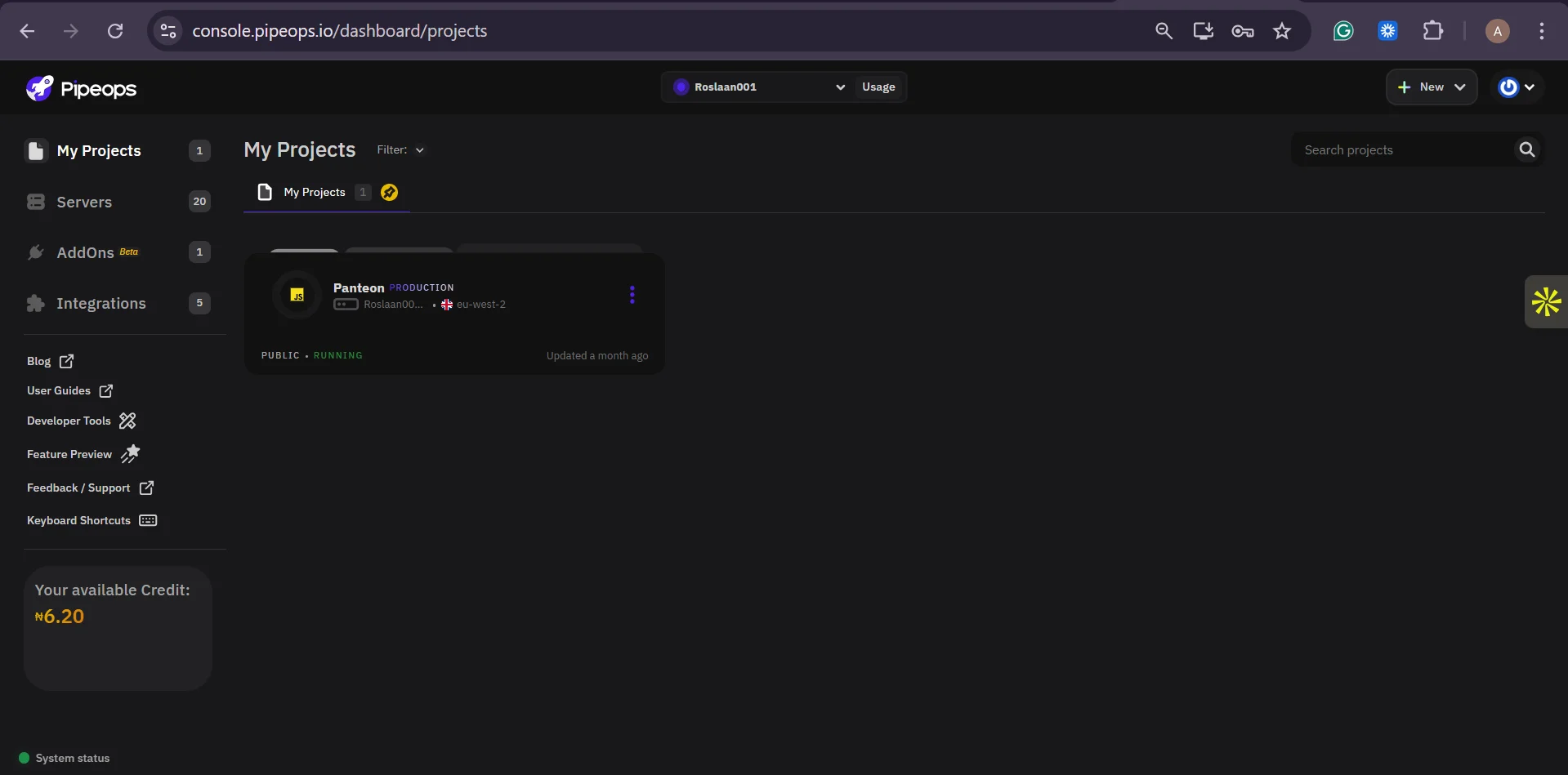\n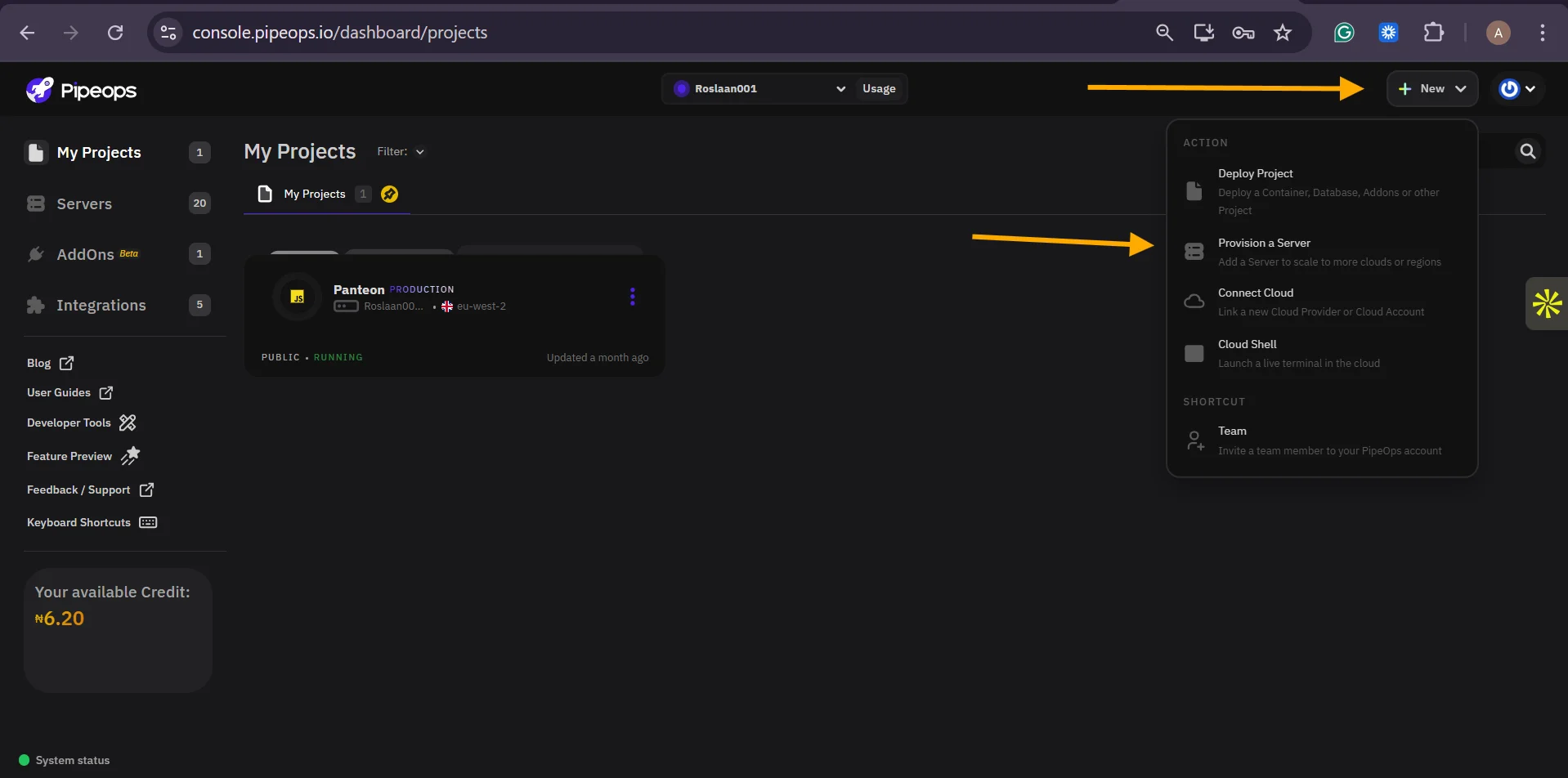\n\n### Step 2: Select 'Bring Your Own Server'\n\nPipeOps will present you with options for c
340onnecting infrastructure. Select 'Bring Your Own Server (BYOS)'. You can optionally label the server type as AWS EC2 or make the name the same as the name of your EC2 instance for organisational clarity within your PipeOps dashboard. Click on generate token to generate your server token and keep it safe.\n\n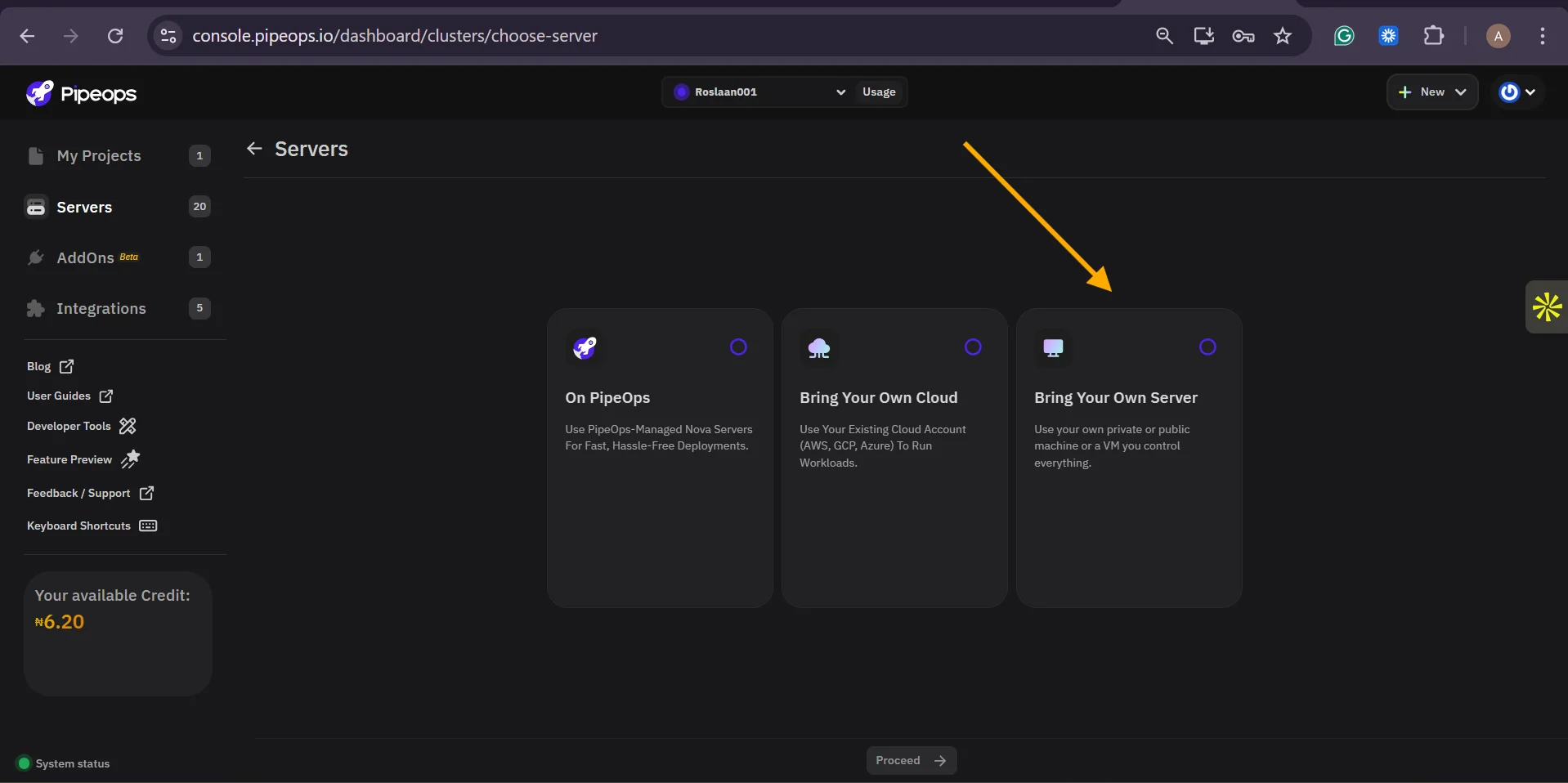\n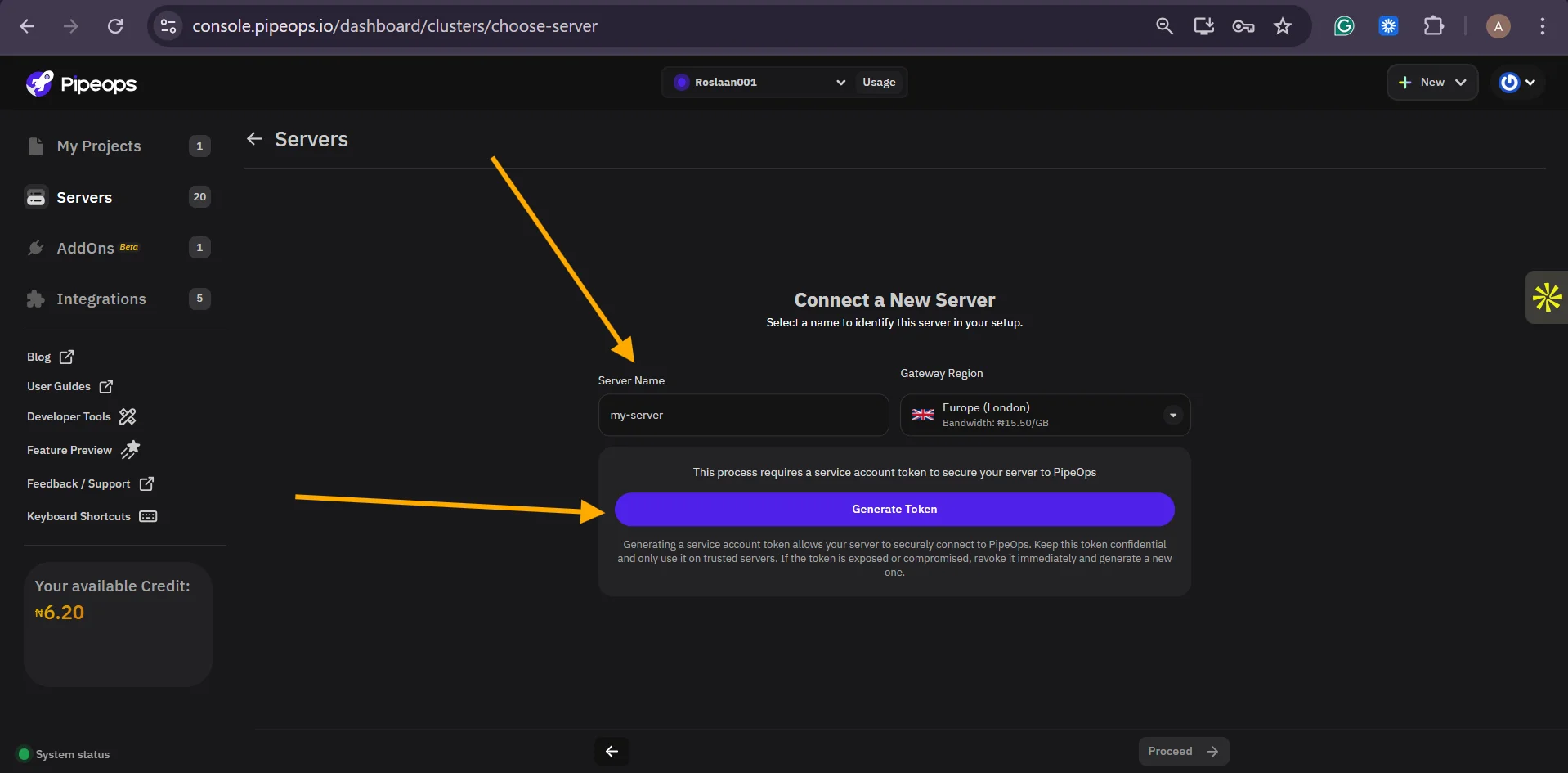\n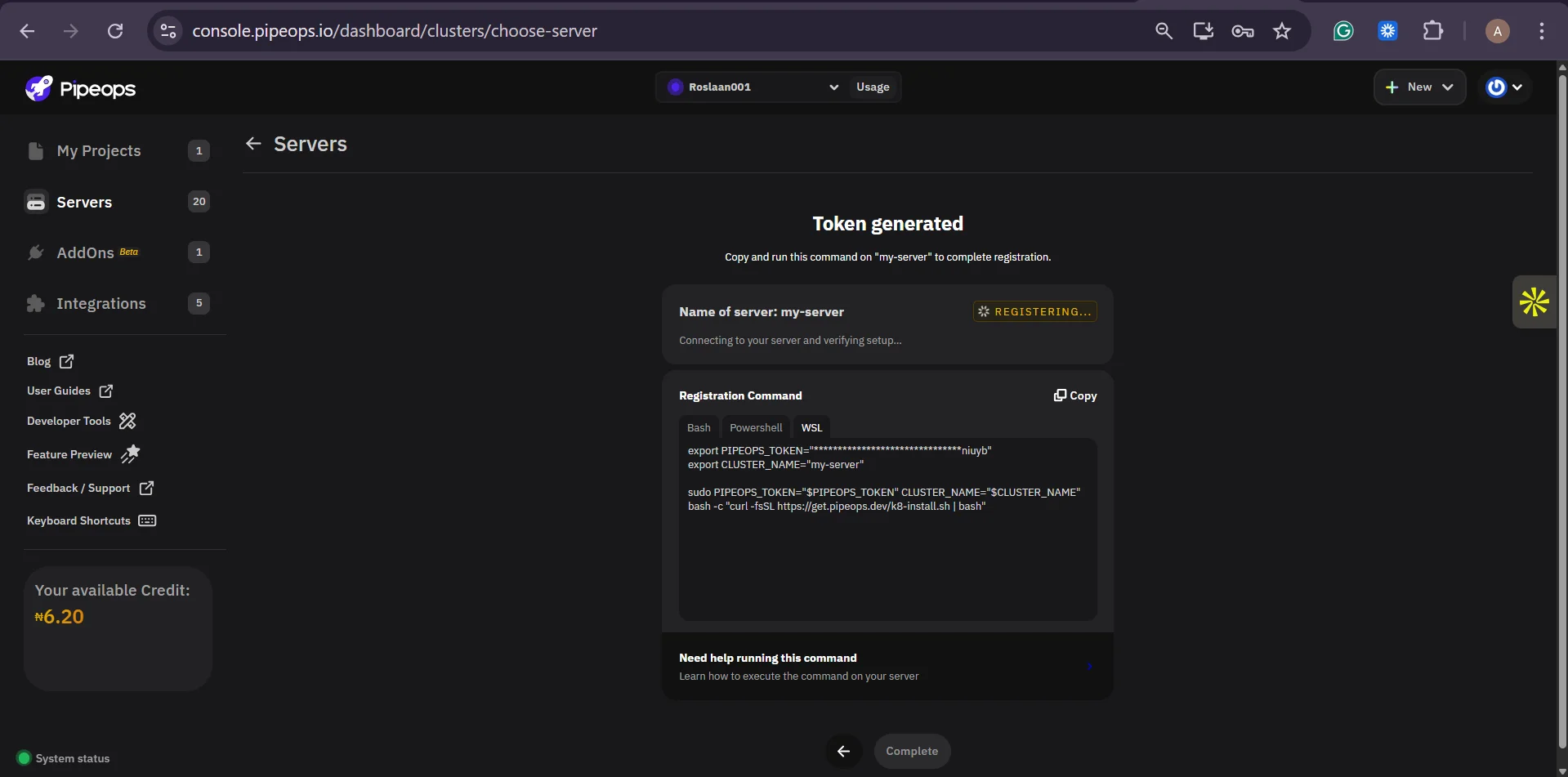\n\n### Step 3: Launch and Configure Your EC2 Instance\n\nLog in to the AWS Management Console and navigate to EC2. Launch a new instance or identify an existing one you want to connect. Select Ubuntu 22.04 LTS as your Amazon Machine Image (AMI). Choose your instance type based on your workload. A t3.medium (2 vCPUs, 4 GB RAM) is a solid starting point for most web applications.\n\n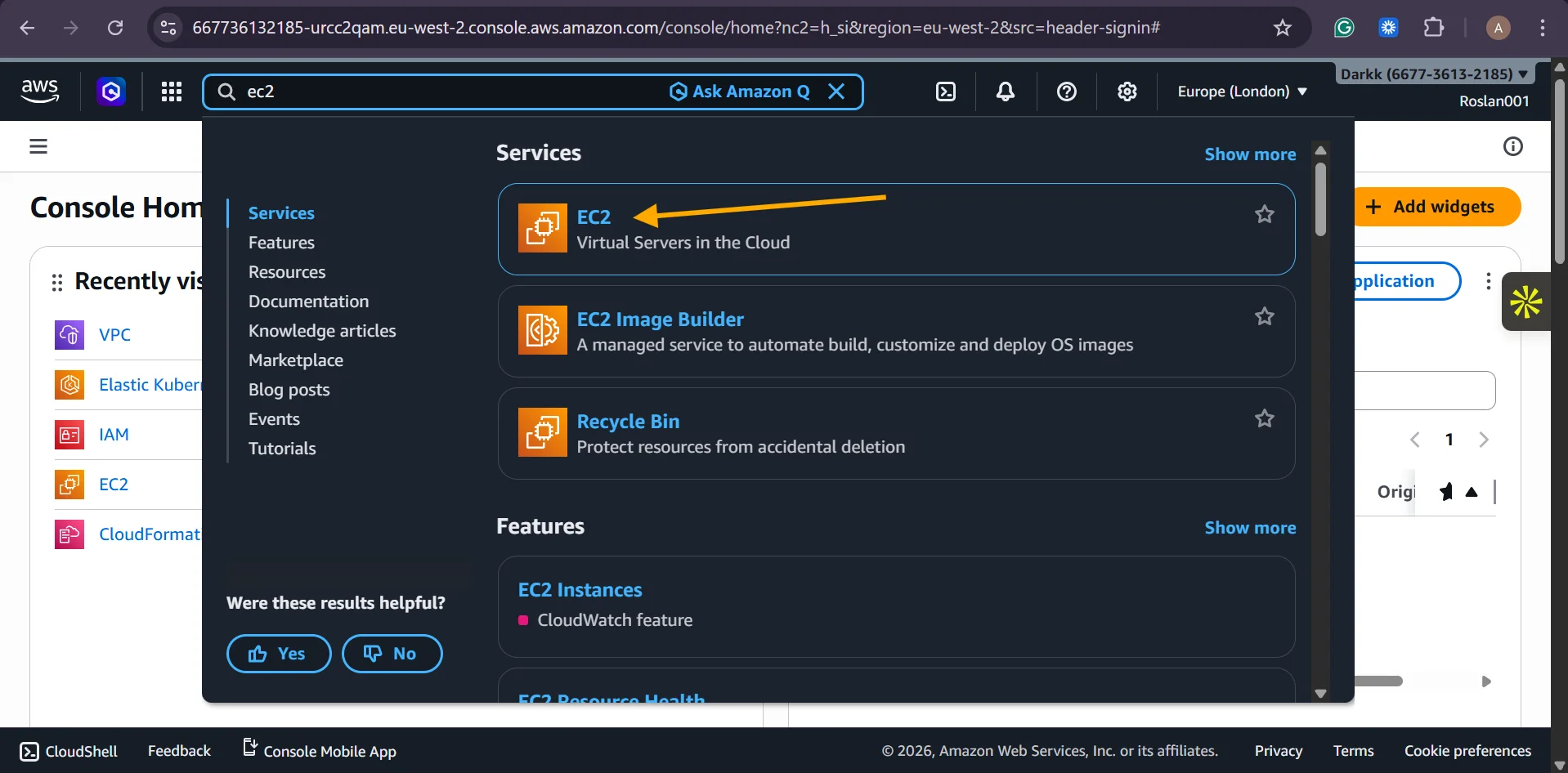\n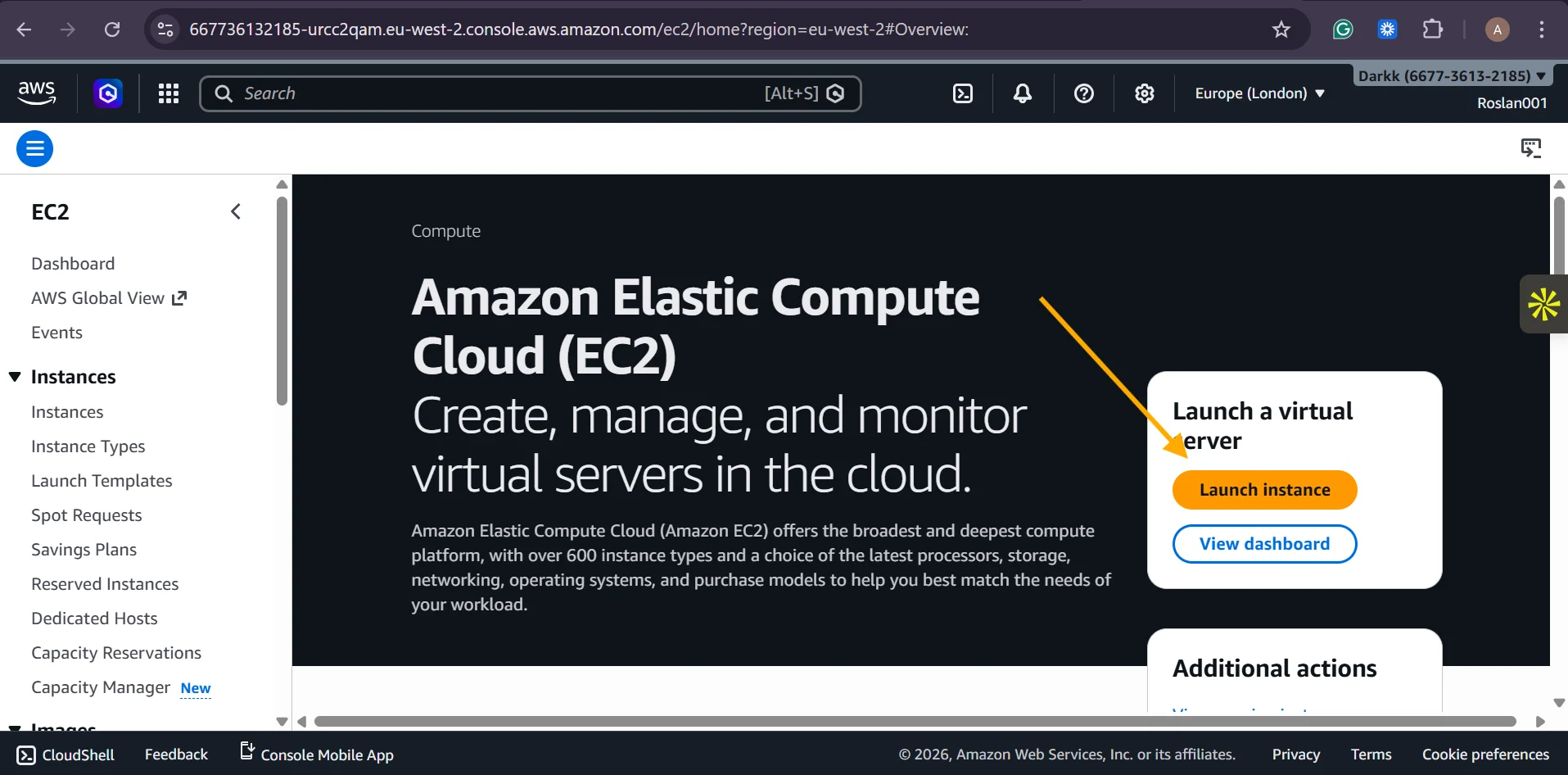\n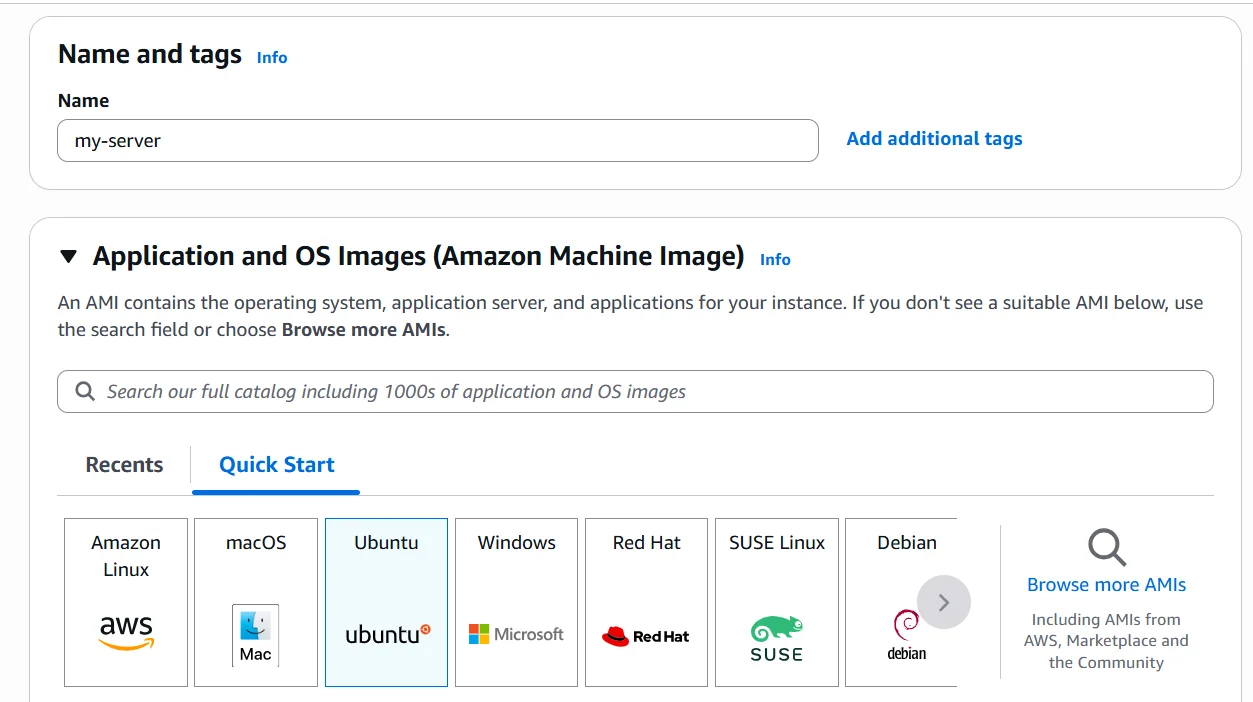\n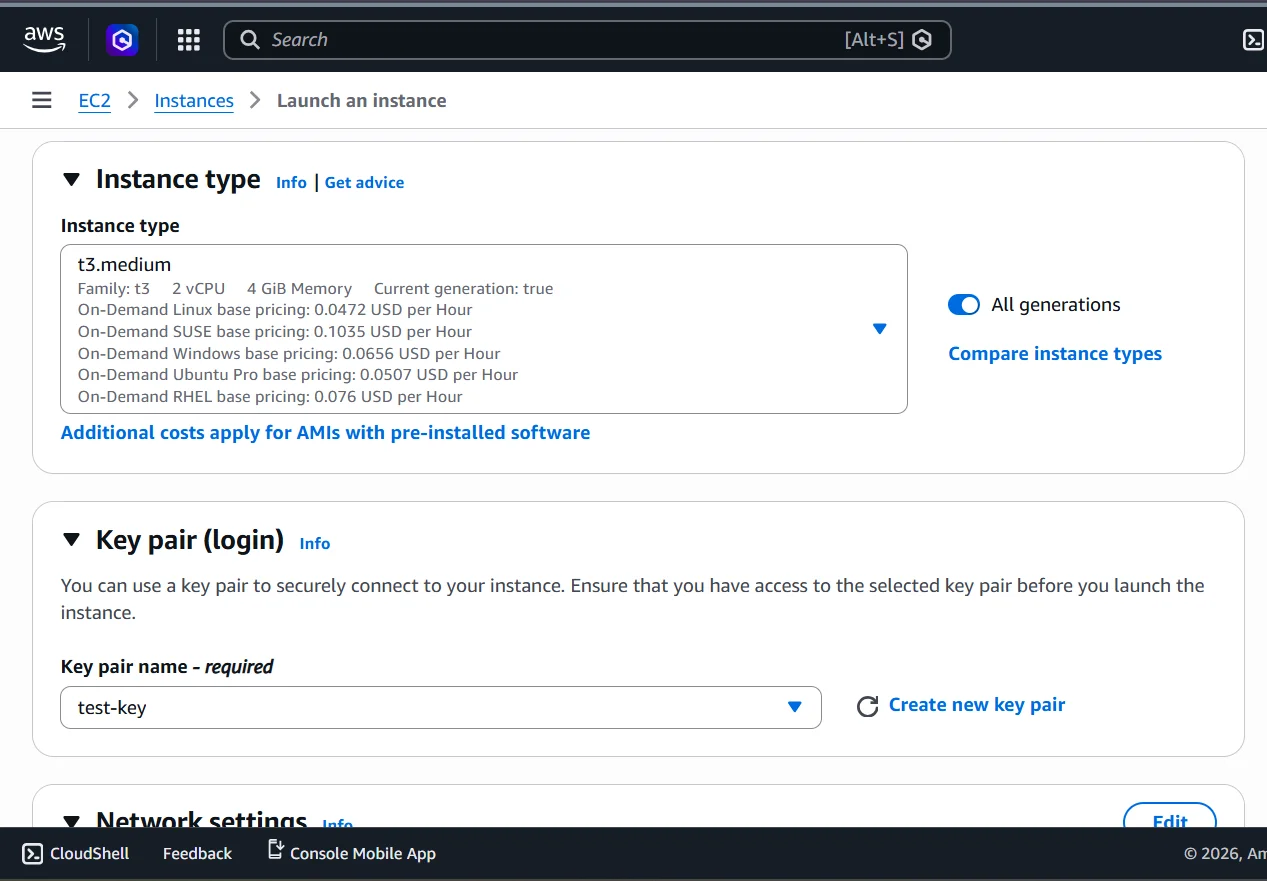\n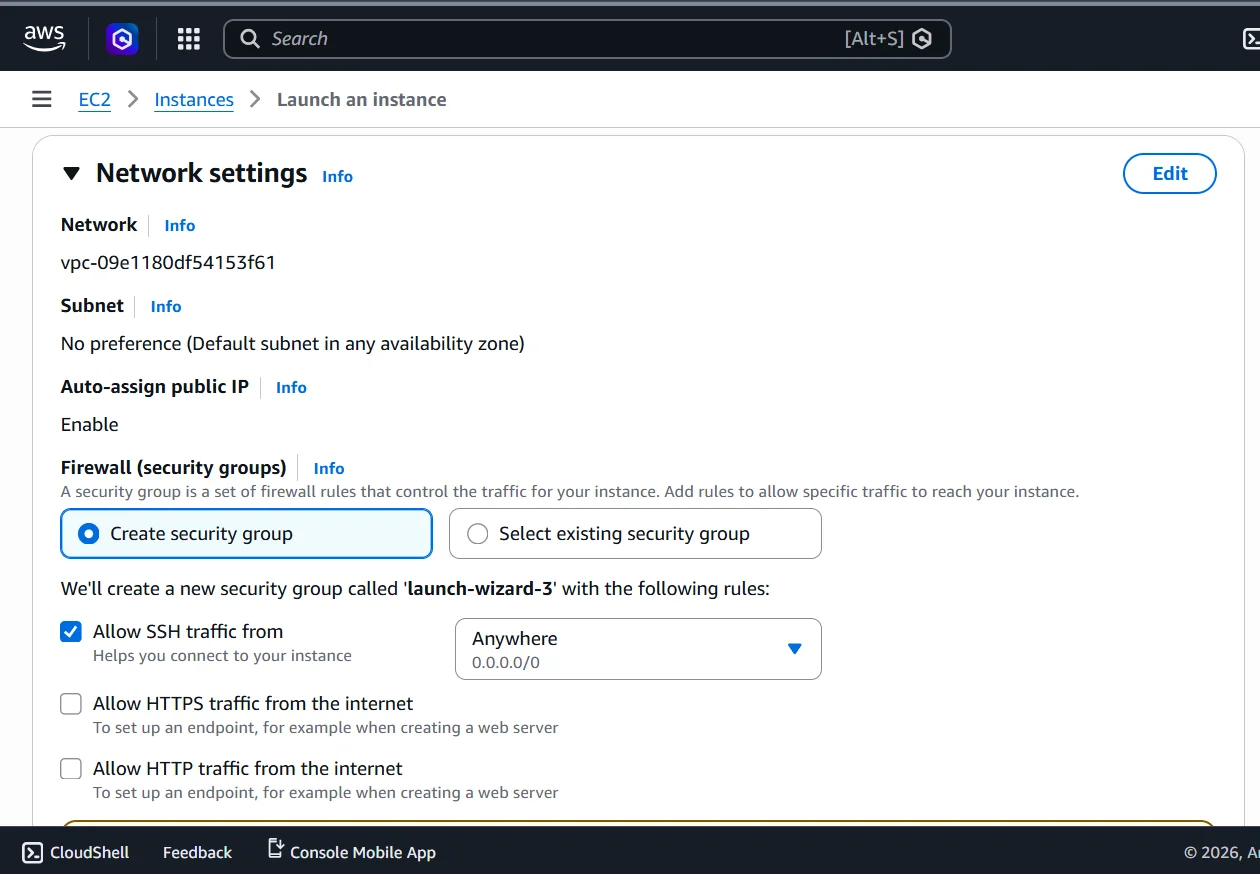\n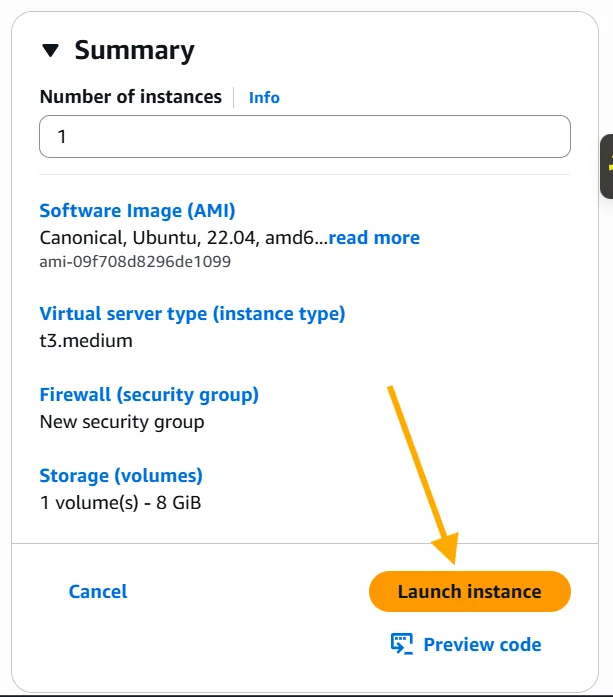\n\n\n### Step 4: Run the PipeOps Installation Script on Your EC2 Instance\n\nCopy the generated unique installation script for your server. Copy this script. You can connect to the server using SSH( your key pair: ssh -i your-key.pem ubuntu@your-ec2-public-ip) or use the EC2 instance connect to have the in browser ssh to your server, or the SSM manager, or the EC2 Serial Console. Paste and execute the installation script with sudo privileges. The script installs the PipeOps agent and all required dependencies, establishes a secure connection between your instance and the PipeOps control plane, and registers the server in your PipeOps dashboard.\n\n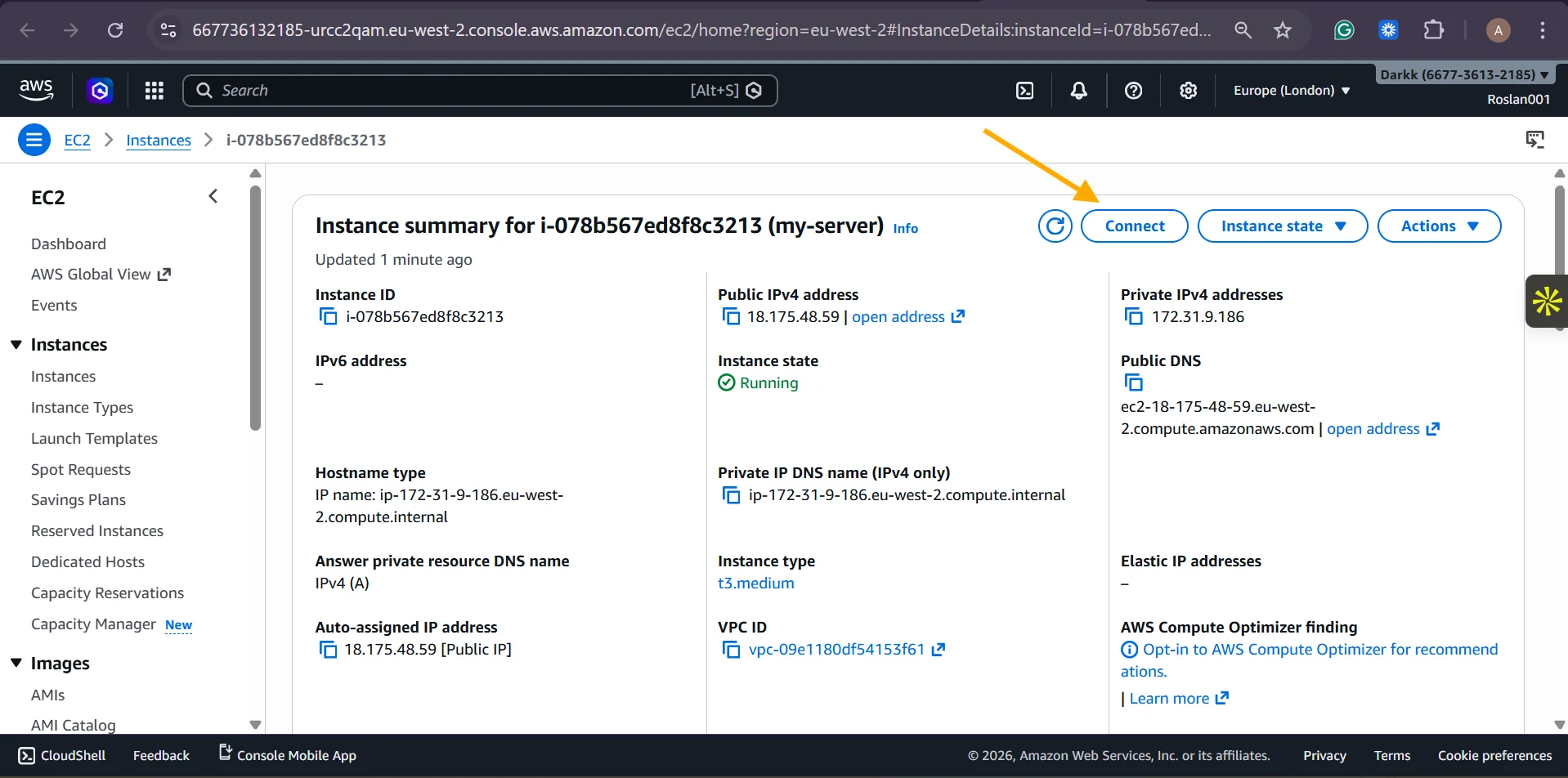\n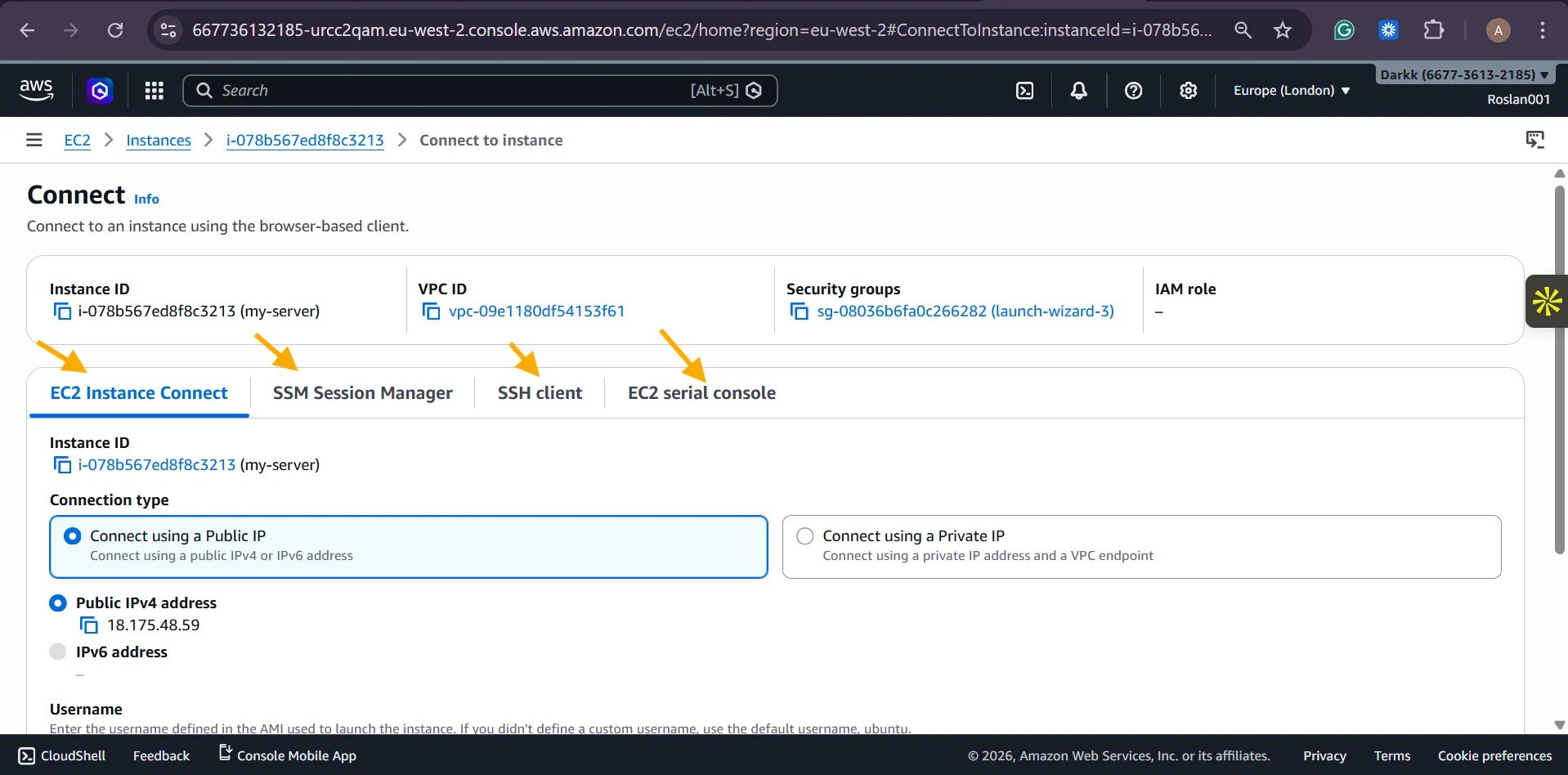\n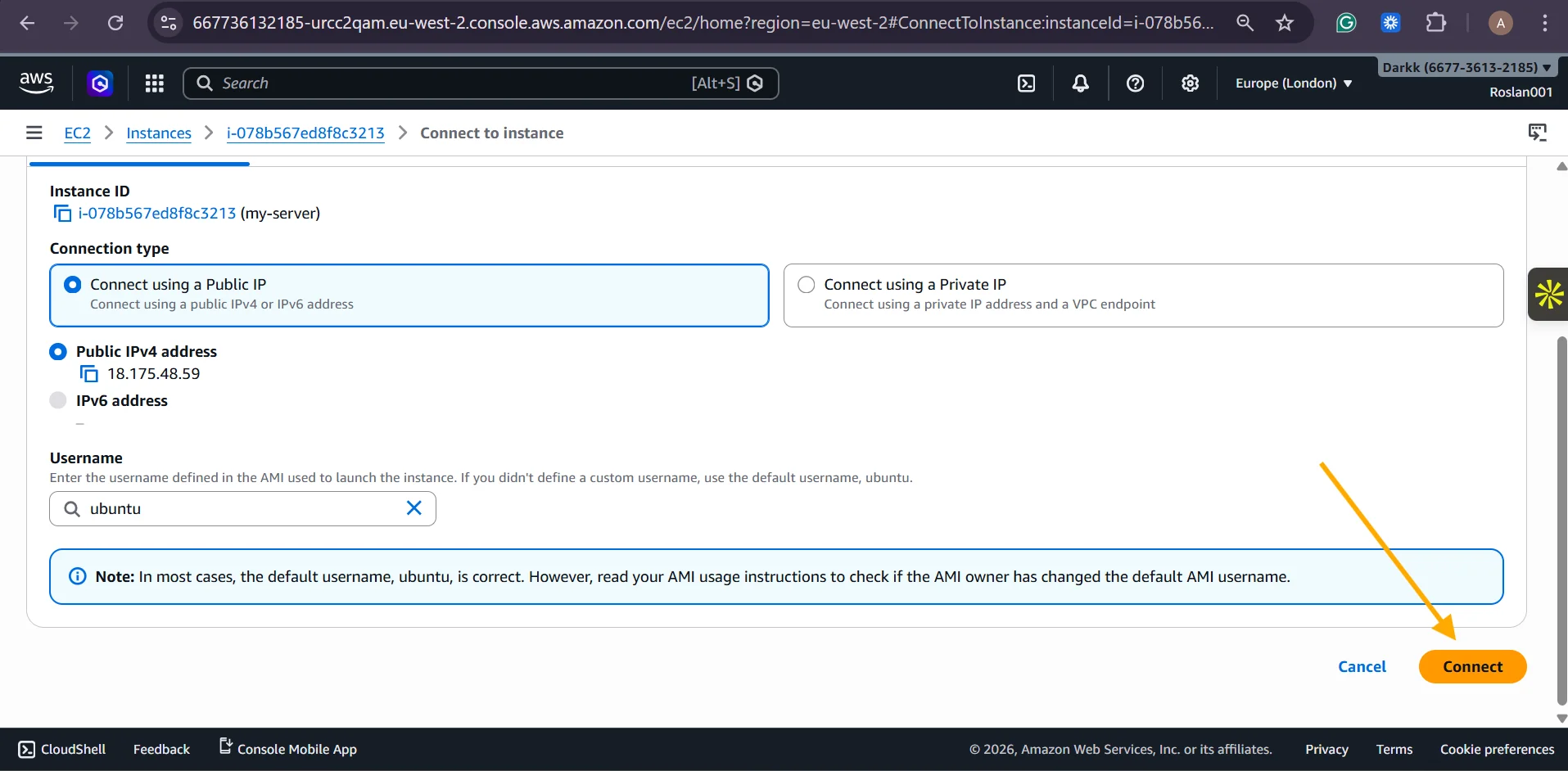\n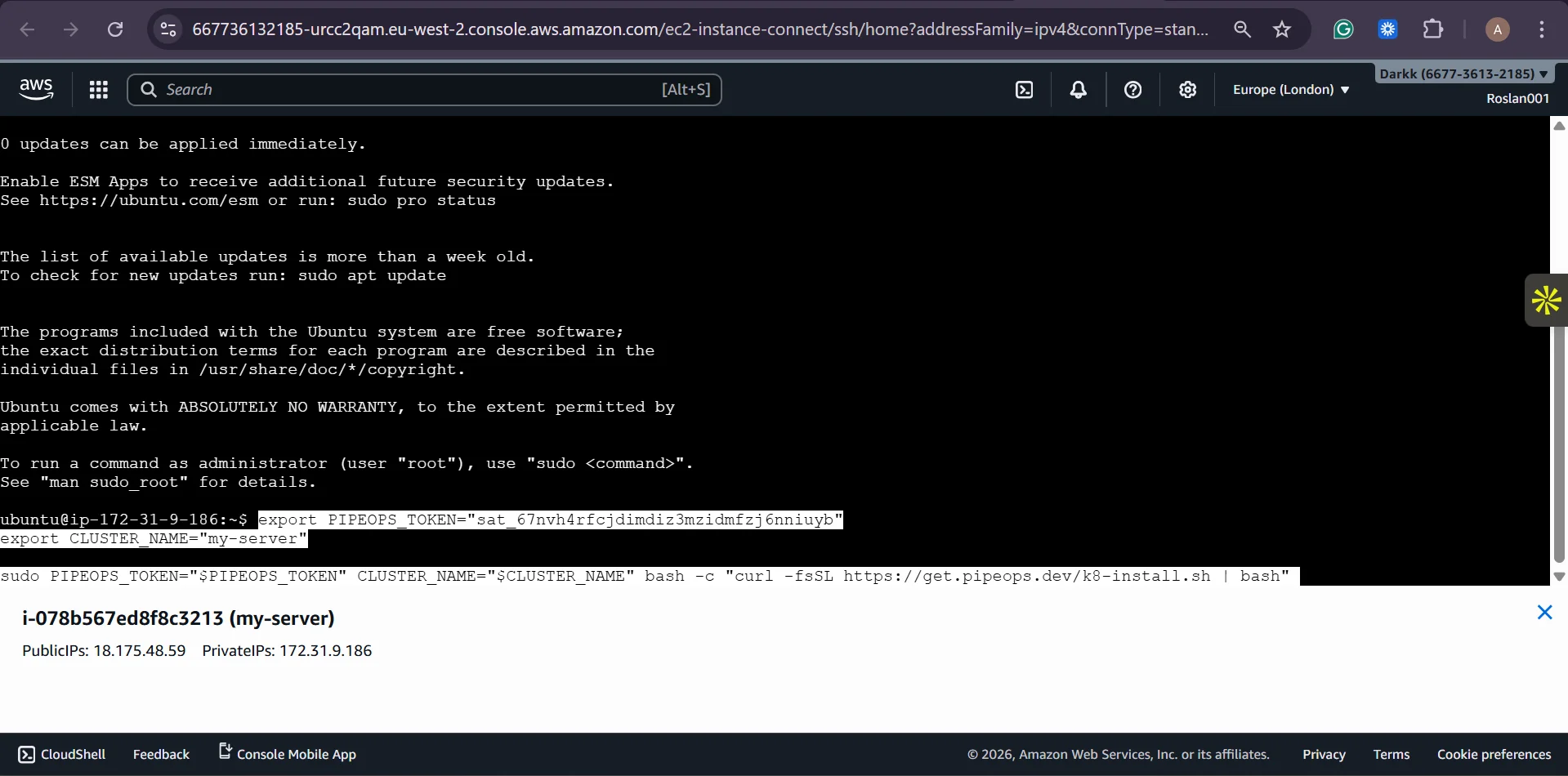\n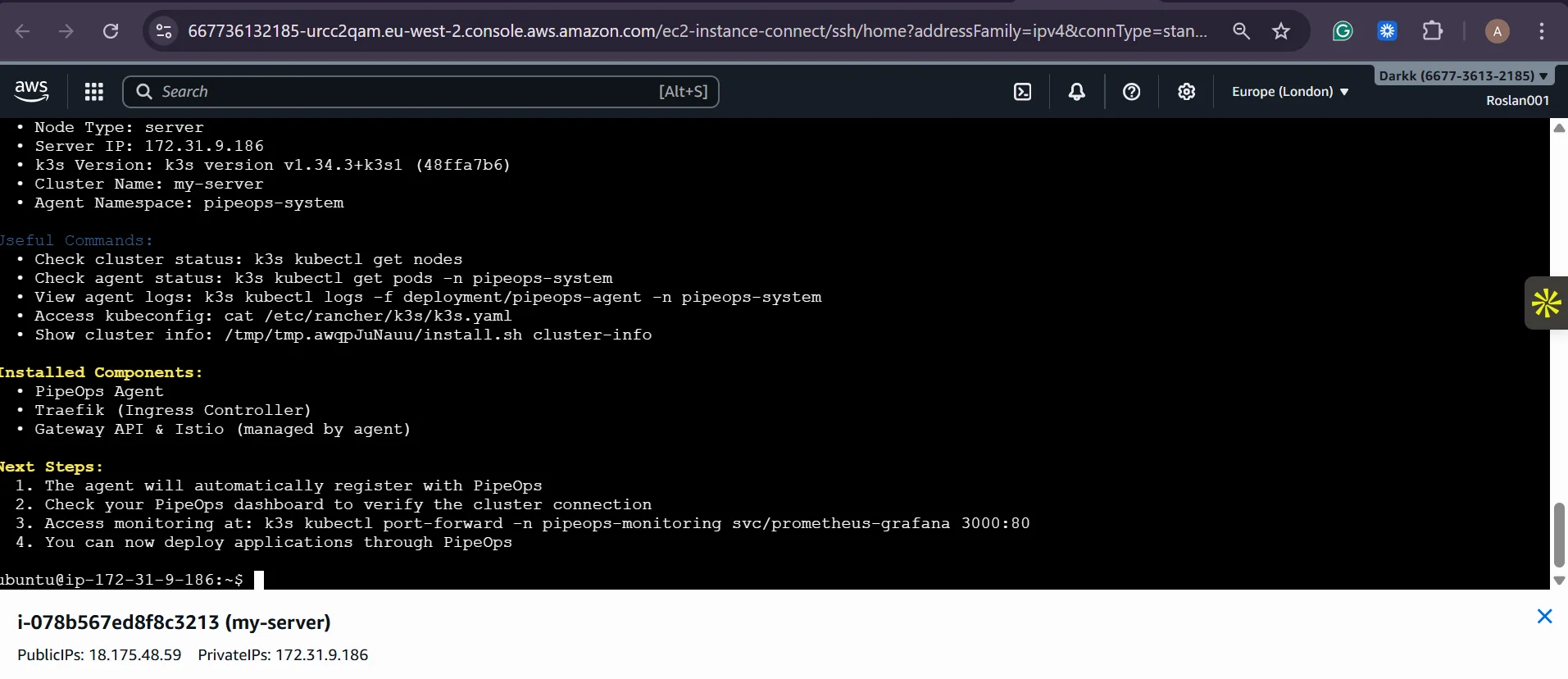\n\n\n### Step 5: Verify the Connection in the PipeOps Dashboard\n\nReturn to your PipeOps console. Within a few minutes, your EC2 instance will appear as an online, deployment-ready server in your Servers list. You will see server health metrics, resource utilisation, and connection status,all directly within PipeOps. Your EC2 instance is now fully integrated.\n\n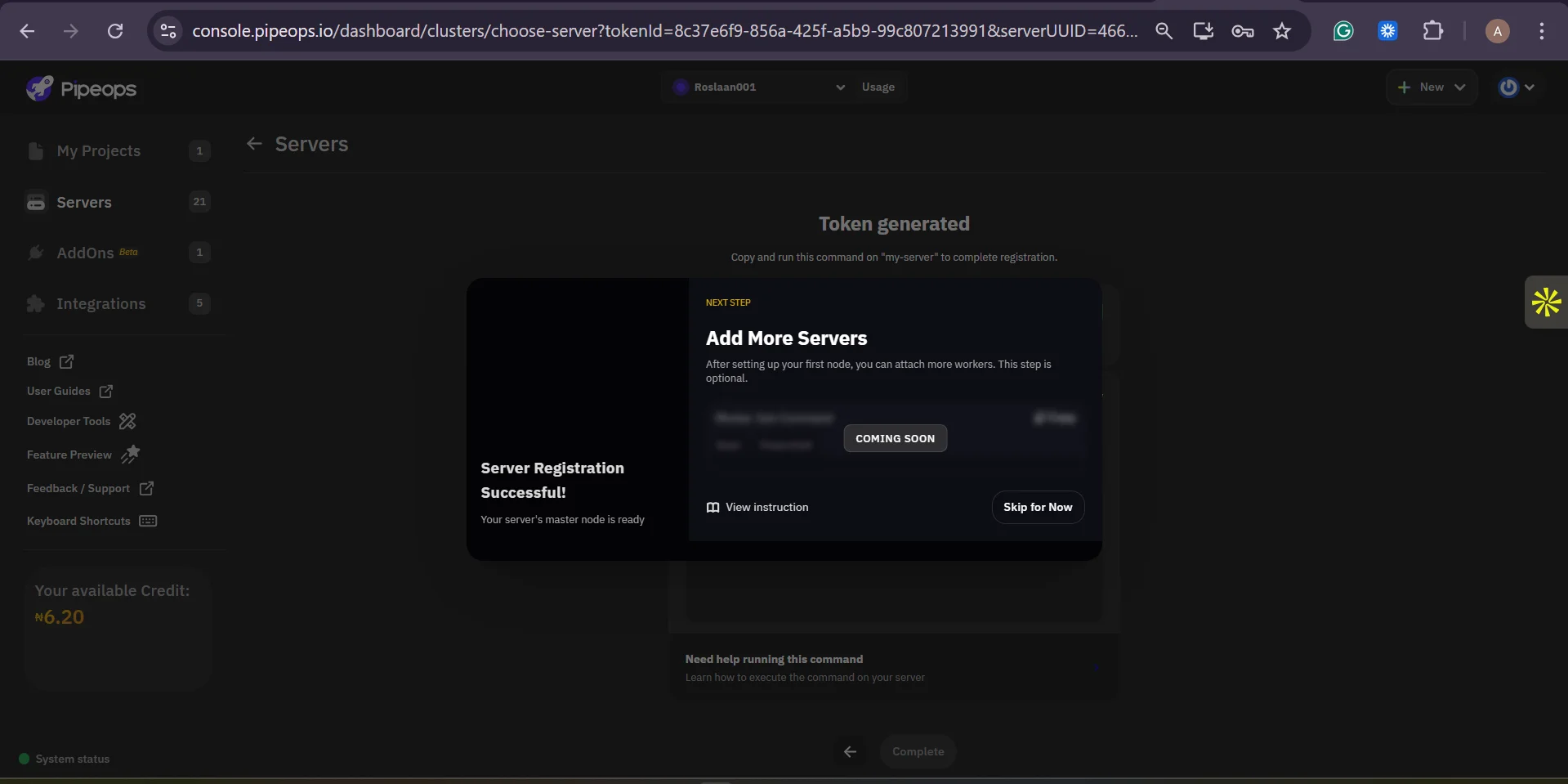\n\n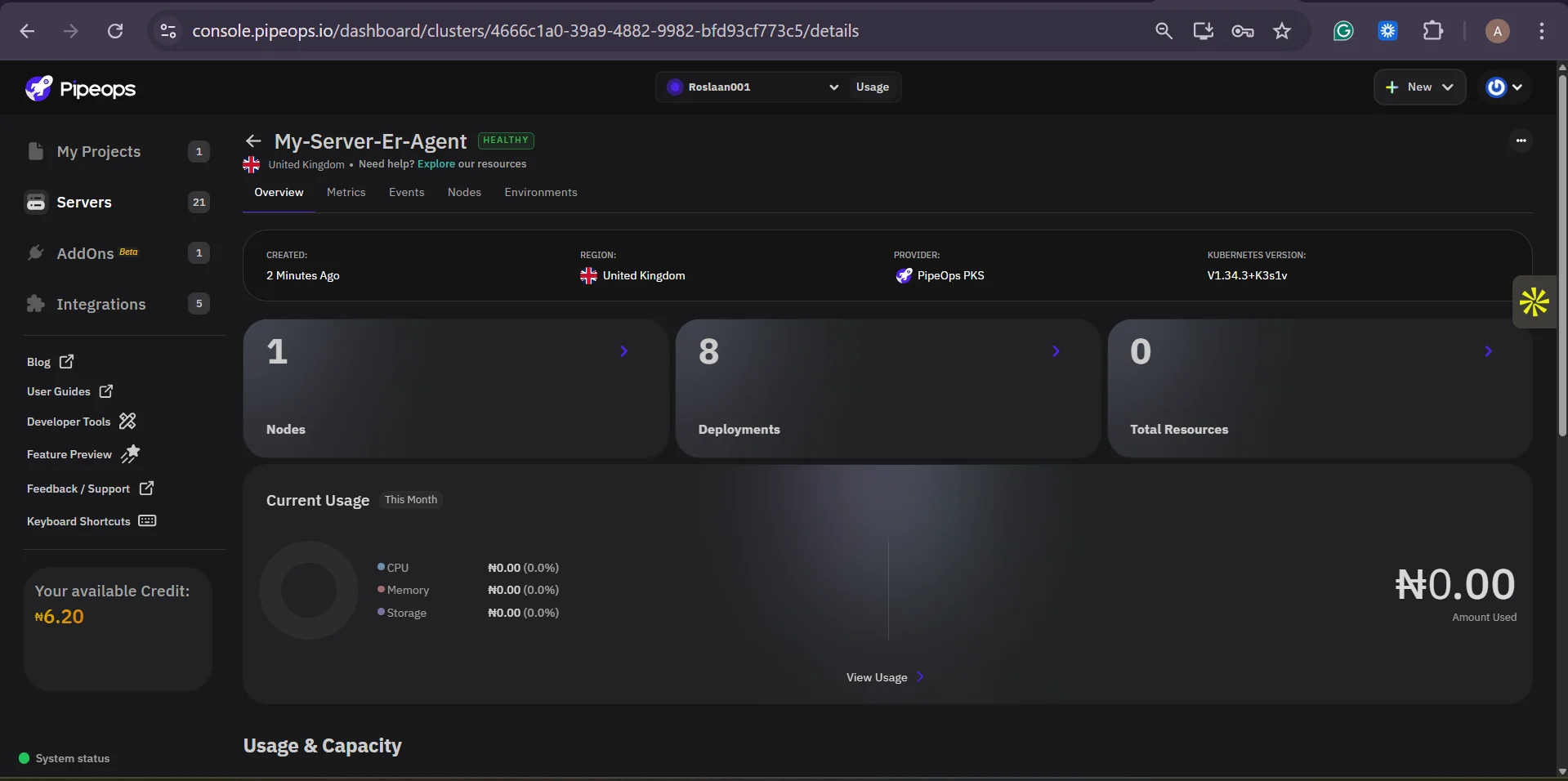\n\n### Step 6: Deploy Your First Project\n\nWith the server connected, navigate to Projects in PipeOps and create a new project. Connect your Git repository (GitHub, GitLab, or Bitbucket). Select your newly added EC2 instance as the server. Configure your build settings, environment variables, and deployment preferences. PipeOps will handle the rest, from building your application via its integrated CI/CD pipeline and deploying it to your EC2 instance automatically on every push to your chosen branch.\n\n## Key Benefits of Running EC2 with PipeOps BYOS\n\n | Benefit | What This Means for Your Business |\n|---|---|\n| Maximise AWS Investment | Use your existing reserved instances, savings plans, or enterprise agreements without restructuring your infrastru
340cture. Every dollar already committed to AWS continues to work. |\n| Instant CI/CD | PipeOps automatically sets up CI/CD pipelines connected to your repository. Developers push code, and it deploys,no pipeline configuration required from your team. |\n| Unified Console | Manage all deployments, environments, and servers from a single PipeOps dashboard regardless of which provider or region your EC2 instances are in. |\n| No DevOps Overhead | Eliminate the need to hire or task DevOps engineers with maintaining the deployment infrastructure. PipeOps handles operational complexity so your engineers can focus on building products. |\n| Vendor Flexibility | Because PipeOps works as the management layer, you can mix EC2 instances with servers from other providers in the same workflow without rebuilding your deployment process. |\n| Sovereign Control | Your data and workloads remain on your EC2 instances in your chosen AWS region. PipeOps orchestrates deployments but does not host your applications, giving you full data sovereignty. |\n\n## The FinOps Perspective: Making EC2 Work Harder\n\nOne of the most overlooked aspects of EC2 cost optimisation is operational inefficiency , teams that spend engineering hours managing deployment pipelines instead of shipping features. PipeOps eliminates this hidden cost entirely.\n\nFor organisations with AWS credits (through programs like AWS Activate for startups or enterprise negotiated credits), BYOS enables you to route those credits directly to compute, whilst PipeOps handles everything above the infrastructure layer. This is a materially different cost model than paying for a managed hosting platform where the provider\\'s margin is embedded in every compute dollar.\n\nAdditionally, because PipeOps is provider-agnostic, you can use AWS EC2 where it makes sense for globally distributed workloads, compliance-sensitive data, or GPU-intensive tasks, and connect to cheaper alternatives for other workloads, all managed from the same console.\n\n\n**Decision-Maker Summary** \nIf your organisation already has EC2 instances or AWS commitments, PipeOps BYOS is the fastest path to turning that infrastru
340cture into a fully productive deployment platform. Setup takes less than 30 minutes. The result is a team that ships faster, infrastructure that costs less to operate, and a deployment workflow that scales with your business. \n\n\n## Conclusion\n\nAWS EC2 is an exceptional compute infrastructure. PipeOps BYOS is the operational layer that makes it as easy to deploy to as the most polished managed platforms, without the premium pricing or loss of control that comes with those alternatives.\n\nBy connecting your EC2 instances to PipeOps, you get the best of both worlds: AWS-grade infrastructure reliability and global reach, paired with PipeOps\\' streamlined deployment experience. Your engineering team gains a professional-grade CI/CD and deployment workflow. Your finance team gains predictable infrastructure costs. And your business gains the freedom to evolve your infrastructure strategy without disrupting how you ship software.\n\n**Ready to get started? Sign up at pipeops.io and connect your first EC2 instance in less than 30 minutes.**\n21:T3f1e,I built **rexec** because I was tired of pretending my CLI worked everywhere.\n\nI needed real-world testing across different machines and architectures â not just \"works on my laptop\" and not just CI logs. The quickest thing that could give me that was: a disposable terminal I can spin up anywhere, run the binary, and throw away.\n\nThat small tool turned into something bigger: a terminal control room for cloud sandboxes and your own machines.\n\n**TL;DR:** Rexec is a Terminal-as-a-Service platform: create network-isolated cloud terminals (Docker-backed), connect your own machines with an outbound agent, share sessions, record sessions, and integrate via CLI/SDKs or an embed widget.\n\n**Positioning:** Rexec turns terminals into infrastructure primitives. Terminals become API-managed sandboxes you can create, connect to (WebSocket), run commands in, share, record, lock down, and delete â with guardrails.\n\n\n## The Origin Story (And the Accidental Product)\n\nRexec started off as a small tool I needed to test our CLI and agent binary on different machine types with real-world usage.\n\nThen the scope creep hit:\n\n1. **CLI testing across machines** â does this binary behave the same on Ubuntu vs Alpine? AMD64 vs ARM64? Fresh box vs crusty box?\n2. **Cloud shell** â once you can spin terminals up quickly, it's basically a cloud shell. So we built a proper terminal UX around it.\n3. **Widget mode** â then we added an embeddable widget, because the terminal shouldn't live only inside the dashboard.\n4. **Students and low-spec laptops** â a hosted terminal with a curated toolchain is a cheat code for learning when your laptop is underpowered (or you don't have one).\n5. **Agent sandboxes** â once I installed `opencode` in a terminal and started running AI-generated code in there, it clicked â this is a safer default for agents and automation.\n6. **Shared expensive machines** â teams can connect a single beefy box (yes, including a GPU machine) and manage access without turning SSH keys into a company-wide group chat.\n\nRexec is now a multipurpose tool. We use it for all of the above. And it's open source.\n\n\n## What Rexec Actually Is\n\nRexec has two primitives:\n\n1. **Cloud terminals** â disposable Linux environments running as isolated containers.\n2. **BYOS agents** â connect your own server/laptop/Raspberry Pi into the same dashboard via an outbound WebSocket tunnel.\n\nEverything else (CLI, SDKs, widget, collaboration, recording) is built around making those two primitives usable in real workflows.\n\n- Docs: https://rexec.sh/docs\n- Resources/tutorials: https://rexec.sh/resources\n- Source: https://github.com/PipeOpsHQ/rexec\n\n\n## How We Built It (High-Level Architecture)\n\nRexec is intentionally boring infrastructure:\n\n- **Compute** â Docker/Podman containers with hard CPU/memory/PID limits (and optional disk quotas when the host supports it).\n- **Isolation** â terminals attach to an isolated bridge network with inter-container communication disabled (`rexec-isolated`) and hardened container settings (dropped capabilities + `no-new-privileges`).\n- **Terminal UX** â WebSocket streaming to xterm.js, with `tmux` inside the container for reconnect and scrollback.\n- **BYOS** â agents connect outbound over WebSockets (no inbound SSH ports).\n- **State** â PostgreSQL for users/sessions/audit logs; optional S3 for session recordings.\n\nFrom the OSS README, the architecture looks like this:\n\n```\n[Browser UI] â(Web
340Socket)â [Rexec API] ââ [PostgreSQL]\n â\n âââ [Container Manager] âââ [Docker Engine]\n â\n âââ [Agent Handler] â(WebSocket)â [Remote Agents]\n```\n\nImplementation stack:\n\n- **Frontend** â Svelte + xterm.js + Tailwind CSS\n- **Backend** â Go (Gin) + Gorilla WebSocket\n- **Runtime** â Docker Engine\n- **DB** â PostgreSQL\n\nThe design goal is simple: a terminal that feels native, but is disposable by default.\n\nOne implementation detail that matters: cloud terminals are kept alive (the container runs indefinitely), and interactive sessions attach via `exec` into a `tmux` session. That's what makes disconnect/reconnect cheap.\n\n\n## What It Can Do (Without the Marketing)\n\n### Disposable, network-isolated Linux terminals\n\nSpin up a new terminal, test something risky, then delete it. You can choose from common images (Ubuntu, Debian, Alpine, Fedora, Arch, Kali, etc) depen
340ding on the workflow.\n\nThis is the feature that makes everything else possible: once environments are cheap, you stop doing dangerous things on your laptop.\n\n### A real terminal UX (not a toy web console)\n\nRexec streams a proper terminal session (xterm.js) over WebSockets, with session persistence and collaboration.\n\nThe \"instant access\" trick is that you can start typing while the environment finishes provisioning in the background â no staring at progress bars.\n\n### Bring-your-own-server access (BYOS agent)\n\nIf you already have machines you care about (prod boxes, staging, a GPU workstation, a lab server), you can connect them to Rexec via an outbound agent. The machine shows up like a terminal you can click into.\n\nKey point: you're not opening inbound SSH or building VPN spaghetti.\n\n### Collaboration and session recording\n\nTwo features that matter when you're doing real ops work:\n\n- **Share a session** (view/control) for pair debugging or teaching.\n- **Record a session** and replay it for documentation, auditing, or incident reviews.\n\n### CLI and TUI (power-user mode)\n\nThe `rexec` CLI lets you create/list/connect to terminals, manage snippets/macros, and register agents.\n\n```bash\nrexec login\nrexec ls\nrexec create --name mydev --image ubuntu:24.04\nrexec connect \u003cterminal-id\u003e\nrexec -i\n```\n\nIt also supports shell completion and SSH integration patterns (ProxyCommand) if you're the type of person that lives in `~/.ssh/config`.\n\n### SDKs and API for automation and agents\n\nRexec exposes a REST API (and WebSockets for terminals). On top of that, there are official SDKs in multiple languages: Go, JS/TS, Python, Rust, Ruby, Java, .NET, and PHP.\n\n```python\nimport asyncio\nfrom rexec import RexecClient\n\nasync def main():\n async with RexecClient(\"https://rexec.sh\", \"YOUR_API_TOKEN\") as client:\n container = await client.containers.create(image=\"ubuntu:24.04\", name=\"sdk-demo\")\n async with client.terminal.connect(container.id) as term:\n await term.write(b\"echo 'Hello from Rexec!'\\n\")\n out = await term.read()\n print(out.decode())\n\nasyncio.run(main())\n```\n\n### Embeddable terminal widget\n\nYou add a script tag, create a div, then embed a session using either a share code (guest access) or an API token (authenticated).\n\n```html\n\u003cscript src=\"https://rexec.sh/embed/rexec.min.js\"\u003e\u003c/script\u003e\n\n\u003cdiv id=\"terminal\" style=\"width: 100%; height: 400px;
340\"\u003e\u003c/div\u003e\n\n\u003cscript\u003e\n const term = Rexec.embed('#terminal', {\n shareCode: 'YOUR_SHARE_CODE'\n });\n\u003c/script\u003e\n```\n\nToken mode (create a new terminal from your site):\n\n```html\n\u003cscript\u003e\n const term = Rexec.embed('#terminal', {\n token: 'YOUR_API_TOKEN',\n image: 'ubuntu',\n role: 'python'\n });\n\u003c/script\u003e\n```\n\nThis is why Rexec is useful for education and DevRel: you can turn \"run this command\" into \"run it here\".\n\n\n## Security: What's Actually Enforced\n\nRexec runs arbitrary shell sessions, so security isn't a paragraph â it's the product.\n\n### Container boundaries\n\n- No privileged containers (`Privileged: false`) plus `SecurityOpt: no-new-privileges:true`\n- `CapDrop: ALL`, with a small allowlist added back (including `NET_BIND_SERVICE` for low ports and `SYS_PTRACE` for debugging/TUI tools)\n- Default seccomp profile (not `unconfined`)\n- Host info masking via masked `/proc` and read-only `/proc/sys*` paths\n\n### Network isolation model\n\n- Terminals attach to a dedicated bridge network: `rexec-isolated`\n- Inter-container communication is disabled (`com.docker.network.bridge.enable_icc=false`)\n\nThis doesn't mean \"no internet\" â it means \"don't let user sandboxes talk to each other by default.\"\n\n### Resource and abuse controls\n\n- Hard memory limit with swap disabled (`MemorySwap == Memory`)\n- CPU quota limiting (`CPUPeriod`/`CPUQuota`)\n- PIDs limit (fork-bomb brake)\n- Optional disk quotas when the host supports it (overlay2 quotas, typically XFS/ext4)\n- Rate limiting at multiple layers (nginx at the edge + application middleware)\n\n### Auth and audit trail\n\n- JWT auth + MFA support, plus hardened account options like single-session mode and IP allowlists\n- API tokens are stored hashed; secrets like MFA/SSH material are encrypted at rest\n- Audit logs stored in Postgres (action, IP, user-agent, JSON details)\n- Session recording (optional S3 backend) for replay/auditing\n\n### Caveats\n\n- The root filesystem is currently writable to support role/tool installation. If you need a stricter boundary, run with gVisor/Kata (`OCI_RUNTIME=runsc` or `OCI_RUNTIME=kata`) or isolate at the host level.\n- `/tmp` is mounted `exec` in the default profile to supp
340ort some terminal tooling. Tighten it if you don't need that.\n\nThere's also ongoing work in the repo to support Firecracker microVM terminals for a stronger isolation boundary than containers.\n\n\n## Differentiation: Compared to the Usual Suspects\n\n| Compared to | The line in the sand |\n| --- | --- |\n| GitHub Codespaces / Gitpod | Great repo-first IDE workspaces. Rexec is terminal-first: disposable sandboxes + BYOS agents + embed widget + SDKs. |\n| Cloud Shell | Usually cloud-vendor specific and tied to their control plane. Rexec is neutral and self-hostable. |\n| wetty / ttyd / \"web SSH\" | Mostly a UI on top of one machine. Rexec adds disposable sandboxes, guardrails, collaboration/recording, and an automation surface (CLI/SDK). |\n| SSH jumpboxes | You can DIY, but then you're building auth, auditing, sharing, recordings, and access workflows yourself. Rexec packages the \"terminal control room\" layer. |\n\nIf you want a full VS Code-in-the-browser experience, use Codespaces/Gitpod. If you want governed terminals as a primitive (sandboxes + BYOS + embed + API), that's the lane Rexec is in.\n\n\n## Performance and Scaling\n\n- **Startup** â create container + start container. For faster boots, prebuild `rexec-*` images (`./scripts/build-images.sh`) so basics like SSH are already there.\n- **Reconnect** â fast because the session is `tmux`-backed and attaches via `exec`. Scrollback is configured to 50,000 lines.\n- **Fairness** â enforced with hard CPU/memory/PID limits, plus per-tier container/agent limits.\n- **Abuse prevention** â exists at multiple layers (edge + app). If you run a public instance, this matters.\n- **Stronger sandboxes** â a deployment choice: set `OCI_RUNTIME=runsc` (gVisor) or `OCI_RUNTIME=kata` (Kata Containers) when self-hosting.\n\nAt real usage scale (dozens to hundreds of concurrent terminals), this becomes capacity planning: per-terminal caps, container-host sizing, and a load balancer that handles long-lived WebSockets properly.\n\n\n## What It Looks Like in Practice\n\n### Release engineering across distros\n\nYou're shipping a CLI. You want confidence it works on real environments, not just CI containers.\n\n```bash\nrexec create --name cli-ubuntu --image ubuntu:24.04\nrexec create --name cli-debian --image debian:12\nrexec create --name cli-alpine --image alpine:3.21\n```\n\nDownload the binary, run the same smoke test on all three. Share one session (view/control) when something breaks, and record it if you need a replayable artifact.\n\n### SRE debugging without SSH key chaos\n\nInstall the agent on the box (outbound connection, no inbound SSH ports). Connect from the dashboard, share the session for pair debugging, and keep an audit trail with session recording.\n\n### Education and DevRel that actually runs\n\nEmbed a terminal in docs/tutorials, hand out share codes, and let people run commands where they're learning â without a \"works on my machine\" setup tax.\n\n### Agents that execute in a sandbox\n\nIf you're using AI coding tools, the safest workflow is generate â run â test in a disposable environment:\n\n1. Create a fresh terminal (or one per task).\n2. Run the agent (e.g., `opencode`, `aider`) inside the sandbox.\n3. Run tests in isolation.\n4. Delete the terminal when done.\n\n\n## Who Needs This (Realistically)\n\nRexec isn't for everyone. If you already have perfect laptops, perfect networks, and perfect discipline, you can stop reading.\n\n- **CLI authors and release engineers** who need to validate binaries on real machines/arches without collecting laptops like Pokémon.\n- **SRE/DevOps teams** who want disposable jump boxes and a safer way to reach machines without SSH key chaos.\n- **Students and bootcamps** who need a real environment without a high-spec laptop.\n- **DevRel and docs teams** who want runnable tutorials via the embed widget (or pre-configured roles).\n- **AI/agent builders** who need a sandbox to run generated code, execute tests, and share sessions for review.\n- **Teams with shared expensive hardware** (including GPUs) â connect the box once, manage access centrally, and avoid \"who has the SSH key?\" as your access-control strategy.\n\n\n## Pitfalls\n\n1. **Treat API tokens like passwords.** They give account-level access.\n2. **Know the trust model.** A sandbox reduces blast radius; it doesn't make malware \"safe\". Don't drop production secrets into random terminals.\n3. **Network isolation is about east/west by default.** If you need strict egress controls, enforce them at the host/network layer.\n4. **Agents need outbound WebSockets.** Some corporate networks break this; plan accordingly.\n5. **Self-hosting defaults are for dev.** Change default credentials, set `JWT_SECRET`, and put it behind TLS.\n\n\n## Try It\n\n### Cloud terminal (hosted)\n\n1. Open https://rexec.sh and create a terminal.\n2. Run something you normally don't want on your laptop (build scripts, installer experiments, etc).\n3. Share the session if you need help debugging.\n\n### Install the CLI\n\n```bash\ncurl -fsSL https://rexec.sh/install-cli.sh | bash\n```\n\nOr build from source:\n\n```bash\ngit clone https://github.com/PipeOpsHQ/rexec\ncd rexec\ngo build -o rexec ./cmd/rexec-cli\nsudo mv rexec /usr/local/bin/rexec\n```\n\nLog in and create a terminal:\n\n```bash\nrexec login\nrexec create --name mydev --image ubuntu:24.04\nrexec connect \u003cterminal-id\u003e\n```\n\n### Connect your own machine (agent)\n\n1. Generate an agent install c
340ommand from the dashboard under **Settings â Agents**.\n2. Run the installer on your server:\n\n```bash\ncurl -fsSL https://rexec.sh/install-agent.sh | sudo bash -s -- --token YOUR_TOKEN\n```\n\n3. Your machine should appear as a terminal card.\n\n### Self-host (open source)\n\n```bash\ngit clone https://github.com/PipeOpsHQ/rexec\ncd rexec/docker\n```\n\nRexec's container manager talks to a Docker/Podman daemon. In the stock `docker/docker-compose.yml`, the API container connects to a remote Docker host over TLS â no `docker.sock` mount â so you must provide `DOCKER_HOST` and certs.\n\nCreate `rexec/docker/.env`:\n\n```bash\nDOCKER_HOST=tcp://YOUR_DOCKER_HOST:2376\nDOCKER_TLS_VERIFY=1\nDOCKER_CA_CERT=\"(contents of ca.pem)\"\nDOCKER_CLIENT_CERT=\"(contents of cert.pem)\"\nDOCKER_CLIENT_KEY=\"(contents of key.pem)\"\nJWT_SECRET=\"change-me\"\nPOSTGRES_PASSWORD=\"change-me\"\n```\n\nStart the stack:\n\n```bash\ndocker compose up -d --build\n```\n\nOpen `http://localhost:8080` and change defaults immediately. For the full remote-Docker deployment model, see: https://github.com/PipeOpsHQ/rexec/blob/main/docs/DEPLOY_STANDALONE.md\n\nFor stricter isolation, configure a hardened runtime (gVisor/Kata) on your container host and set `OCI_RUNTIME` for the `rexec` service:\n\n```yaml\n# docker/docker-compose.yml\nenvironment:\n - OCI_RUNTIME=runsc\n```\n\n\n## Summary\n\nRexec turns terminals into infrastructure primitives. It started as a way to test a CLI on real machines. It became a terminal control room: disposable cloud terminals, a BYOS agent, an embed widget for docs, SDKs for automation, and a safer sandbox for agents.\n\nIf that sounds like your workflow, start with the docs: https://rexec.sh/docs22:T29af,## Complete Guide to CI/CD Best Practices\n\nSoftware developers rely on Continuous Integration (CI) and Continuous Delivery/Deployment (CD), to ensure software moves from code to production quickly and consistently. CI involves frequently merging small code changes into a shared repository with automated builds and tests to catch issues early. \n\nCD extends this automation to deploy the tested code into production or production-like environments, enabling reliable, frequent releases with minimal manual intervention. A CI/CD pipeline is the practical implementation of these processes, comprising automated steps from code commit to deployment and monitoring.\n\n\nThis article explains what CI/CD is, why it matters, and the best practices you should follow to build pipelines that deliver speed, security, and scalability.\n\n\n## Why CI/CD Matters for Modern Development\n\n- **Faster Time-to-Market:** Automating testing and deployments means new features and bug fixes reach users quicker.\n\n\n- **Improved Code Quality:** Frequent, automated testing catches bugs earlier, lowering the cost of fixing them.\n\n\n- **Reduced Risk:** Smaller, incremental releases are easier to troubleshoot than large, infrequent ones.\n\n\n- **Increased Developer Productivity:** Developers spend less time on manual integrations and deployments, and more time writing code.\n\n\n- **Stronger Collaboration:** CI/CD fosters a culture of shared ownership and visibility across development, QA, and operations.\n\n\n## Key Steps in Setting Up CI/CD Pipelines\nFrom tool selection to automation and testing, the following key activities lay the groundwork for an efficient CI/CD workflow:\n\n\n1. Choose the Right CI/CD Tool\n\nSelect the best CI/CD tools that fit your technology stack and organizational needs. Popular choices include Jenkins, GitLab CI, Travis CI, and cloud-native pipelines like AWS CodePipeline. Evaluate tools on scalability, integrations, community support, and ease of use.\n\n2. Implement Version Control\nUse Git-based repositories (GitHub, GitLab, Bitbucket) to manage code and avoid merge conflicts by integrating frequently and in small increments. \n\n3. Automate Build Processes\nSet up a build server to compile code and generate immutable artifacts (.jar files, .zip, Docker images) only once. These binaries or containers then propagate through all environments to ensure consistency and reduce discrepancies.\n\n4. Automate Tests at Every Level\nIncorporate multiple layers of automated tests: unit tests, integration tests, end-to-e
340nd tests, security scans, and performance tests. Prioritize faster tests early in the pipeline to provide rapid feedback and catch bugs sooner.\n\n5. Deploy with Automation\nConfigure continuous delivery or deployment to push builds automatically to testing, staging, and production environments. Feature flags and progressive delivery techniques (canary, blue/green) further reduce risks by controlling rollouts.\n\n6. Create Production-Like Test Environments\nUse containerization and Infrastructure as Code (IaC) tools like Terraform or Ansible to spin up isolated, realistic test setups that mirror production, enabling accurate validation.\n\n7. Monitor and Measure Pipeline Performance\nLeverage monitoring tools (Prometheus, Grafana, Datadog) and logging to track build times, test pass rates, deployment frequency, and recovery times. Continuous monitoring identifies bottlenecks to optimize pipeline efficiency.\n\n\n## CI/CD Best Practices \n\nImplementing an effective CI/CD pipeline requires strategic planning and adherence to proven engineering practices. Below are CI/CD best practices that help ensure your pipeline is scalable, reliable, and aligned with modern DevOps principles.\n\n\n### Maintain a Single Source of Truth\nA reliable CI/CD pipeline starts with a single source of truth. All application code, configuration files, infrastructure definitions, and even pipeline scripts should be stored in a version-controlled Git repository. \n\nThis centralized approach ensures that every team member works with the same information, reducing inconsistencies across environments. It also provides a full history of changes, making it easy to audit, roll back, or troubleshoot when something goes wrong. By treating everything as code and storing it in Git, teams can maintain transparency and enforce better collaboration practices.\n\n\n### Automate Everything You Can\nAutomation is the backbone of CI/CD. Manual steps in the pipeline, whether for building, testing, or deploying, introduce delays, errors, and inconsistencies. Automating the full lifecycle ensures repeatability, speeds up feedback loops, and reduces human error. \n\nStart by automating builds and artifact generation, then move on to testing across all levels: unit, integration, security, and performance. Infrastructure provisioning should also be automated using Infrastructure as Code (IaC) tools like Terraform or Ansible. Finally, define deployment workflows that automatically promote builds through environments based on test results and approval gates.\n\n### Shift Testing Left\nShift testing left means running tests earlier in the development cycle. Bugs are cheaper to fix the earlier theyâre found, which is why this approach is critical. CI/CD pipelines should be designed to trigger tests as soon as code is committed. This includes unit tests that validate isolated functions, integration tests that verify communication between services, and static analysis tools that scan for potential bugs, security vulnerabilities, or code quality issues. Early testing allows developers to receive instant feedback, enabling them to resolve problems before they become more complex and costly.\n\n\n### Use Feature Flags for Safer Deployments\nFeature flags provide a powerful way to decouple code deployment from feature releases. By wrapping new functionality in conditional logic, teams can deploy code to production without making it immediately available to users. \n\nThis enables safer, gradual rollouts, targeted A/B testing, and quick rollbacks without needing to redeploy the application. Feature flags are especially useful in continuous delivery environments, where new code reaches production frequently but needs to be controlled based on user segments, regions, or internal testing needs.\n\n\n### Prioritize Security throughout the Pipeline\nSecurity should be baked into your pipeline, not tacked on at the end. Integrating DevSecOps practices helps detect vulnerabilities early and ensures secure software delivery without slowing down development. Incorporate automated vulnerability scanning for container images and dependencies, and use tools that flag outdated or risky libraries. \n\nSecrets and credentials should be handled securely with secret management tools like HashiCorp Vault or AWS Secrets Manager, not hardcoded into repositories. Access to CI/CD tools must also be managed carefully, with role-based permissions and audit logs to track changes.\n\n\n### Monitor and Measure Everything\nCI/CD pipelines need ongoing monitoring to remain efficie
340nt and reliable. Track the performance of your pipeline by measuring key metrics such as build duration, test pass rates, deployment frequency, and change failure rates. \n\nBeyond pipeline-level metrics, monitor the health of deployed applications using observability tools like Prometheus, Grafana, or Datadog. This allows teams to identify bottlenecks, detect regressions quickly, and ensure that production systems are performing as expected.\n\n### Standardize Environments Using Containers\nOne of the most common sources of deployment issues is inconsistency between environments. Using containers, such as Docker, helps standardize the runtime environment across development, testing, staging, and production. \n\nContainers ensure that applications run the same way regardless of where theyâre deployed, reducing the infamous âit works on my machineâ problem. When combined with orchestration platforms like Kubernetes, containers also make it easier to scale workloads and manage complex deployments in cloud-native environments.\n\n\n### Optimize for Speed Without Sacrificing Quality\nCI/CD pipelines must be fast enough to provide timely feedback but thorough enough to catch critical issues. A slow pipeline discourages developer adoption and increases delivery times. To improve performance, run tests in parallel, cache dependencies between builds, and use incremental builds that only recompile changed code. Organize the pipeline so that the most important and fastest tests run first, providing early feedback and enabling developers to act quickly when problems are detected.\n\n\n### Implement Rollback and Recovery Mechanisms\nEven with robust testing, not every deployment will go as planned. Thatâs why it's essential to design your pipeline with rollback and recovery strategies in place. Blue-green deployments and canary releases allow teams to minimize the blast radius of new changes by rolling them out gradually or in parallel environments. If something goes wrong, automated health checks can trigger rollbacks to the previous stable version, reducing downtime and preserving user trust. These strategies add a layer of resilience to your CI/CD process.\n\n\n### Continuously Improve the Pipeline\nA CI/CD pipeline is never truly finished. It should evolve alongside your application and team. Treat the pipeline like a product: gather feedback from developers, monitor performance, and refine stages to reduce friction. Identify recurring failures or slowdowns and address them proactively. Whether itâs simplifying complex workflows, improving test stability, or upgrading tooling, continuous improvement ensures that the pipeline remains a catalyst for delivering high-quality software.\n\n\n\n## Scale Your CI/CD with PipeOps\nImplementing CI/CD best practices is essential for accelerating delivery and ensuring resilient applications. However, as development environments become more complex, managing pipelines across multiple platforms can pose significant challenges. \n\nPipeOps addresses these complexities by providing a unified platform that automates deployments through built-in CI/CD workflows, facilitating seamless management of multi-cloud environments. This automation allows teams to scale applications efficiently without the constraints of infrastructure bottlenecks. \n\nAdditionally, PipeOps offers comprehensive monitoring and logging capabilities, providing end-to-end visibility into the deployment process. This transparency enables teams to proactively identify and resolve issues, ensuring consistent and reliable application performance across all stages of development!23:T2edd,"])</script>
340<script type="1832f25453b266f6f89fd57e-text/javascript">self.__next_f.push([1,"## Building Scalable Web Applications: Everything You Need to Consider\n\n\nAs your application grows, so does the pressure on your infrastructure. A simple web app that works flawlessly with a hundred users can quickly break down when thousands, or even millions, start relying on it daily. Thatâs why scalability should be a core design principle when building modern applications.\n\nIn this guide, weâll explore the key considerations for building scalable web applications, from architecture design to monitoring.\n\n\n## Why is Scalability Essential?\nUsers have little patience for slow or unreliable applications. A few extra seconds of load time can lead to frustration, higher bounce rates, and ultimately lost revenue. Scalability ensures that your app performs consistently well, even as the number of users or requests grows.\n\n\nWithout scalability, growth becomes a liability. What works for a few hundred users may collapse under thousands. Performance issues surface, downtime increases, and your infrastructure costs can spiral as you scramble to provide short-term fixes.\nBy designing with scalability in mind from the start, you create a foundation that allows your application to:\n\n- **Maintain performance under load.** No matter how traffic grows, response times stay stable.\n\n\n- **Ensure reliability.** The system adapts to spikes without crashing.\n\n\n- **Support business growth.** New users and features can be added without re-architecting the entire system.\n\n\n- **Control costs.** Resources scale up when needed and back down when traffic subsides.\n\n\nScalability isnât just about handling more users. Itâs about ensuring your product grows smoothly with your business, without sacrificing the user experience or your teamâs ability to deliver.\n\n\n## Types of Web Application Scaling Models\n\nWhen the topic of web application scaling comes up, two different strategies are presented: vertical and horizontal scaling. Thereâs also a third one, diagonal scaling, which weâll cover in this section.\n\n### Vertical Scaling \n\nVertical scaling, also called scaling up, means increasing the resources of individual servers. This could be adding more CPU cores, memory, or storage to handle higher workloads. Itâs the simplest approach since it doesnât require major changes to your applicationâs architecture.\n\n\n### Horizontal Scaling\nHorizontal scaling, also known as scaling out, means adding more servers to your infrastructure. Instead of making one machine more powerful, you spread the load across multiple servers. This approach is the backbone of large-scale web applications, from e-commerce platforms to social networks.\n\n\n### Diagonal Scaling\nDiagonal scaling is a hybrid strategy that blends vertical and horizontal scaling. You first scale up your existing servers to a reasonable limit and then scale out by adding more machines as demand grows. This approach offers flexibility: you get the simplicity of vertical scaling in the beginning, while still leaving room to expand horizontally once your application demands it.\n\n## Essential Factors to Build Scalable Web Applications\nThe following factors are essential to ensure your web app can scale smoothly and meet increasing user expectations:\n\n### Define Scalability Metrics\nMonitoring ensures you detect issues before they affect end users. To scale effectively, you need measurable performance indicators:\nCPU \u0026 Memory Usage: Most applications use CPU and memory usage to track performance issues. Memory refers to the amount of RAM used by the system during a certain period of time.\n\n- **Network Throughput (I/O):** Check if bandwidth limits affect performance.\n\n- **Database Queries per Second (QPS):** Monitor query latency and load.\n\n- **Response Time \u0026 Error Rates:** Crucial for user experience.\n\nTracking these metrics helps pinpoint exactly what needs scaling - compute, storage, or architecture.\n\n\n### Implement Effective Caching Strategies\nCaching is one of the most powerful techniques for reducing load on servers and databases. By storing frequently requested data temporarily, your app avoids recalculating or re-fetching the same information repeatedly.\n\nThere are different levels of caching you can implement:\n\n- **Client-side caching:** Browsers store static assets like images, CSS, and JavaScript locally to reduce repeat requests.\n\n- **Server-side caching:** Tools like Redis or Memcached can cache database queries or entire HTML fragments to speed up response times.\n\n- **Content caching:** Combining a CDN with caching rules ensures that static and semi-static content is served quickly, even under high traffic.\n\nWithout caching, scaling often becomes a game of constantly adding more servers. With caching, you reduce unnecessary work and maximize efficiency.\n\n\n### Use a Content Delivery Network (CDN)\nNo matter how optimized your servers are, users located far from them will naturally experience higher latency. A Content Delivery Network (CDN) solves this problem by distributing your applicationâs content across a network of servers located in different geographic regions. When a user requests content, itâs delivered from the server closest to them, significantly reducing latency and improving page load times.\n\nA CDN doesnât just boost performance, it also supports website scalability. By offloading requests for static assets such as images, stylesheets, and JavaScript files to the CDN, your origin servers are freed up to handle more critical application logic. Some advanced CDNs even cache dynamic content where it makes sense, further easing the burden on your infrastru
340cture.\n\n\nTo implement a CDN effectively:\n\n- Select the right provider based on your appâs audience and target regions. A provider with edge servers near your users will offer the best performance.\n\n- Configure your app to serve static assets, such as images and CSS, through the CDN.\n\n- Consider using a CDN to cache dynamic content.\n\n\n### Deploy Load Balancers\nLoad balancers act as traffic directors, distributing requests across multiple servers to ensure no single server becomes overloaded. This not only improves web application scalability but also enhances availability and fault tolerance. If one server fails, traffic is automatically routed to healthy ones.\n\nThere are several strategies for load balancing, each designed for different scenarios:\n\n\n- **Round Robin:** Requests are assigned sequentially to servers in the pool. This is simple and effective when all servers have roughly equal capacity.\n\n- **Least Connections:** New requests are sent to the server with the fewest active connections, making it ideal when traffic patterns are unpredictable or uneven.\n\n\n- **IP Hash:** Requests from the same client IP are consistently routed to the same server. This is useful when session persistence is important, such as with user logins or shopping carts.\n\n\n### Select a Scalable Architecture\n\nChoosing a scalable application architecture is one of the most essential steps. The architecture defines how your system adapts as user demand increases. Two major architecture patterns are monolithic architecture and microservices.\n\n#### Monolithic Architecture\n\nA monolithic application is built as a single, unified codebase where all components: user interface, business logic, and database interactions, are tightly coupled together. This type of architecture is often the starting point for small projects because of its simplicity. With only one codebase to manage, development and deployment are straightforward, making it easier for small teams to ship features quickly.\n\nHowever, as the application grows, challenges start to appear. Adding new features can become complicated because even a small change in one part of the system may require redeploying the entire application. Scaling is also limited since the whole application runs as a single unit. You can only scale vertically by adding more resources (CPU, RAM) to the server. This works up to a point, but eventually the system becomes harder to maintain and less flexible when adapting to new requirements.\n\n\n\n#### Microservices Architecture\nA [microservices application](https://pipeops.io/blog/37/the-microservices-advantage:-scalability,-flexibility,-and-speed) is designed as a collection of independent services, each responsible for a specific function. Instead of one large codebase, you have multiple smaller ones, and each service communicates with the others through APIs. For example, in an e-commerce app, you might have separate microservices for user authentication, payments, product catalog, and order management.\n\nThis approach offers flexibility and resilience. Each service can be developed, tested, deployed, and scaled independently without affecting the others. If one service fails, it doesnât necessarily bring down the entire system. It also allows teams to use different technologies for different services, which can speed up innovation. Scaling is much easier, too. You can scale only the parts of your system that need more resources, like the payment service during Black Friday sales, without wasting resources on less-demanding areas.\n\n### Use Asynchronous Processing and Queues\nNot every task needs to run immediately or in the main application thread. Heavy operations like sending bulk emails, processing large datasets, or generating reports can overwhelm your application if handled during user requests.\n\n\nThis is where asynchronous processing comes in. By offloading tasks to background workers using tools like RabbitMQ, Kafka, Celery, or Sidekiq, your app can respond quickly to users while still ensuring heavier jobs are completed in the background.\nQueues and async workers improve scalability by:\n\n- Preventing bottlenecks in request handling\n- Distributing workload across multiple servers\n- Handling spikes in demand without downtime\n\n\n### Choose the Right Database\nThe database is the center of your application. As your user base grows, so does the volume of data, queries, and transactions your system must handle. If your database is not designed or selected with scalability in mind, it can quickly slow down the entire application.\n\nThere are generally two categories of databases to consider:\n\n1. **Relational Databases (SQL):** Examples include MySQL, SQLite, and PostgreSQL. These databases use structured schemas and are excellent for handling structured data, such as in finance, e-commerce, and HR systems. Relational databases are consistent, reliable, and widely supported. They scale vertically quite well (by adding more power to the database server) and can also be extended horizontally with techniques like replication and sharding, though that adds complexity.\n\n\n2. **Non-Relational Databases (NoSQL):** Examples include MongoDB, Cassandra, and DynamoDB. These are better suited for applications with unstructured or semi-structured data, such as social media feeds or large-scale logging. NoSQL databases are built with real-time scaling requirements in mind. They offer horizontal scalability, so more servers can be added to increase their data load. NoSQL databases trade off strict relational features for flexibility and performance at scale. \n\n\n## Scale Your Web Application with PipeOps\nBuilding a scalable web application requires considering everything from architecture and infrastru
340cture to database management. While there are a lot of factors involved, scaling doesnât have to be complex. \n\nThatâs where PipeOps comes in.\n\nWith PipeOps, you get a platform that automates the hard parts of infrastructure, deployment, and scaling, so you can focus on building features your users love. \nWhether youâre starting with a small monolithic app or managing a large microservices ecosystem, PipeOps equips you with the flexibility, reliability, and performance needed to grow without limits.\n\n[Sign up for PipeOps](https://pipeops.io/) today and start building a more scalable, reliable, and efficient web application.24:T34cd,DevOps monitoring has gone from a nice-to-have to a crucial component of modern software development. As applications become increasingly complex and distributed across multiple environments, effective monitoring strategies can improve user experience and reduce the risks of downtime.\n\nThis article explains essential DevOps monitoring best practices that every software engineer should implement to build resilient, observable systems.\n\n\n\n## Understanding Monitoring in DevOps\n\n\nWhat is DevOps monitoring? Monitoring in DevOps involves the continuous observation of applications and infrastructure to identify and resolve issues quickly. It is usually done through a manual or automated monitoring solution.\n\nThe core principle behind DevOps monitoring lies in the concept of observability. Itâs the ability to understand the state of your systems based on the data they produce. This involves three fundamental pillars:\n\n- Metrics\n- Logs\n- Traces\n\n \n\n### Metrics\n\nMetrics are numerical indicators that reflect the behavior and performance of a system over time. They help answer questions like: How is the system performing? Are there trends we should be aware of?\n\nCommon examples include CPU and memory usage, request rates, error counts, and response times. These data points are usually stored in time-series databases like Prometheus, which make it easy to visualize trends, set up alerts, and define baselines for normal behavior.\n\n \n\n### Logs\n\nLogs capture detailed, timestamped records of system events. Theyâre invaluable when you need to dig into what happened, especially during debugging, incident response, or security audits. DevOps logging and monitoring solutions like the ELK Stack (Elasticsearch, Logstash, Kibana), Fluentd, Loki, or Splunk make it possible to aggregate logs from multiple sources. You can correlate events across services and search through massive volumes of log data efficiently.\n\n \n\n### Traces\n\nTracing provides a high-level view of how requests flow through a distributed system, particularly useful in microservices architectures. The best monitoring tools in DevOps like Jaeger, Zipkin, and OpenTelemetry allow you to trace a request from start to finish. You can identify which services were involved, how long each step took, and where latency or errors occurred. This level of visibility is essential for diagnosing performance issues and understanding system dependencies.\n\nSuccessful monitoring implementations require a shift from reactive to proactive approaches. Rather than waiting for issues to surface through user complaints or system failures, comprehensive monitoring enables teams to identify potential problems before they impact end users.\n\n\n\n## Why DevOps Monitoring is Essential\n \n\n1. Early Issue Detection\n\nEffective monitoring allows teams to catch and address problems early before they impact end-users. By identifying issues in development, staging, or production, you minimize downtime and reduce the risk of service outages.\n\n2. Continuous Feedback Loops\n\nMonitoring provides real-time feedback that fuels data-driven decisions across the software lifecycle. This supports a DevOps culture of continuous improvement, experimentation, and iteration.\n\n3. Performance Optimization\n\nDevOps monitoring tools highlight bottlenecks, latency, and resource inefficiencies, helping you fine-tune infrastructure and application performance for better user experiences and cost savings.\n\n4. Security and Compliance\n\n
340Modern DevOps monitoring solutions include real-time security observability, spotting anomalies, vulnerabilities, and compliance issues. Integration with SIEM (Security Information and Event Management) tools ensures your infrastructure meets regulatory requirements.\n\n5. Resource Utilization and Efficiency\n\nBy tracking CPU, memory, bandwidth, and storage usage, teams can optimize resource allocation and scale intelligently, leading to operational efficiency and cost reduction.\n\n6. Improved Collaboration\n\nMonitoring brings development and operations teams together through shared dashboards, metrics, and logs. This common visibility improves cross-functional collaboration and accelerates issue resolution.\n\n\n## Types of DevOps Monitoring\n\n\nTo build a comprehensive observability strategy, DevOps teams must monitor systems at multiple layers, from infrastructure to user experience. Here are the main types of DevOps monitoring:\n\n1. ### Infrastructure Monitoring\n \n\nFocuses on servers, containers, networks, and cloud resources. It includes:\n\n* CPU/memory/disk usage\n* Network throughput\n* Uptime and health checks\n\nPopular tools: Prometheus, Nagios, Zabbix, Datadog Infrastructure.\n\n2. ### Application Performance Monitoring (APM)\n \n\nAPM dives into the application layer, helping you monitor:\n\n* Transaction response times\n* Error rates\n* Dependency health\n* Database performance\n\nPopular tools: New Relic, Dynatrace, AppDynamics.\n\n3. ### Log Monitoring\n \n\nLog monitoring involves collecting, centralizing, and analyzing logs from servers, containers, applications, and cloud services. Itâs key for debugging and detecting anomalies.\n\nPopular tools: ELK Stack (Elasticsearch, Logstash, Kibana), Splunk, Fluentd.\n\n4. ### User Experience Monitoring\n \n\nFocuses on front-end performance and how users interact with your application. It includes:\n\n- Page load time\n- API latency\n- Conversion paths\n\nPopular tools: Google Analytics, Pingdom, Lighthouse, synthetic monitoring tools.\n\n5. ### Security Monitoring\n \n\nTracks threats, vulnerabilities, and suspicious activity in real time. Often integrated with compliance dashboards and SIEM systems.\n\nPopular tools: Splunk Security, Datadog Security, Azure Sentinel, Wazuh.\n\n6. ### Container \u0026 Orchestration Monitoring\n \n\nAs containerization grows, monitoring tools in DevOps must track Kubernetes clusters, Docker containers, and service orchestration.\n\nPopular tools: Prometheus + Grafana, cAdvisor, Kubernetes-native tools, Lens, Datadog Kubernetes.\n\n\n## Implementing the Four Golden Signals\n\n\nMany teams follow the 'Four Golden Signals' framework as a foundation for monitoring. These metrics provide comprehensive insight into system health and performance characteristics.\n\n* Latency\n* Traffic\n* Errors\n* Saturation\n\n \n\n### Latency\n\nThis indicates how long it takes to service requests, distinguishing between successful requests and failed requests. High latency in successful requests often indicates performance bottlenecks, while latency patterns in failed requests can reveal system stress points.You can establish latency baselines for different types of operations and set up alerts when these thresholds are exceeded.\n\n \n\n### Traffic\n\nTraffic measures the demand being placed on your system, typically expressed as requests per second, transactions per minute, or similar throughput metrics. Understanding traffic patterns helps teams anticipate scaling needs and identify unusual usage spikes that might indicate attacks or viral content distribution.\n\n \n\n### Error\n\nThis tracks the rate of failed requests, both explicit failures like HTTP 500 errors and implicit failures such as requests that return incorrect content. Effective error monitoring goes beyond simple error counts to include error categorization, impact assessment, and correlation with deployment events.\n\n \n\n### Saturation\n\nSaturation measures how \"full\" your service is, focusing on the most constrained resources in your system. This might include CPU utilization, memory consumption, disk space, or network bandwidth. Understanding saturation patterns helps prevent resource exh
340austion and guides capacity planning decisions.\n\n\n\n## Top DevOps Monitoring Best Practices\n\n\n\nHere are top DevOps monitoring best practices to help you implement a more effective and scalable strategy.\n\n1. ### Know Your Platform Inside-Out\n \n\nEffective observability starts with understanding the platform you're working on. Different systems, bare metal, cloud-native, hybrid, have unique architecture, performance characteristics, and limitations.\n\nTo build a meaningful observability strategy:\n\n- Understand the full architecture: services, dependencies, communication patterns.\n \n- Know your workloads: real-time services, batch jobs, background processes.\n\n- Consider operating system characteristics: Input/Output performance, process limits, memory usage.\n\nBy understanding your environment deeply, you can design observability systems that provide real insights, not just raw data.\n\n\n2. ### Donât Monitor Everything\n \n\nA common mistake in DevOps monitoring is trying to collect every possible metric and log. Instead, focus on business-critical signals.\n\nBenefits of selective monitoring:\n\n- Reduces noise, so you can detect real issues faster.\n- Optimizes storage and processing costs by filtering unnecessary data at the source.\n- Improves clarity by focusing dashboards and alerts on KPIs that matter.\n\nThat said, be mindful not to discard data that's valuable for business intelligence or compliance. Segment your observability strategy accordingly.\n\n3. ### Alert Only on Critical Events\n \n\nDevOps monitoring and alerting are essential. But too many alerts can lead to fatigue and missed incidents. Your alerts should:\n\n- Be triggered by clear, predefined thresholds or anomaly detection.\n- Cover events that require immediate attention, like production errors or service outages.\n- Route to the right on-call personnel with minimal delay.\n\nLeverage automation for non-critical events and use self-healing mechanisms where appropriate.\n\n4. ### Use Structured Logging for Better Insights\n \n\nUnstructured log data is hard to parse, especially at scale. Instead, implement structured logging. Log entries formatted as key-value pairs or JSON.\n\nWhy it matters:\n\n- Makes logs machine-readable and easily searchable.\n- Enables powerful visualizations in dashboards and log analytics tools.\n- Simplifies root cause analysis when correlating logs across services.\n\nEnsure all services follow a standardized logging schema and include consistent metadata like timestamps, service name, environment, and request ID.\n\n5. ### Retain Only Logs That Provide Actionable Insights\n \n\nStoring every log line isn't practical. Instead, design log retention policies that focus on:\n\n- Security-relevant logs: failed logins, firewall events, unauthorized changes.\n- Compliance-mandated logs: user access, financial transactions, audit trails.\n- Application error logs: useful for debugging and identifying systemic issues.\n\nFilter out noise, and archive long-term logs based on business, legal, or security needs.\n\n6. ### Centralize Your Observability Data\n \n\nSiloed log files and metrics make troubleshooting a nightmare. A best practice in observability is to aggregate all logs, metrics, and traces into a single platform.\n\nBenefits of centralized observability:\n\n- Provides end-to-end visibility across development, staging, and production.\n- Simplifies correlation across services and environments.\n- Enables faster response to incidents.\n\nCentralized data also supports collaborative troubleshooting, aligning teams under a single source of truth.\n\n7. ### Use Integrations to Boost Observability\n \n\nThe best observability setups donât work in isolation, they integrate deeply with your entire DevOps toolchain. You should connect:\n\n- CI/CD tools like GitHub Actions and Jenkins to track deployments.\n- Incident response tools such as PagerDuty, Opsgenie for alert escalation.\n- Collaboration tools such as Slack for real-time notifications.\n- Infrastructure automation for proactive remediation.\n\n8. ### Automate Remediation Where Possible\n \n\nObservability should go hand-in-hand with automated responses. For low-level or recurring issues, automation can:\n\n- Patch or restart services\n- Scale workloads horizontally\n- Re-allocate resources\n- Roll back failed deployments\n\nThis allows your team to focus on high-priority incidents, while automation handles routine problems. Just make sure any automation is well-tested to avoid cascading failures.\n\n \n\n## DevOps Monitoring with PipeOps\n\n\nIf you're deploying your applications with PipeOps, observability is built into the platform by default, making it easier to monitor and troubleshoot your services without configuring external tools from scratch.\n\nThe platform provides logs and metrics for every deployed application, offering deep visibility into how your system behaves in real time. You can view build and app logs to debug issues faster and trace application behavior over time. Monitor metrics like CPU, memory, storage, network I/O for your workloads.\n\nThis helps teams detect problems early, optimize performance, and debug faster, all from a single dashboard. PipeOps simplifies monitoring so you can focus on building and shipping, not setting up tooling.\n\n\n## Conclusion\n\nEffective DevOps monitoring requires a thoughtful, layered strategy that evolves with your system. By starting with strong foundations in metrics, logs, and traces and expanding to cover containers, user experience, and security, you can build more reliable and maintainable applications.\n\nRemember that monitoring is not a one-time setup. It's an ongoing effort that supports faster iteration, better incident response, and continuous delivery. Whether you're deploying with custom tooling or using platforms like PipeOps, make observability a core part of your DevOps workflow.\n\n25:T2fed,The speed and quality of decisions made in any team heavily depen
340d on access to data. Yet many organizations struggle with centralizing, analyzing, and sharing insights efficiently. Thatâs where Metabase steps in, a low-barrier business intelligence (BI) tool designed to democratize data access.\n\nThis powerful, open-source BI tool enables teams to ask questions around their data and visualize the answers in tables, charts, and dashboards. Best of all? You can do all this with minimal technical experience.\n\nIn this article, weâll cover how Metabase works, its features, benefits, and steps for setting it up.\n\n\n## What is Metabase?\n\n\nMetabase is an open-source Business Intelligence (BI) tool that empowers teams to explore, visualize, and share data insights effortlessly. It simplifies data analysis by allowing users to create dashboards filled with rich KPIs (Key Performance Indicators) and other metrics that are valuable to an organization. Once your dashboards are set up, Metabase can also provide updates and alerts based on the metrics youâve defined.\n\nLetâs consider an e-commerce brand. Its users might perform actions like subscribing to a newsletter, adding items to a cart, or completing a purchase. With Metabase, you can query this activity and gain meaningful insights to inform business decisions. For example, you can identify bottlenecks in your sales funnel or spot trends in customer behavior.\n\n\n\nSource: [metabase.com](https://example.com)\n\nIn many organizations, sharing data insights is often a technical process. Publishing analysis results may require coding, building custom interfaces, or using advanced tools like MATLAB or Julia.\n\nMetabase changes that by making it easy to share data across the organization. You can generate shareable links to dashboards or embed them into internal platforms and webpages. This means both technical and non-technical users can access, view, and act on key metrics with no code required.\n\n## Core Features of Metabase\n\nMetabase stands out among Business Intelligence tools because of its simplicity, flexibility, and accessibility. Below are the key features that make Metabase a powerful tool for organizations of all sizes:\n\n \n\n### Dashboard subscriptions for Team Updates\n\nMetabaseâs Dashboard subscriptions feature is designed to automate and streamline reporting within organizations. It allows users to send regular updates, such as KPIs, goals, or operational metrics to individuals or teams via email or Slack. All you need to do is create a dashboard and add subscribers to it.\n\nA company can use this feature to share:\n\n* The number of customer complaints received and resolved.\n* How many users performed specific actions (e.g., signups, purchases, cart abandon)\n\n\n\nSource: [metabase.com](https://example.com)\n\n \n\n### Powerful Query Builder â No SQL Required\n\nMetabase offers a visual query builder that allows users to explore data without writing a single line of SQL. Through its intuitive drag-and-drop interface, non-technical users can filter, group, and summarize data with ease.\n\nBehind the scenes, Metabase translates these actions into SQL queries, ensuring that the results are accurate and efficient, even if the user doesnât know how to write code.\n\n\n\nSource: [metabase.com](https://example.com)\n\n \n\n### Advanced SQL Editor for Technical Users\n\nWhile the visual builder is great for beginners, Metabase also supports advanced analytics through a full-featured SQL editor. Power users and analysts can write custom SQL queries, use variables, and even create reusable snippets for more complex analysis. This flexibility makes Metabase suitable for both entry-level users and experienced data professionals.\n\n\n\nSource: [metabase.com](https://example.com)\n\n \n\n### Real-Time Analytics from Data Warehouses\n\nMetabase can be connected to modern data warehouses like Snowflake, BigQuery, Redshift, or traditional databases like MySQL and PostgreSQL. Once connected, it supports real-time analytics, enabling teams to visualize and share up-to-date metrics.\n\nThese live dashboards:\n\n* Provide a single source of truth across departments.\n \n* Support collaboration through exploratory analysis.\n \n* Encourage data creativity by allowing users to drill down into specific segments or trends.\n \n\nThis makes Metabase particularly powerful for data-driven organizations that encourage input and insights from multiple team members.\n\n \n\n### Simple and Flexible Installation\n\nMetabase is known for its quick and easy setup. Depending on your needs, you can choose to:\n\n* Run it locally on your Mac or PC.\n* Deploy using Docker.\n* Host it on a cloud provider like AWS, GCP, or Azure.\n* Use a managed service like Metabase Cloud or deploy via platforms such as [PipeOps](https://pipeops.io/)\n\nThe flexibility of deployment means you can get started in minutes or scale up for enterprise use. Metabase also allows integration with multiple databases, including:\n\n* PostgreSQL\n* MySQL\n* MongoDB\n* Amazon Redshift\n* Snowflake\n* Google BigQuery\n* Apache Spark, and more.\n\n## How to Install Metabase\n\n\nAs mentioned earlier, Metabase offers flexible installation options depending on your needs. You can work with it locally or install on the cloud. Weâll cover both methods below.\n\n \n\n### Setting up Metabase Locally\n\nThere are diverse ways to work with Metabase locally:\n\n#### Installing the JAR File\n\nThis method is platform-independent and best if you already have Java installed.\n\nRequirements:\n\nJava Runtime Environment (JRE) installed on your system.\n\nSteps:\n\n* Download the Metabase Jar file from the [official website](https://www.metabase.com/start/oss/jar).\n* Create a new directory and move the downloaded file into
340it. This step is important because when you run Metabase, it will create some new files.\n* Change to your newly created Metabase directory. Open a terminal or command prompt and run:\n \n `java -jar metabase.jar`\n \n\n* Metabase will run using default settings. Visit [http://localhost:3000](http://localhost:3000) in your browser to access the server.\n\nIf an application is running on port 3000, you can use another port by setting the MB\\_JETTY\\_PORT environment variable before running the jar.\n\n\n#### Running on Mac Environment (Metabase App)\n\nMetabase also provides a native macOS app thatâs easy to install and beginner-friendly.\n\n**Steps:**\n\n* Download the Mac app from the Metabase [download page](https://metabase.com/start/mac.html).\n* Open the .dmg file and drag Metabase into your Applications folder.\n* Launch the app. It will open Metabase in your default browser at [http://localhost:3000](http://localhost:3000).\n\nThis method is ideal for users who prefer graphical apps over command-line interfaces.\n \n\n#### Using Docker Container\n\nMetabase offers an official Docker image on Docker Hub, compatible with any system running Docker.\n\nRequirements:\n\nDocker installed on your machine.\n\nSteps:\n\n* Pull the Metabase image from DockerHub:\n \n `docker pull metabase/metabase:latest`\n \n* Run the container:\n \n `docker run -d -p 3000:3000 --name metabase metabase/metabase`\n \n\nThis is optional. But you can view the logs as your Open Source Metabase initializes when you run:\n\n `docker logs -f metabase`\n \n\nAccess Metabase at [http://localhost:3000](http://localhost:3000)\n\nTo run your Metabase on another port, say port 12345:\n\n `docker run -d -p 12345:3000 --name metabase metabase`\n \n\n### Running Metabase in the Cloud\n\nIf you prefer managing your own infrastructure or want tighter control over security and scalability, deploying Metabase to the cloud is a great option.\n\n**Common Deployment Options:**\n\n* DigitalOcean\n* Heroku\n* Running on Azure Web Apps\n* Running on Debian as a service\n\n \n\n## Running Metabase on PipeOps** \n\n\nYou always have options when it comes to hosting Metabase. In some cases, self-hosting might be the better fit. But more often than not, it adds unnecessary complexity, even for a simple setup.\n\nYou can deploy Metabase on PipeOps, a fully managed service that handles everything for you. From setup to maintenance, PipeOps takes care of the heavy lifting, so you can focus on what really matters: gaining insights from your data.\n\n \n\n### Steps to Deploy Metabase on PipeOps:\n\n* Log into your PipeOps dashboard. If you donât have an account, you can create one [here](https://console.pipeops.io/).\n* Navigate to the Addâons section.\n\n\n\n* Locate Metabase among available add-ons and click Deploy App.\n\n\n\n* On the \"Configure AddOn\" page, you can set options such as environment and server, or leave everything at the default settings.\n\n\n\n* Next, click the Deploy button. PipeOps will automatically provision an open-source version of Metabase that uses SQLite.\n\n* Click the \"View Addon\" button to launch Metabase.\n\n\n\n\n\n## Advantages of Metabase** \n \n\n### No Need for Deep Technical Skills\n\nMetabase is designed for everyone, not just data teams. Non-technical users can explore dashboards, apply filters, and ask questions about their data without writing a single line of SQL. This empowers more team members to make informed, data-backed decisions on their own.\n\n\n### Visually Appealing for Presentations\n\nThe charts and dashboards created in Metabase are clean and professional. This makes it easy to share findings in internal meetings or client-facing reports. Dashboards are visually simple but powerful enough for commercial or strategic presentations.\n \n\n### Secure and Easy Database Connections\n\nMetabase supports secure connections to various databases with encrypted credentials. Admins can manage and store these credentials safely, allowing users to work with live data without needing constant database logins or access permissions.\n\n## Disadvantages of Metabase\n \n\n* While Metabase is excellent for straightforward data exploration, dashboards, and analytics, it does have limitations when it comes to more complex or deeply customized analysis.\n \n* Can become slow when querying large datasets or poorly optimized databases, especially on shared infrastru
340cture.\n \n\n## Summary: Is Metabase the Best BI Tool for You?\n\n\nMetabase strikes a great balance between simplicity and functionality. Itâs an ideal choice for teams that want to explore their data, build dashboards, and make informed decisions without relying heavily on engineering. With its intuitive interface, flexible deployment options, and broad database support, Metabase lowers the barrier to data analytics for both technical and non-technical users.\n\nHowever, itâs important to recognize that Metabase isnât built for highly complex analytics, deep data modeling, or custom visualizations at an enterprise scale. For those needs, more advanced BI tools like Tableau or Power BI might be a better fit.\n\nThat said, for most organizations, especially startups and growing teams, it delivers more than enough power to build clear, actionable, and collaborative insights with minimal setup. Whether you're running it locally, in the cloud, or via platforms like PipeOps, Metabase makes data exploration accessible and impactful.26:T32bc,DevOps automation is essential for modern software delivery, helping teams move faster, reduce errors, and stay competitive. Traditionally, it required advanced coding skills. But today, low-code/no-code (LCNC) platforms make DevOps automation accessible to everyone, even non-developers.\n\nIn this guide, weâll explore how no-code tools are transforming DevOps, walk through the automation process step by step, and highlight the best platforms to get started.\n\n\n## Traditional Challenges in DevOps Automation\n\n\n* Complexity and skill barriers: Writing CI/CD pipelines, managing Kubernetes clusters, provisioning cloud resources, and monitoring require specialized skills.\n \n* Time-consuming setup: Setting up infrastructure and pipelines can take days or weeks, delaying product releases.\n \n* Fragmented toolchains: DevOps often involves multiple disconnected tools, making end-to-end automation difficult.\n \n* Error-prone manual steps: Manual interventions increase risks of deployment failures and security lapses.\n \n\n## How No-Code Resolves DevOps Challenges\n \n\nThe complexity of DevOps, from [CI/CD](https://pipeops.io/blog/46/best-tool-for-ci-cd:-pipeops-vs-traditional-pipelines) pipelines to infrastructure as code, has made it the domain of skilled engineers.\n\n* **Visual Workflow Builders:** Intuitive interfaces to create automation pipelines without code.\n \n* **Pre-Built Integrations:** Native connectors to GitHub, GitLab, cloud providers (AWS, GCP, DigitalOcean), and monitoring tools.\n \n* **Infrastructure Abstraction with Control:** Simplify infrastructure management while allowing users to customize and maintain ownership.\n \n* **Automated Build and Deployment Triggers:** Automatically initiate builds and deployments on code commits.\n \n* **Unified Monitoring and Alerts:** Consolidate logs, metrics, and notifications into a single dashboard for proactive management.\n \n\n## Step-by-Step Guide To DevOps Automation with No Code\n\nImagine if anyone on your team could build and manage DevOps workflows. No-code platforms make this possible by transforming DevOps automation into a reality for everyone, not just the most technical users.\n\nAutomating DevOps with no-code platforms is a game-changer. The speed at which software can be developed accelerates dramatically. Itâs no longer about slogging through intricate code; itâs about getting things done swiftly and efficiently.\n\nThe potential for transforming the DevOps landscape is immense. No-code platforms are a paradigm shift that democratizes DevOps, making automation accessible and scalable.\n\nHere are the key steps to automate with no code:\n\n### Step 1: Identify Processes to Automate\n\nStart by analyzing your current DevOps workflows to determine which tasks are suitable for automation. Common areas include code deployment, server provisioning, monitoring and alerting. Focus on repetitive, manual, or error-prone tasks that slow down delivery or introduce inconsistencies.\n\n### Step 2: Select No-Code Automation Tools\n\nChoosing the right no-code platform is critical to seamless DevOps automation. Consider these key features when evaluating platforms:\n\n \n\n* **Ease of use:** Look for platforms with user-friendly interfaces, intuitive navigation, and minimal learning curve.\n\n* **Flexibility:** While no-code automation platforms are designed for ease, they should also offer a level of customization options to fit your needs.\n\n* **Integration:** The platform should seamlessly integrate with your existing tools. For instance, if you use Bitbucket for version control, a platform that has this option makes the process smooth.\n\n* **Scalability:** As your business grows, so do its automation needs. Choose a no-code platform that can handle increased data volumes and more intricate workflows.\n\nWith a working automation flow in place, the next step is choosing a platform that supports your full DevOps lifecycle. One standout tool in this space is PipeOps.\n\n \n\n### Popular No-Code Platforms for DevOps Automation\n\nSeveral no-code platforms have emerged as powerful solutions for streamlining and automating DevOps processes. Here are some of the leading tools in this space
340:\n\n#### PipeOps.io\n\nA comprehensive DevOps platform designed to streamline deployment, monitoring, and scaling, especially for startups and indie developers. It offers no-code cloud deployments similar to Heroku but with some control over your own infrastructure.\n\nPipeOps supports multiple cloud providers including AWS, automates build triggers on Git pushes, and simplifies infrastructure management for teams without deep operational expertise.\n\nKey features that set PipeOps apart include:\n\n\n* **Ease of Use:** One of PipeOpsâ core philosophies is accessibility. Its user dashboard is designed for clarity and efficiency, making the deployment, monitoring, and scaling of applications straightforward for both individuals and small teams. Even those without advanced DevOps or infrastructure experience can quickly onboard and deploy production-grade applications.\n \n * **Control Over Infrastructure:** Unlike many no-code tools that constrain users to predefined infrastructure or cloud environments, PipeOps bridges the gap between speed and flexibility. It provides the ease of a PaaS while still granting users full control over their underlying infrastructure. This means teams can deploy to their cloud of choice and retain autonomy over resources, effectively eliminating vendor lock-in.\n \n * **Automatic Build Triggers:** Automation is a core strength of PipeOps. The platform features automatic build triggers when changes are pushed to repositories hosted on platforms like GitHub or GitLab. This removes manual steps from the deployment workflow, ensuring that every commit or push automatically initiates a new build and deployment. This continuous integration feature keeps development cycles fast and consistent.\n \n\n#### Railway\n\nAbstracts cloud infrastructure complexities, enabling quick deployments and infrastructure automation with minimal configuration.\n\n#### Qovery\n\nQovery offers a DevOps automation platform that supports CI/CD, autoscaling, preview environments, and infrastructure as code while reducing the configuration overhead.\n\n#### Porter\n\nA PaaS platform built on Kubernetes that simplifies deploying apps to your own cloud. It provides a GUI for infrastru
340cture management and deployment automation.\n \n\n### Step 3: Map DevOps Processes to No-Code Workflows\n\nAfter selecting a no-code platform, the next step is to align your DevOps processes with no-code workflows:\n\n* **Identify automatable processes:** Not every task should be automated. Prioritize those that add the most value, such as code reviews, automated testing, and deployment.\n \n* **Design workflows:** Once youâve identified the automatable tasks, create your workflows within the no-code environment. Since each platform has its own unique interface and features, itâs important to familiarize yourself with your chosen platform to build workflows that are both effective and efficient.\n\n### Step 4: Test and Iterate\n\nOnce your no-code workflows are in place, it's time to put them to the test.\n\n#### Start with Controlled Testing\n\nRun initial tests in a staging environment to ensure your workflows perform as expected without affecting live systems. This helps you catch bugs, logic errors, or integration issues early on.\n\n \n\n#### Analyze and Optimize\n\nReview logs, outputs, and performance metrics. Look for bottlenecks, failures, or unexpected behaviors. This is your opportunity to refine the workflow, improve error handling, or optimize task execution.\n\n#### Make Adjustments and Retest\n\nBased on your findings, tweak your automation logic. Then retest thoroughly to validate the changes. Treat this as an ongoing feedback loop: test â analyze â improve â retest.\n\n#### Monitor in Production\n\nOnce you're confident, deploy to production â but keep monitoring. Use built-in monitoring tools or third-party integrations to track performance, detect issues, and trigger alerts when necessary.\n\n#### Continuously Iterate\n\nAutomation isnât a one-and-done deal. As your product, infrastructure, or team evolves, so should your workflows. Regularly revisit and update them to adapt to new requirements and scale with your operations.\n\n### Challenges and Considerations\n\nWhile no-code DevOps automation offers many advantages, some challenges remain:\n\n* **Complex Environments:** Highly customized or legacy systems may still require traditional scripting.\n* **Security and Compliance:** Automated workflows must comply with organizational policies and regulatory standards.\n* **Integration Limits:** Some no-code platforms may have constraints with niche or proprietary tools.\n* **Skill Balance:** Teams benefit from foundational DevOps knowledge to design effective automation.\n\n**Advantages of Low-Code/No-Code for DevOps** \n\nIntegrating low-code/no-code platforms into your DevOps pipeline offers a range of strategic and operational benefits that go well beyond simple automation. These platforms are reshaping how teams develop, deploy, and maintain software by lowering barriers and accelerating innovation.\n\n#### Reducing Stress and Workload Distribution\n\nDevOps teams and developers often face overwhelming workloads due to the complexity of app integration, infrastru
340cture management, and continuous delivery tasks. LCNC platforms changes this by enabling non-developers, such as QA engineers, and product managers, to participate in building and managing workflows. This spreads the workload more evenly across the organization, reducing burnout and allowing specialists to focus on higher-value activities.\n\n#### Redefining Developer Roles for Strategic Impact\n\nBy offloading routine automation and integration tasks to no-code tools, developers can concentrate on complex problem-solving and innovation that drive business value. This shift allows organizations to leverage their technical talent more effectively, fostering creativity and enabling teams to build differentiated features rather than reinventing deployment pipelines or infrastructure scripts.\n\n#### Accelerating Innovation Through Rapid Prototyping\n\nNo-code platforms facilitate quick proof-of-concept development and iterative testing without heavy upfront investment in coding. DevOps teams can experiment with new ideas, validate assumptions, and refine software faster. This agility reduces time-to-market and helps organizations respond swiftly to changing customer needs or competitive pressures.\n\n#### Improving Customer Experience with Seamless Integration\n\nCustomers expect consistent, reliable experiences across applications. LCNC platforms enable rapid integration with multiple services and APIs, ensuring that applications can communicate and operate cohesively. This leads to faster delivery of features that enhance user satisfaction and retention.\n\n#### Lowering IT Infrastructure Costs and Complexity\n\nMost low-code/no-code solutions are cloud-native, providing scalable infrastructure on demand without large upfront capital expenditures. Organizations can avoid overprovisioning by scaling resources dynamically and reduce operational overhead by relying on managed services embedded in these platforms.\n\n## The Future of No-Code in DevOps \n\nNo-code platforms are fundamentally reshaping the DevOps ecosystem. By lowering technical barriers, they open the door for a wider range of team members, from product managers to QA engineers, to actively participate in software delivery. This isnât just a passing trend; itâs a long-term shift in how teams build, deploy, and manage software.\n\nAs organizations strive for speed, reliability, and innovation, no-code tools offer a way to accelerate development while maintaining quality. They reduce the reliance on custom scripts and complex infrastructure, bringing consistency and standardization to automation workflows.\n\nSelecting the right platform remains key. Whether itâs PipeOps for full-stack DevOps automation or Zapier for workflow integrations, your choice should align with your teamâs needs, infrastru
340cture, and scale.\n\nThe future of DevOps is increasingly inclusive, agile, and efficient, and no-code is helping lead the way.\n\n## Final Thoughts\n\nAs you adopt no-code DevOps automation, remember to document every step. Clear documentation helps teams collaborate, onboard faster, and avoid duplication of effort.\n\nSecurity and compliance should also remain a top priority. Make sure your workflows follow internal policies, safeguard sensitive data, and include monitoring to catch vulnerabilities early. No-code platforms may simplify the how, but thoughtful strategy and disciplined execution still define long-term success.\n\nReady to simplify DevOps automation with a cost-efficient tool? [PipeOps](https://pipeops.io) is a great place to start.27:T2c72,## The Best Tool for CI/CD: PipeOps vs. Traditional Pipelines\n\nDeploying applications quickly and efficiently is critical, whether youâre a developer, startup founder, or DevOps engineer. Continuous Integration and Continuous Deployment (CI/CD) have become essential practices to streamline this process, enabling rapid, reliable delivery of updates.\n\nWhile traditional CI/CD pipelines have helped automate parts of the software delivery process, they often introduce unnecessary complexity and slowdowns. Thatâs why teams are looking for smarter alternatives.\n\nIn this article, weâll look at how PipeOps revolutionizes CI/CD by providing a simpler, more efficient deployment experience compared to traditional pipelines.\n\n## What is CI/CD?\n\nCI/CD stands for Continuous Integration and Continuous Deployment/Delivery. It's a set of practices that automate the building, testing, and deployment of software, allowing teams to deliver updates faster and with higher quality.\n\nTo put it simply, imagine a car factoryâs assembly line:\n\n* **Continuous Integration (CI):** Each worker adds a part (features, code changes) to the car as it moves down the line. If a part doesnât fit (broken code), the problem is detected immediately, and the process stops to fix it. This ensures that every car is built correctly from the start.\n \n* **Continuous Deployment (CD):** At the end of the line, once the car passes all inspections, itâs immediately delivered to the showroom for customers. Thereâs no waiting period; as soon as itâs ready, itâs available for use.\n \nSimilarly, CI/CD automates the integration and deployment of code changes, enabling developers to focus on innovation rather than manual deployment tasks.\n\n## Understanding Traditional CI/CD Pipelines\n\nTraditional CI/CD pipelines are automated workflows designed to build, test, and deploy software changes in a structured sequence. Typically, these pipelines are configured using scripting languages and configuration files like YAML.\n\nWhile they bring consistency and automation, they also present several challenges:\n\n* **Lengthy Setup Times:** Configuring build tools, test suites, and deployment workflows can be complex and time-consuming.\n \n* **Configuration Complexity:** Managing intricate scripts and dependencies often requires specialized DevOps expertise.\n \n* **Maintenance Overhead:** Pipelines require continuous updates and optimization as projects evolve, increasing operational workload.\n \n* **Limited Scalability:** Scaling pipelines to handle growing workloads can be difficult without significant manual intervention.\n \n\nEach stage often requires specific tools and custom scripts, making the pipeline a complex system to maintain and scale. These challenges can hinder agility, increase costs, and slow down the delivery process.\n\n## Introducing PipeOps\n\nPipeOps is a cloud-native CI/CD platform designed to simplify and accelerate the entire deployment lifecycle, from code integration to production release. The aim of PipeOps is to ensure that everyone, regardless of their expertise, can deploy applications seamlessly. It offers a centralized, user-friendly interface for managing build pipelines, deployment, and monitoring.\n\nWhere traditional CI/CD requires deep DevOps knowledge, complex tool management, and constant maintenance, PipeOps removes the friction. Its focus on simplicity, speed, and scalability makes it especially powerful for small teams, startups, and growing organizations.\n\n### Key Features and Capabilities of PipeOps\n\nPipeOps provides a range of features and capabilities designed to enhance efficiency throughout the deployment process. These include:\n\n* **Pipeline Orchestration:** Manage CI/CD pipelines via a visual interface, allowing for easy configuration of build, test, and deployment stages. This lowers the barrier for teams new to DevOps.\n \n* **Abstracted Infrastru
340cture Management:** PipeOps simplifies deployment by leveraging buildpacks to automatically detect, build, and package applications into optimized container images without requiring developers to write Dockerfiles or manage container orchestration. This enables teams to focus on writing code and delivering features, while the platform handles the operational heavy lifting.\n \n* **Integration with Cloud Providers:** PipeOps offers native integration with popular cloud providers like AWS, allowing for seamless deployment to cloud infrastructure with minimal configuration. It also handles resource provisioning and scaling automatically.\n \n* **Monitoring and Analytics:** Every build and deployment you make is fully traceable. PipeOps provides detailed logs and real-time insights into pipeline performance, deployment health, and application metrics, helping teams proactively detect and resolve issues.\n \n* **Easy Rollbacks:** One of the standout features of PipeOps is its rollback functionality. If a release goes wrong, teams can swiftly restore a previous stable version with minimal disruption. This ensures business continuity and gives developers time to investigate without pressure.\n \nPipeOps simplifies the deployment process through its intuitive interface, automation capabilities, and built-in best practices. By abstracting infrastructure management and configuration complexity, PipeOps enables teams to deploy applications with just a few clicks. This significantly accelerates software release and eliminates the manual errors that often occur when building pipelines.\n\n## Comparing PipeOps vs. Traditional Pipelines\n\nWhen comparing PipeOps to traditional CI/CD pipelines, several important factors highlight why PipeOps stands out as a modern, efficient solution.\n\n1. **Reduced Complexity**\n \nOne of the biggest hurdles with traditional CI/CD pipelines is their inherent complexity. They typically require deep expertise in scripting languages, infrastructure setup, and tool integrations. This steep learning curve can slow down the release of new updates and increase the risk of configuration errors.\n \n PipeOps addresses these challenges by offering an intuitive, user-friendly interface that abstracts away technical complexities. Developers and DevOps teams can create and manage pipelines visually, without scripting or manual intervention. This simplicity not only speeds up deployment but also lowers the barrier for new team members to contribute effectively.\n \n 2. **Speed and Efficiency of Deployment**\n \n Teams dependent on traditional pipelines often experience slow deployment cycles due to manual configurations and dependency management. These manual steps can create bottlenecks, delaying the release of new features or fixes. Additionally, the performance of traditional pipelines is often dependent on the expertise of the team building and monitoring them.\n \n In contrast, PipeOps leverages automation, parallel processing, and optimized workflows to significantly accelerate deployment times. This streamlined approach enables teams to push changes to production faster, reducing time-to-market and increasing responsiveness to user feedback.\n \n 3. **Seamless Integration with Existing Infrastructure**\n \n A major advantage of PipeOps is its ability to integrate smoothly with existing development tools and workflows. Whether your team uses GitHub, GitLab, or Bitbucket for version control, PipeOps fits seamlessly into your environment.\n \n The migration from traditional pipelines to PipeOps is straightforward, supported by comprehensive documentation and flexible customization options. This interoperability ensures that teams can adopt PipeOps without disrupting their current processes, enabling a more cohesive and streamlined development pipeline.\n \n 4. **Cost-Effectiveness and Resource Optimization**\n \n Traditional CI/CD setups often come with high costs related to infrastructure provisioning, ongoing maintenance, and licensing fees. These expenses can escalate as projects scale.\n \nPipeOps optimizes resource usage by dynamically scaling compute and storage based on workload demands. This elasticity eliminates the need for over-provisioning and reduces waste, leading to significant cost savings. Additionally, PipeOps offers transparent pricing models with no hidden fees, providing predictable budgeting for organizations of all sizes.\n\n## Why Choose PipeOps for Your CI/CD?\n\nPipeOps offers a modern take on CI/CD, focusing on automation and ease of use. By removing the complexity of traditional pipelines, PipeOps empowers development teams to focus on building great products rather than managing infrastru
340cture.\n\nWith capabilities like intelligent versioning, every push to your codebase automatically triggers the build and deployment of a new release. No manual steps, no outdated deployments. Rollbacks are seamless, deployments are traceable, and changes are visible in real time.\n\nRegardless of your team size, from a fast-moving startup to a growing engineering team, PipeOps gives you the tools to:\n\n* Ship updates faster\n* Maintain stability in production\n* Scale without DevOps overhead\n\nIf you're ready to simplify your CI/CD pipeline and accelerate your delivery workflow, PipeOps is the tool built with your team in mind.\n\n \n\n## Frequently Asked Questions (FAQs)\n\nHere are common questions teams have about CI/CD and how PipeOps can simplify the process:\n\n### What is the difference between Continuous Integration and Continuous Deployment?\n\nContinuous Integration (CI) is the practice of regularly merging code changes into a shared repository, where automated builds and tests check for integration issues. It helps teams catch bugs early and maintain a stable codebase.\n\nContinuous Deployment (CD) goes one step further by automatically releasing validated code to production or staging environments, ensuring that new features and fixes reach users quickly and reliably without manual steps.\n\n### Do I need to know Kubernetes or DevOps tools to use PipeOps?\n\nNo. PipeOps abstracts away the complexity of infrastructure setup. You donât need to write Dockerfiles or manage Kubernetes clusters. Using buildpacks, PipeOps automatically detects your application and packages it into containers, handling deployment, scaling, and orchestration behind the scenes so you can focus on writing code.\n\n### What happens if a deployment fails?\n\nPipeOps provides an easy rollback functionality that lets you quickly restore a previously stable version with just one click. Deployment logs offer full visibility into each release, helping your team troubleshoot and resolve issues efficiently with minimal disruption.\n\n### How does PipeOps help with cost optimization?\n\nPipeOps automatically scales compute and storage resources based on real-time workload demands, so you're only using what you need. This prevents over-provisioning and unnecessary costs. Plus, its transparent pricing ensures you get predictable billing without hidden fees, making it ideal for teams of any size.\n\n### Can PipeOps integrate with GitHub, GitLab, or Bitbucket?\n\nYes. PipeOps supports seamless integration with major version control platforms like GitHub, GitLab, and Bitbucket. Code pushes automatically triggers builds and deployments, enabling a fully automated, end-to-end CI/CD workflow with minimal setup.28:T23d3,PostgreSQL, often simply called Postgres, is more than just another database engine. Itâs a powerful, open-source system known for its reliability, flexibility, and strong community support.\n\nLightweight web applications and large enterprise systems alike benefit from Postgresâs powerful performance. Best of all, it can be deployed across a variety of environments, from AWS and Azure to streamlined platforms like PipeOps.\n\nIn this article, weâll explore what makes Postgres so powerful and show you how to get it up and running across the cloud platforms developers trust most.\n\nPacked with advanced features and real-world advantages, Postgres continues to stand out as a top choice in modern database management. Letâs take a closer look at what makes it so exceptional.\n\n## Why Choose Postgres?\n\nPostgreSQL stands out as a powerful database choice for many reasons:\n\n* **Free \u0026 Open Source:** Postgres is fully open source with no licensing fees, making it an excellent option for projects of any scale. This freedom allows businesses to avoid vendor lock-in and maintain full control over their data infrastructure.\n \n* **Feature-Rich:** Postgres natively supports a wide array of advanced features, including complex SQL queries with joins, window functions, and common table expressions (CTEs). It also offers full-text search capabilities, triggers, stored procedures, and support for custom data types and extensions. Beyond relational data, Postgres supports non-relational data types such as JSON/JSONB for efficient JSON storage and querying, geospatial data through the popular PostGIS extension, arrays, hstore (key-value pairs), and range types.\n \n\n* **Flexible Data Types:** Postgres accommodates diverse data requirements with native support for arrays, JSON/JSONB, geometric types, and even user-defined types, making it adaptable across numerous use cases.\n \n\n* **Scalable \u0026 Reliable:** Postgres scales well vertically by utilizing more CPU and memory and offers horizontal scaling through replication and table partitioning. It supports synchronous and asynchronous replication, and high-availability setups can be managed using tools like Patroni and connection poolers like PgBouncer. Built with reliability in mind, Postgres uses Multi-Version Concurrency Control (MVCC) for consistent transactions, write-ahead logging (WAL) for crash recovery, and supports point-in-time recovery (PITR) to restore databases to a
340specific state.\n \n\n* **Cross-Platform \u0026 Extensible:** Postgres runs seamlessly on major operating systems including Linux, macOS, and Windows, and can be deployed on cloud platforms such as AWS and Azure. It integrates smoothly with containerization and orchestration tools like Docker and Kubernetes. Additionally, it has first-class support in popular Object-Relational Mappers (ORMs) such as Sequelize, Prisma, and SQLAlchemy, making it accessible to developers across many languages and frameworks.\n \n\n* **Active Community \u0026 Support:** Postgres benefits from a large and active global community that contributes to extensive documentation, plugins, and third-party tools. For enterprise-grade deployments, commercial support and consulting services are available through several vendors.\n \n\n## How to Set Up Postgres\n\nYou can set up Postgres in several ways depending on your needs. For local development, download the official Postgres installer for Windows, macOS, or Linux from the PostgreSQL website. Once installed, you can manage your databases via the command-line interface (CLI) or use graphical tools like pgAdmin.\n\n
340If you prefer a hassle-free solution, platforms like AWS, Azure, and PipeOps let you deploy fully managed Postgres instances with just a few clicks, no manual setup required.\n\n### Deploying PostgreSQL on AWS\n\nAmazon RDS (Relational Database Service) offers a managed PostgreSQL service, making it easy to set up, operate, and scale a Postgres database in the cloud.\n\n**Steps to deploy PostgreSQL on AWS:**\n\n* Log in to AWS Console and go to Amazon RDS\n \n* Click âCreate databaseâ.\n \n\n\n\n* Choose PostgreSQL as the database engine.\n\n\n\n* Select \"Standard Create\" to customize options or \"Easy Create\" to use recommended configurations.\n\n* Choose a sample template that meets your use case - production, dev/test, or free tier.\n\n\n\n* Select the deployment option that provides the availability you need, instance size, and storage options.\n* Set your database name, master username, and password.\n\n\n\n* Choose your VPC and networking options.\n\n\n\n* Enable public access if you need to connect from outside AWS.\n\nReview your configuration and click Create database to launch the instance. AW
340S will begin provisioning your database.\n\n\n\nOnce ready, use the endpoint provided in the console to connect using any PostgreSQL client tool or command-line interface.\n\n\n\n### Deploying Postgres on PipeOps\n\nPipeOps makes deploying Postgres even simpler, offering a seamless experience for developers and teams. Hereâs how you can get your Postgres database up and running on PipeOps in minutes:\n\n1. Access Your Dashboard\n\nBegin by logging in to your PipeOps account. Once you're in, look for the sidebar menu and click on \"AddOns\" to open the available services.\n\n2. Choose the Postgres Add-On\n\nSearch for \"Postgres\" and click on it. Youâll be taken to the Postgres details page, where you can explore the key information like resource requirements and how the service works. To begin deployment, hit the \"Deploy App\" button located at the top-right corner of the page.\n\n\n\n\n\n3. Set Up Your Database\n\nOn the deployment setup page, you can select the server where your database should be hosted. Choose the same server as your application for internal communication to work. You can ajust the variables if needed, but defaults are preconfigured for Postgres.\n\n\n\n\n\n4. Deploy\n\nAfter youâve finalized your settings, click the Deploy button to launch your Postgres instance. PipeOps will handle the provisioning process, which typically takes a few moments. Once the deployment is complete, your Postgres database will be live and ready to use on PipeOps.\n\n\n\n### Retrieve Connection Details\n\nNavigate to the Overview page of your Postgres instance by selecting it from your dashboard. Here, you'll find all the essential connection parameters: Username, Password, Database Name, and Host.\n\n\n\n\n\nYou can supply these individually to your workload if your application is configured to use separate parameters instead of a connection string. The Overview page also provides a full connection string, formatted as:\n\n`postgresql://[username:password@][host][:port]/[database]`\n\nThis is often the simplest way to connect your application to the database.\n\nCheck out our detailed guide on how to [communicate with databases](https://pipeops.io/resources/guides/31/how-to-communicate-with-databases-deployed-on-pipeops) deployed on PipeOps.\n\n## Conclusion\n\nThe stability and wide features Postgres offer make it a go-to database for developers building everything from side projects to production systems.\n\nWith tools like Amazon RDS, Azure Database for PostgreSQL, and platforms like PipeOps, you have more flexibility than ever to choose the setup that fits your workflow.\n\nRegardless of where you deploy, Postgres offers a dependable foundation for building modern, data-driven applications.\n\nReady to get started? Set up your first Postgres database today and see why it continues to be the database of choice for reliability."])</script>
340<script type="1832f25453b266f6f89fd57e-text/javascript">self.__next_f.push([1,"29:T18e1,As a leading cloud infrastructure solutions platform, PipeOps empowers developers and organizations to deploy both simple and complex applications to the cloud effortlessly. We drastically reduce the deployment workload engineers typically face when preparing their applications for production environments.\n\nAt PipeOps, we continually push the boundaries of whatâs possible, transforming how seamlessly anyone can deploy applications to the cloud. In the first half of 2025, we rolled out several powerful updates to make your deployment experience even smoother.\n\nAs we move through 2025, we are thrilled to share the latest innovations and improvements weâve made to the platform. Our goal remains clear: to make cloud deployments seamless and more cost-effective.\n\nIn this post, weâll walk you through the major changes and what they mean for you as a PipeOps user.\n\n## Deploy Workers and Background Jobs\n\n\nOne of the standout additions this year is the ability to deploy Worker and Job Projects directly through PipeOps. Many modern applications rely on background tasks, scheduled jobs, and asynchronous processing to handle workloads outside the main application flow. With this new feature, you can now:\n\n* Deploy worker projects, which are ideal for long-running background tasks such as queue processing or event handling.\n* Deploy cron jobs to schedule one-off or recurring tasks like report generation or data backups.\n* Manage and monitor these background processes from the same unified dashboard.\n\n\n\n\n\nThis enhancement means PipeOps is now a one-stop platform for both web services and the critical background jobs that power them, reducing the need for external tools or manual server management.\n\n## Smarter Server Provisioning with Karpenter\n\n\nWeâve added Karpenter as a configuration option when provisioning servers on your integrated cloud account. Karpenter is an open-source autoscaling solution that intelligently provisions cloud resources based on real-time demand.\n\n\n\nInstead of manually defining resource parameters, you can now opt for [Karpenter configuration](https://pipeops.io/blog/38/optimizing-kubernetes-provisioning-with-karpenter-in-pipeops), and PipeOps will automatically spin up the right type and number of instances as your traffic changes. Itâs ideal for teams looking to optimize infrastructure costs without sacrificing scalability.\n\n## More Flexible Pricing Model\n\n\nPipeOps adopted a usage-based billing model designed to give you maximum flexibility and value. We introduced 3 new subscription tiers: Grow, Scale, and Custom, with monthly and yearly billing options. Choose yearly billing to enjoy a 20% discount, helping you save more as your projects grow. No matter which plan youâre on, you only pay for the resources your applications consume.\n\n\n\nEach plan includes a base usage allowance, so if your usage stays within that limit, you pay only a fixed subscription fee. If your application grows and exceeds the included usage, you simply pay for the extra resources used, ensuring seamless scalability without surprise costs. This approach keeps costs manageable for small projects while providing the flexibility larger workloads need to grow efficiently without unnecessary overhead.\n\nLearn more about pricing [here](https://pipeops.io/pricing).\n\n## Networking and Firewall Rules\n\n\nAs applications grow in complexity, so do their networking requirements. PipeOps now offers comprehensive networking and [firewall rule](https://pipeops.io/resources/guides/27/how-to-enable-firewall-rules-on-pipeops-) management, giving you full control over how your applications communicate, both internally and externally.\n\n\n\n\n\nWith these tools, you can:\n\n* Define granular access controls for your deployed servers.\n* Restrict traffic to specific IP addresses, ports, or protocols.\n* Qu
340ickly update rules as your applicationâs security needs evolve.\n* Use built-in keyword options like any, internal, or private to easily manage traffic flows.\n\nThese features significantly enhance security, especially in production environments where tight access control is critical to protect your infrastructure and data.\n\n## Project Health Checks\n \n\nPipeOps now includes a configurable liveness check to keep your applications stable and resilient. This check continuously monitors your deployed projects to ensure they're responsive and running as expected. If an application becomes unresponsive, the liveness check can trigger an automatic restart, minimizing downtime and reducing the need for manual intervention.\n\n\n\nBy enabling the liveness check, you help ensure your services stay available and maintain a high level of reliability in production.\n\n## Payment with Card Support\n \n\nBuilding on previous payment options like Paystack and Stripe, PipeOps now supports direct card payments. This update provides a seamless, secure way to pay using credit or debit cards. It offers greater payment flexibility and convenience for customers worldwide. By expanding payment methods, PipeOps simplifies billing and reduces friction for users managing their cloud costs.\n\n## Whatâs Next?\n \n\nAt PipeOps, we are deeply committed to continuous innovation driven by your evolving needs. The powerful updates weâve introduced in 2025 are just the beginning of our journey to make cloud deployment and management more flexible, efficient, and accessible for everyone.\n\nFrom solo developers to enterprise teams, PipeOps equips you with the tools to build, deploy, and scale with confidence. Ready to experience the new PipeOps? Log in today and try out these features for yourself.2a:T1b15,## PipeOps vs Netlify: Deploy to the Cloud with Ease\n\n \nCloud deployment platforms arenât one-size-fits-all. Whether youâre launching a static site or a complex full-stack app, the right tool depends on how much flexibility, control, and scalability you need. Both PipeOps and Netlify make it easy to deploy projects to the cloud, but they serve different use cases and audiences.\n\nThis article explores what each platform is best suited for and which to choose depending on your project goal.\n\n### TL;DR: PipeOps allows you to deploy any application or service, from static sites to complex backends. Netlify shines for frontend hosting.\n\n\nPipeOps and Netlify support modern web app deployment, but they serve different needs. Netlify is ideal for frontend projects like static sites and JAMstack apps. PipeOps supports those too, but also goes further, with support for backend APIs, databases, background workers, and jobs. It provides flexibility and DevOps automation, all without requiring deep infrastructure knowledge.\n\n## What Netlify Offers Developers\n \n\nNetlify is a developer-friendly platform tailored mainly for frontend developers. It allows you to deploy static sites and frontend frameworks (like React, Vue, Svelte) with Git-based CI/CD. With features like serverless functions, global CDN, and automatic HTTPS, Netlify simplifies what used to be complex hosting setups.\n\n\n\n### Where Netlify Falls Short\n\n\nNetlify shines when it comes to static site hosting, serverless functions, and streamlined CI/CD pipelines. However, these same features can become limiting as your project grows more complex, like needing background jobs, custom backend logic, persistent databases, or full containerized infrastructure.\n\nHere are some common pain points:\n\n* **Backend constraints:** Netlifyâs serverless functions are great for lightweight logic, but not ideal for full APIs, background processing, or persistent services.\n\n* **Unexpected costs:** Netlify is cost-effective at first, but as your usage increases, especially in terms of build minutes and bandwidth, the pricing can quickly escalate.\n\n* **Limited control:** Netlify abstracts away the underlying infrastru
340cture, which is great for simplicity. However, it also means you have no access to server-level specs and metrics.\n\nAs projects evolve, many teams run into Netlifyâs limits. Juggling external services or needing backend features that serverless just canât handle.Thatâs where PipeOps comes in: designed to handle not just your frontend, but your entire stack.\n\n## What Makes PipeOps Different?\n\nPipeOps simplifies the process of creating servers and deploying applications to the cloud. It gives you DevOps automation without the hassle. You can provision infrastructure, deploy code, manage databases, schedule jobs, and monitor performance, all from a clean UI. The platform is designed to support applications from basic static sites to complex enterprise-grade architectures seamlessly.\n\n\n\nPipeOps also supports Bring Your Own Cloud (BYOC), so you can deploy to your own cloud account, or use [PipeOps Nova](https://pipeops.io/blog/41/nova-server,-explained:-what-it-is-and-why-it-matters), the managed server option.\n\nIf youâre building a simple frontend site or portfolios, Netlify might be a great choice. However, when your needs go beyond static hosting like deploying full backend APIs, integrating databases, or managing multiple environments, PipeOps is purpose-built for you.\n\n## PipeOps' Advantages for Development Teams\n\n \n\nPipeOps is designed to support your entire application lifecycle, from provisioning infrastructure and deploying code to scaling, monitoring, and managing updates over time. It allows you to start simple, whether itâs a frontend project or a single service, and scale seamlessly as your app grows in complexity. Its advantages include:\n\n* **Seamless full-stack deployment:** PipeOps makes it easy to deploy both frontend and backend services, along with databases. Whether you're running microservices or a monolithic app, everything can be deployed effortlessly.\n * **Integrated support for stateful services:** PipeOps makes it simple to add and manage databases like PostgreSQL, MySQL, MongoDB, Redis, and more. These services are available through its addon feature directly from the dashboard, so you donât have to manage external providers or tools. Most importantly, they are billed the same as any other service on PipeOps.\n * **Supports worker/cron jobs:** Need to run cron jobs or queue workers? PipeOps supports long-running processes and background tasks out of the box.\n * **Powered by Kubernetes without the overhead:** PipeOps gives you [Kubernetes-level](https://pipeops.io/blog/38/optimizing-kubernetes-provisioning-with-karpenter-in-pipeops) performance and resilience without requiring deep Kubernetes knowledge. It handles autoscaling, self-healing, and orchestration behind the scenes.\n * **Production-grade observability:** PipeOps provides logging, metrics, and monitoring built-in. You can view logs, monitor app performance, and troubleshoot issues, all without needing to set up external services.\n * **Deploy anywhere:** With Bring Your Own Cloud (BYOC) support, you can deploy across your own cloud providers account, from AWS and GCP to Azure, Huawei, and Digital Ocean. Avoid vendor lock-in and keep full cost visibility.\n * **Private Networking:** PipeOps enables secure, private communication between your services, such as your backend and database, without exposing them to the public internet. Internal traffic stays isolated, reducing security risks and improving performance across your deployment.\n * **Pricing \u0026 Payments:** PipeOps offers straightforward, resource-based pricing that scales with your needs. It supports payments through Paystack, making it easier for developers in countries like Nigeria to pay in their local currencies.\n\n## The Bottom Line\n \n\nBoth PipeOps and Netlify simplify cloud deployment, but theyâre built for different use cases. Netlify is a great choice for frontend developers who want fast static hosting with minimal setup. PipeOps, on the other hand, is built for developers and enterprises who need support for modern, production-ready applications. Itâs designed to handle your entire stack, from frontend to backend, without the usual DevOps complexity. Where others halt, PipeOps keeps going. You can start simple and scale on your own terms.\n\nReady to scale beyond static hosting? [Get started with PipeOps](https://pipeops.io/resources/guides/24/getting-started-with-pipeops:-from-signup-to-first-deployment) and deploy your applications with confidence.14:[\"$\",\"$L1b\",null,{\"initialData\":[{\"id\":161,\"documentId\":\"x7lg6rc2tk3b0uy1g2h2ccsh\",\"title\":\"Alerting \u0026 Cost Control: Cloud Bill Shock Is a Product Problem, Not a Discipline Problem\",\"createdat\":\"2026-09-11\",\"categories\":\"Engineering\",\"ReadTime\":7,\"slug\":null,\"createdAt\":\"2026-09-11T06:37:15.513Z\",\"updatedAt\":\"2026-09-11T06:37:48.555Z\",\"publishedAt\":\"2026-09-11T06:37:48.600Z\",\"locale\":\"en\",\"content\":\"$1c\",\"banner\":null,\"seo\":null,\"createdBy\":{\"id\":1,\"documentId\":\"tkj1geqikt3m9b9m3jagrxfv\",\"firstname\":\"Shaibu\",\"lastname\":\"Abdulsalam\",\"username\":\"Lamara\",\"preferedLanguage\":null,\"createdAt\":\"2026-02-01T15:40:55.293Z\",\"updatedAt\":\"2026-02-01T16:55:50.149Z\",\"publishedAt\":\"2026-02-01T15:40:55.295Z\"},\"updatedBy\":{\"id\":1,\"documentId\":\"tkj1geqikt3m9b9m3jagrxfv\",\"firstname\":\"Shaibu\",\"lastname\":\"Abdulsalam\",\"username\":\"Lamara\",\"preferedLanguage\":null,\"createdAt\":\"2026-02-01T15:40:55.293Z\",\"updatedAt\":\"2026-02-01T16:55:50.149Z\",\"publishedAt\":\"2026-02-01T15:40:55.295Z\"},\"localizations\":[],\"attributes\":{\"id\":161,\"documentId\":\"x7lg6rc2tk3b0uy1g2h2ccsh\",\"title\":\"Alerting \u0026 Cost Control: Cloud Bill Shock Is a Product Problem, Not a Discipline Problem\",\"createdat\":\"2026-09-11\",\"categories\":\"Engineering\",\"ReadTime\":7,\"slug\":null,\"createdAt\":\"2026-09-11T06:37:15.513Z\",\"updatedAt\":\"2026-09-11T06:37:48.555Z\",\"publishedAt\":\"2026-09-11T06:37:48.600Z\",\"locale\":\"en\",\"content\":\"There is a familiar cloud story: a team deploys something small, usage grows, and someone eventually opens an invoice that is far larger than expected. The usual response...\",\"banner\":null,\"seo\":null,\"createdBy\":\"$14:props:initialData:0:createdBy\",\"updatedBy\":\"$14:props:initialData:0:updatedBy\",\"localizations\":\"$14:props:initialData:0:localizations\"}},{\"id\":157,\"documentId\":\"s620hep34xg2m8c3d9eoef15\",\"title\":\"Your Server Location Matters: Introducing South Africa Region on PipeOps Nova\",\"createdat\":\"2026-06-19\",\"categories\":\"Stories\",\"ReadTime\":5,\"slug\":\"your-server-location-matters-introducing-south-africa-region-on-pipe-ops-nova-2\",\"createdAt\":\"2026-06-22T09:11:42.986Z\",\"updatedAt\":\"2026-06-22T09:11:42.986Z\",\"publishedAt\":\"2026-06-22T09:11:43.015Z\",\"locale\":\"en\",\"content\":\"$1d\",\"banner\":null,\"seo\":null,\"createdBy\":{\"id\":9,\"documentId\":\"eig4a4gakricc7xpl294enw2\",\"firstname\":\"Precious\",\"lastname\":\"Ngwube\",\"username\":null,\"preferedLanguage\":null,\"createdAt\":\"2026-06-22T09:07:42.872Z\",\"updatedAt\":\"2026-06-22T09:09:00.662Z\",\"publishedAt\":\"2026-06-22T09:07:42.872Z\"},\"updatedBy\":{\"id\":9,\"documentId\":\"eig4a4gakricc7xpl294enw2\",\"firstname\":\"Precious\",\"lastname\":\"Ngwube\",\"username\":null,\"preferedLanguage\":null,\"createdAt\":\"2026-06-22T09:07:42.872Z\",\"updatedAt\":\"2026-06-22T09:09:00.662Z\",\"publishedAt\":\"2026-06-22T09:07:42.872Z\"},\"localizations\":[],\"attributes\":{\"id\":157,\"documentId\":\"s620hep34xg2m8c3d9eoef15\",\"title\":\"Your Server Location Matters: Introducing South Africa Region on PipeOps Nova\",\"createdat\":\"2026-06-19\",\"categories\":\"Stories\",\"ReadTime\":5,\"slug\":\"your-server-location-matters-introducing-south-africa-region-on-pipe-ops-nova-2\",\"createdAt\":\"2026-06-22T09:11:42.986Z\",\"updatedAt\":\"2026-06-22T09:11:42.986Z\",\"publishedAt\":\"2026-06-22T09:11:43.015Z\",\"locale\":\"en\",\"content\":\"Deployment regions are easy to overlook. For many teams, it feels like one more dropdown in the setup process. You choose a region, move to the next step, and focus on ge...\",\"banner\":null,\"seo\":null,\"createdBy\":\"$14:props:initialData:1:createdBy\",\"updatedBy\":\"$14:props:initialData:1:updatedBy\",\"localizations\":\"$14:props:initialData:1:localizations\"}},{\"id\":150,\"documentId\":\"q2yvxogy4anpcd4ax4wjnakp\",\"title\":\"Your Password Is Not a Security Strategy\",\"createdat\":\"2026-06-05\",\"categories\":\"Engineering\",\"ReadTime\":5,\"slug\":null,\"createdAt\":\"2026-06-03T
34007:59:52.248Z\",\"updatedAt\":\"2026-06-05T16:33:05.514Z\",\"publishedAt\":\"2026-06-05T16:33:10.764Z\",\"locale\":\"en\",\"content\":\"$1e\",\"banner\":null,\"seo\":null,\"createdBy\":{\"id\":1,\"documentId\":\"tkj1geqikt3m9b9m3jagrxfv\",\"firstname\":\"Shaibu\",\"lastname\":\"Abdulsalam\",\"username\":\"Lamara\",\"preferedLanguage\":null,\"createdAt\":\"2026-02-01T15:40:55.293Z\",\"updatedAt\":\"2026-02-01T16:55:50.149Z\",\"publishedAt\":\"2026-02-01T15:40:55.295Z\"},\"updatedBy\":{\"id\":1,\"documentId\":\"tkj1geqikt3m9b9m3jagrxfv\",\"firstname\":\"Shaibu\",\"lastname\":\"Abdulsalam\",\"username\":\"Lamara\",\"preferedLanguage\":null,\"createdAt\":\"2026-02-01T15:40:55.293Z\",\"updatedAt\":\"2026-02-01T16:55:50.149Z\",\"publishedAt\":\"2026-02-01T15:40:55.295Z\"},\"localizations\":[],\"attributes\":{\"id\":150,\"documentId\":\"q2yvxogy4anpcd4ax4wjnakp\",\"title\":\"Your Password Is Not a Security Strategy\",\"createdat\":\"2026-06-05\",\"categories\":\"Engineering\",\"ReadTime\":5,\"slug\":null,\"createdAt\":\"2026-06-03T07:59:52.248Z\",\"updatedAt\":\"2026-06-05T16:33:05.514Z\",\"publishedAt\":\"2026-06-05T16:33:10.764Z\",\"locale\":\"en\",\"content\":\"Somewhere right now, a credential stuffing bot is testing your old password against 50 different platforms. It's not dramatic â it's just Tuesday. Account breaches have b...\",\"banner\":null,\"seo\":null,\"createdBy\":\"$14:props:initialData:2:createdBy\",\"updatedBy\":\"$14:props:initialData:2:updatedBy\",\"localizations\":\"$14:props:initialData:2:localizations\"}},{\"id\":149,\"documentId\":\"x411lqprt8g4a8rjgtapu2x6\",\"title\":\"Your Next.js App Is a Target â Here's What the CVEs Are Telling You\",\"createdat\":\"2026-06-03\",\"categories\":\"Engineering\",\"ReadTime\":8,\"slug\":null,\"createdAt\":\"2026-06-04T23:44:38.016Z\",\"updatedAt\":\"2026-06-05T10:37:06.808Z\",\"publishedAt\":\"2026-06-05T10:37:10.550Z\",\"locale\":\"en\",\"content\":\"$1f\",\"banner\":null,\"seo\":null,\"createdBy\":{\"id\":1,\"documentId\":\"tkj1geqikt3m9b9m3jagrxfv\",\"firstname\":\"Shaibu\",\"lastname\":\"Abdulsalam\",\"username\":\"Lamara\",\"preferedLanguage\":null,\"createdAt\":\"2026-02-01T15:40:55.293Z\",\"updatedAt\":\"2026-02-01T16:55:50.149Z\",\"publishedAt\":\"2026-02-01T15:40:55.295Z\"},\"updatedBy\":{\"id\":1,\"documentId\":\"tkj1geqikt3m9b9m3jagrxfv\",\"firstname\":\"Shaibu\",\"lastname\":\"Abdulsalam\",\"username\":\"Lamara\",\"preferedLanguage\":null,\"createdAt\":\"2026-02-01T15:40:55.293Z\",\"updatedAt\":\"2026-02-01T16:55:50.149Z\",\"publishedAt\":\"2026-02-01T15:40:55.295Z\"},\"localizations\":[],\"attributes\":{\"id\":149,\"documentId\":\"x411lqprt8g4a8rjgtapu2x6\",\"title\":\"Your Next.js App Is a Target â Here's What the CVEs Are Telling You\",\"createdat\":\"2026-06-03\",\"categories\":\"Engineering\",\"ReadTime\":8,\"slug\":null,\"createdAt\":\"2026-06-04T23:44:38.016Z\",\"updatedAt\":\"2026-06-05T10:37:06.808Z\",\"publishedAt\":\"2026-06-05T10:37:10.550Z\",\"locale\":\"en\",\"content\":\"In December 2025, a single HTTP request â no login, no credentials, no special knowledge â could execute arbitrary code on any default Next.js 15.x or 16.x server in the ...\",\"banner\":null,\"seo\":null,\"createdBy\":\"$14:props:initialData:3:createdBy\",\"updatedBy\":\"$14:props:initialData:3:updatedBy\",\"localizations\":\"$14:props:initialData:3:localizations\"}},{\"id\":139,\"documentId\":\"pp99n462j4641d4kko6hqj51\",\"title\":\" How to Turn Your AWS EC2 Instance into a Deployable Server on PipeOps\",\"createdat\":\"2026-04-27\",\"categories\":\"How To\",\"ReadTime\":8,\"slug\":null,\"createdAt\":\"2026-04-27T07:02:32.725Z\",\"updatedAt\":\"2026-04-27T07:02:32.725Z\",\"publishedAt\":\"2026-04-27T07:02:32.746Z\",\"locale\":\"en\",\"content\":\"$20\",\"banner\":null,\"seo\":{\"id\":35,\"metaTitle\":null,\"metaDescription\":null,\"metaRobots\":\"index,follow\",\"keywords\":null,\"structuredData\":null,\"canonicalURL\":null},\"createdBy\":{\"id\":7,\"documentId\":\"oeu3wdk6rhmvsujuso1sfbks\",\"firstname\":\"Abdulwahab\",\"lastname\":\"Abdulsomad\",\"username\":null,\"preferedLanguage\":null,\"createdAt\":\"2026-04-21T12:28:02.805Z\",\"updatedAt\":\"2026-04-21T12:28:46.838Z\",\"publishedAt\":\"2026-04-21T12:28:02.805Z\"},\"updatedBy\":{\"id\":7,\"documentId\":\"oeu3wdk6rhmvsujuso1sfbks\",\"firstname\":\"Abdulwahab\",\"lastname\":\"Abdulsomad\",\"username\":null,\"preferedLanguage\":null,\"createdAt\":\"2026-04-21T12:28:02.805Z\",\"updatedAt\":\"2026-04-21T12:28:46.838Z\",\"publishedAt\":\"2026-04-21T12:28:02.805Z\"},\"localizations\":[],\"attributes\":{\"id\":139,\"documentId\":\"pp99n462j4641d4kko6hq
340j51\",\"title\":\" How to Turn Your AWS EC2 Instance into a Deployable Server on PipeOps\",\"createdat\":\"2026-04-27\",\"categories\":\"How To\",\"ReadTime\":8,\"slug\":null,\"createdAt\":\"2026-04-27T07:02:32.725Z\",\"updatedAt\":\"2026-04-27T07:02:32.725Z\",\"publishedAt\":\"2026-04-27T07:02:32.746Z\",\"locale\":\"en\",\"content\":\"Amazon Web Services (AWS) Elastic Compute Cloud (EC2) remains one of the most trusted compute platforms in the world. Millions of businesses run their critical workloads ...\",\"banner\":null,\"seo\":\"$14:props:initialData:4:seo\",\"createdBy\":\"$14:props:initialData:4:createdBy\",\"updatedBy\":\"$14:props:initialData:4:updatedBy\",\"localizations\":\"$14:props:initialData:4:localizations\"}},{\"id\":158,\"documentId\":\"oyq3uj778bmktj476e78q2uw\",\"title\":\"Rexec: The Terminal Control Room I Built to Test a CLI\",\"createdat\":\"2026-02-27\",\"categories\":\"Engineering\",\"ReadTime\":5,\"slug\":null,\"createdAt\":\"2026-02-27T10:44:08.778Z\",\"updatedAt\":\"2026-08-07T18:28:30.226Z\",\"publishedAt\":\"2026-08-07T18:28:30.295Z\",\"locale\":\"en\",\"content\":\"$21\",\"banner\":null,\"seo\":null,\"createdBy\":{\"id\":5,\"documentId\":\"ukqyt4zerfhmsoegcfnfwicl\",\"firstname\":\"Alex\",\"lastname\":\"Idowu\",\"username\":null,\"preferedLanguage\":null,\"createdAt\":\"2026-02-27T10:37:30.995Z\",\"updatedAt\":\"2026-02-27T10:38:24.222Z\",\"publishedAt\":\"2026-02-27T10:37:30.995Z\"},\"updatedBy\":{\"id\":1,\"documentId\":\"tkj1geqikt3m9b9m3jagrxfv\",\"firstname\":\"Shaibu\",\"lastname\":\"Abdulsalam\",\"username\":\"Lamara\",\"preferedLanguage\":null,\"createdAt\":\"2026-02-01T15:40:55.293Z\",\"updatedAt\":\"2026-02-01T16:55:50.149Z\",\"publishedAt\":\"2026-02-01T15:40:55.295Z\"},\"localizations\":[],\"attributes\":{\"id\":158,\"documentId\":\"oyq3uj778bmktj476e78q2uw\",\"title\":\"Rexec: The Terminal Control Room I Built to Test a CLI\",\"createdat\":\"2026-02-27\",\"categories\":\"Engineering\",\"ReadTime\":5,\"slug\":null,\"createdAt\":\"2026-02-27T10:44:08.778Z\",\"updatedAt\":\"2026-08-07T18:28:30.226Z\",\"publishedAt\":\"2026-08-07T18:28:30.295Z\",\"locale\":\"en\",\"content\":\"I built **rexec** because I was tired of pretending my CLI worked everywhere. I needed real-world testing across different machines and architectures â not just \\\"works on...\",\"banner\":null,\"seo\":null,\"createdBy\":\"$14:props:initialData:5:createdBy\",\"updatedBy\":\"$14:props:initialData:5:updatedBy\",\"localizations\":\"$14:props:initialData:5:localizations\"}},{\"id\":129,\"documentId\":\"d50hfmm5kiq8g5nsdmdwazn8\",\"title\":\"Complete Guide to CI/CD Best Practices\",\"createdat\":\"2025-09-01\",\"categories\":\"Engineering\",\"ReadTime\":5,\"slug\":null,\"createdAt\":\"2026-02-18T17:25:05.969Z\",\"updatedAt\":\"2026-02-27T15:36:51.802Z\",\"publishedAt\":\"2026-02-27T15:36:51.834Z\",\"locale\":\"en\",\"content\":\"$22\",\"banner\":null,\"seo\":null,\"createdBy\":{\"id\":1,\"documentId\":\"tkj1geqikt3m9b9m3jagrxfv\",\"firstname\":\"Shaibu\",\"lastname\":\"Abdulsalam\",\"username\":\"Lamara\",\"preferedLanguage\":null,\"createdAt\":\"2026-02-01T15:40:55.293Z\",\"updatedAt\":\"2026-02-01T16:55:50.149Z\",\"publishedAt\":\"2026-02-01T15:40:55.295Z\"},\"updatedBy\":{\"id\":1,\"documentId\":\"tkj1geqikt3m9b9m3jagrxfv\",\"firstname\":\"Shaibu\",\"lastname\":\"Abdulsalam\",\"username\":\"Lamara\",\"preferedLanguage\":null,\"createdAt\":\"2026-02-01T15:40:55.293Z\",\"updatedAt\":\"2026-02-01T16:55:50.149Z\",\"publishedAt\":\"2026-02-01T15:40:55.295Z\"},\"localizations\":[],\"attributes\":{\"id\":129,\"documentId\":\"d50hfmm5kiq8g5nsdmdwazn8\",\"title\":\"Complete Guide to CI/CD Best Practices\",\"createdat\":\"2025-09-01\",\"categories\":\"Engineering\",\"ReadTime\":5,\"slug\":null,\"createdAt\":\"2026-02-18T17:25:05.969Z\",\"updatedAt\":\"2026-02-27T15:36:51.802Z\",\"publishedAt\":\"2026-02-27T15:36:51.834Z\",\"locale\":\"en\",\"content\":\"Software developers rely on Continuous Integration (CI) and Continuous Delivery/Deployment (CD), to ensure software moves from code to production quickly and consistently...\",\"banner\":null,\"seo\":null,\"createdBy\":\"$14:props:initialData:6:createdBy\",\"updatedBy\":\"$14:props:initialData:6:updatedBy\",\"localizations\":\"$14:props:initialData:6:localizations\"}},{\"id\":114,\"documentId\":\"avm1k142d89dne6fhzpp8hlz\",\"title\":\"Building Scalable Web Applications: Everything You Need to Consider\",\"createdat\":\"2025-08-27\",\"categories\":\"Engineering\",\"ReadTime\":5,\"slug\":null,\"createdAt\":\"2026-02-18T17:21:14.539Z\",\"updatedAt\":\"2026-02-19T10:25:59.397Z\",\"publishedAt\":\"2026-02-19T10:25:59.428Z\",\"locale\":\"en\",\"content\":\"$23\",\"banner\":null,\"seo\":null,\"createdBy\":{\"id\":1,\"documentId\":\"tkj1geqikt3m9b9m3jagrxfv\",\"firstname\":\"Shaibu\",\"lastname\":\"Abdulsalam\",\"username\":\"Lamara\",\"preferedLanguage\":null,\"createdAt\":\"2026-02-01T15:40:55.293Z\",\"updatedAt\":\"2026-02-01T16:55:50.149Z\",\"publishedAt\":\"2026-02-01T15:40:55.295Z\"},\"updatedBy\":{\"id\":1,\"documentId\":\"tkj1geqikt3m9b9m3jagrxfv\",\"firstname\":\"Shaibu\",\"lastname\":\"Abdulsalam\",\"username\":\"Lamara\",\"preferedLanguage\":null,\"createdAt\":\"2026-02-01T15:40:55.293Z\",\"updatedAt\":\"2026-02-01T16:55:50.149Z\",\"publishedAt\":\"2026-02-01T15:40:55.295Z\"},\"localizations\":[],\"attributes\":{\"id\":114,\"documentId\":\"avm1k142d89dne6fhzpp8hlz\",\"title\":\"Building Scalable Web Applications: Everything You Need to Consider\",\"createdat\":\"2025-08-27\",\"categories\":\"Engineering\",\"ReadTime\":5,\"slug\":null,\"createdAt\":\"2026-02-18T17:21:14.539Z\",\"updatedAt\":\"2026-02-19T10:25:59.397Z\",\"publishedAt\":\"2026-02-19T10:25:59.428Z\",\"locale\":\"en\",\"content\":\"As your application grows, so does the pressure on your infrastru
340cture. A simple web app that works flawlessly with a hundred users can quickly break down when thousands,...\",\"banner\":null,\"seo\":null,\"createdBy\":\"$14:props:initialData:7:createdBy\",\"updatedBy\":\"$14:props:initialData:7:updatedBy\",\"localizations\":\"$14:props:initialData:7:localizations\"}},{\"id\":108,\"documentId\":\"n6aqg9dbqlu083pqqfadi4o0\",\"title\":\"Top DevOps Monitoring Best Practices: A Complete Guide\",\"createdat\":\"2025-07-27\",\"categories\":\"Engineering\",\"ReadTime\":5,\"slug\":null,\"createdAt\":\"2026-02-18T17:14:48.403Z\",\"updatedAt\":\"2026-02-18T19:54:54.586Z\",\"publishedAt\":\"2026-02-18T19:54:54.610Z\",\"locale\":\"en\",\"content\":\"$24\",\"banner\":null,\"seo\":null,\"createdBy\":{\"id\":1,\"documentId\":\"tkj1geqikt3m9b9m3jagrxfv\",\"firstname\":\"Shaibu\",\"lastname\":\"Abdulsalam\",\"username\":\"Lamara\",\"preferedLanguage\":null,\"createdAt\":\"2026-02-01T15:40:55.293Z\",\"updatedAt\":\"2026-02-01T16:55:50.149Z\",\"publishedAt\":\"2026-02-01T15:40:55.295Z\"},\"updatedBy\":{\"id\":1,\"documentId\":\"tkj1geqikt3m9b9m3jagrxfv\",\"firstname\":\"Shaibu\",\"lastname\":\"Abdulsalam\",\"username\":\"Lamara\",\"preferedLanguage\":null,\"createdAt\":\"2026-02-01T15:40:55.293Z\",\"updatedAt\":\"2026-02-01T16:55:50.149Z\",\"publishedAt\":\"2026-02-01T15:40:55.295Z\"},\"localizations\":[],\"attributes\":{\"id\":108,\"documentId\":\"n6aqg9dbqlu083pqqfadi4o0\",\"title\":\"Top DevOps Monitoring Best Practices: A Complete Guide\",\"createdat\":\"2025-07-27\",\"categories\":\"Engineering\",\"ReadTime\":5,\"slug\":null,\"createdAt\":\"2026-02-18T17:14:48.403Z\",\"updatedAt\":\"2026-02-18T19:54:54.586Z\",\"publishedAt\":\"2026-02-18T19:54:54.610Z\",\"locale\":\"en\",\"content\":\"DevOps monitoring has gone from a nice-to-have to a crucial component of modern software development. As applications become increasingly complex and distributed across m...\",\"banner\":null,\"seo\":null,\"createdBy\":\"$14:props:initialData:8:createdBy\",\"updatedBy\":\"$14:props:initialData:8:updatedBy\",\"localizations\":\"$14:props:initialData:8:localizations\"}},{\"id\":92,\"documentId\":\"sfhcpdpu9lisb3c3ye5lhsix\",\"title\":\"How to Set Up Metabase for Improved Team Productivity\",\"createdat\":\"2025-07-23\",\"categories\":\"Engineering\",\"ReadTime\":5,\"slug\":null,\"createdAt\":\"2026-02-08T00:37:44.608Z\",\"updatedAt\":\"2026-02-18T19:17:40.557Z\",\"publishedAt\":\"2026-02-18T19:17:40.585Z\",\"locale\":\"en\",\"content\":\"$25\",\"banner\":null,\"seo\":null,\"createdBy\":null,\"updatedBy\":{\"id\":1,\"documentId\":\"tkj1geqikt3m9b9m3jagrxfv\",\"firstname\":\"Shaibu\",\"lastname\":\"Abdulsalam\",\"username\":\"Lamara\",\"preferedLanguage\":null,\"createdAt\":\"2026-02-01T15:40:55.293Z\",\"updatedAt\":\"2026-02-01T16:55:50.149Z\",\"publishedAt\":\"2026-02-01T15:40:55.295Z\"},\"localizations\":[],\"attributes\":{\"id\":92,\"documentId\":\"sfhcpdpu9lisb3c3ye5lhsix\",\"title\":\"How to Set Up Metabase for Improved Team Productivity\",\"createdat\":\"2025-07-23\",\"categories\":\"Engineering\",\"ReadTime\":5,\"slug\":null,\"createdAt\":\"2026-02-08T00:37:44.608Z\",\"updatedAt\":\"2026-02-18T19:17:40.557Z\",\"publishedAt\":\"2026-02-18T19:17:40.585Z\",\"locale\":\"en\",\"content\":\"The speed and quality of decisions made in any team heavily depend on access to data. Yet many organizations struggle with centralizing, analyzing, and sharing insights e...\",\"banner\":null,\"seo\":null,\"createdBy\":null,\"updatedBy\":\"$14:props:initialData:9:updatedBy\",\"localizations\":\"$14:props:initialData:9:localizations\"}},{\"id\":86,\"documentId\":\"hj1aizvtggux1oeec47miaey\",\"title\":\"How To Automate DevOps With No Code\",\"createdat\":\"2025-07-11\",\"categories\":\"Engineering\",\"ReadTime\":5,\"slug\":null,\"createdAt\":\"2026-02-08T00:37:44.855Z\",\"updatedAt\":\"2026-02-18T18:30:50.575Z\",\"publishedAt\":\"2026-02-18T18:30:50.619Z\",\"locale\":\"en\",\"content\":\"$26\",\"banner\":null,\"seo\":null,\"createdBy\":null,\"updatedBy\":{\"id\":1,\"documentId\":\"tkj1geqikt3m9b9m3jagrxfv\",\"firstname\":\"Shaibu\",\"lastname\":\"Abdulsalam\",\"username\":\"Lamara\",\"preferedLanguage\":null,\"createdAt\":\"2026-02-01T15:40:55.293Z\",\"updatedAt\":\"2026-02-01T16:55:50.149Z\",\"publishedAt\":\"2026-02-01T15:40:55.295Z\"},\"localizations\":[],\"attributes\":{\"id\":86,\"documentId\":\"hj1aizvtggux1oeec47miaey\",\"title\":\"How To Automate DevOps With No Code\",\"createdat\":\"2025-07-11\",\"categories\":\"Engineering\",\"ReadTime\":5,\"slug\":null,\"createdAt\":\"2026-02-08T00:37:44.855Z\",\"updatedAt\":\"2026-02-18T18:30:50.575Z\",\"publishedAt\":\"2026-02-18T18:30:50.619Z\",\"locale\":\"en\",\"content\":\"DevOps automation is essential for modern software delivery, helping teams move faster, reduce errors, and stay competitive. Traditionally, it required advanced coding sk...\",\"banner\":null,\"seo\":null,\"createdBy\":null,\"updatedBy\":\"$14:props:initialData:10:updatedBy\",\"localizations\":\"$14:props:initialData:10:localizations\"}}
340,{\"id\":82,\"documentId\":\"jq03rotbj04c2i43tj1x7vnd\",\"title\":\"Best Tool for CI-CD: PipeOps vs Traditional Pipelines\",\"createdat\":\"2025-07-10\",\"categories\":\"Engineering\",\"ReadTime\":5,\"slug\":null,\"createdAt\":\"2026-02-08T00:37:43.219Z\",\"updatedAt\":\"2026-02-18T17:52:10.058Z\",\"publishedAt\":\"2026-02-18T17:52:10.086Z\",\"locale\":\"en\",\"content\":\"$27\",\"banner\":null,\"seo\":null,\"createdBy\":null,\"updatedBy\":{\"id\":1,\"documentId\":\"tkj1geqikt3m9b9m3jagrxfv\",\"firstname\":\"Shaibu\",\"lastname\":\"Abdulsalam\",\"username\":\"Lamara\",\"preferedLanguage\":null,\"createdAt\":\"2026-02-01T15:40:55.293Z\",\"updatedAt\":\"2026-02-01T16:55:50.149Z\",\"publishedAt\":\"2026-02-01T15:40:55.295Z\"},\"localizations\":[],\"attributes\":{\"id\":82,\"documentId\":\"jq03rotbj04c2i43tj1x7vnd\",\"title\":\"Best Tool for CI-CD: PipeOps vs Traditional Pipelines\",\"createdat\":\"2025-07-10\",\"categories\":\"Engineering\",\"ReadTime\":5,\"slug\":null,\"createdAt\":\"2026-02-08T00:37:43.219Z\",\"updatedAt\":\"2026-02-18T17:52:10.058Z\",\"publishedAt\":\"2026-02-18T17:52:10.086Z\",\"locale\":\"en\",\"content\":\"Deploying applications quickly and efficiently is critical, whether youâre a developer, startup founder, or DevOps engineer. Continuous Integration and Continuous Deploym...\",\"banner\":null,\"seo\":null,\"createdBy\":null,\"updatedBy\":\"$14:props:initialData:11:updatedBy\",\"localizations\":\"$14:props:initialData:11:localizations\"}},{\"id\":85,\"documentId\":\"j6tkmc18zc2aztr8ra91jl9d\",\"title\":\"Getting Started with Postgres: A Complete Beginnerâs Guide\",\"createdat\":\"2025-07-07\",\"categories\":\"Engineering\",\"ReadTime\":5,\"slug\":null,\"createdAt\":\"2026-02-08T00:37:40.191Z\",\"updatedAt\":\"2026-02-18T18:24:55.121Z\",\"publishedAt\":\"2026-02-18T18:24:55.149Z\",\"locale\":\"en\",\"content\":\"$28\",\"banner\":null,\"seo\":null,\"createdBy\":null,\"updatedBy\":{\"id\":1,\"documentId\":\"tkj1geqikt3m9b9m3jagrxfv\",\"firstname\":\"Shaibu\",\"lastname\":\"Abdulsalam\",\"username\":\"Lamara\",\"preferedLanguage\":null,\"createdAt\":\"2026-02-01T15:40:55.293Z\",\"updatedAt\":\"2026-02-01T16:55:50.149Z\",\"publishedAt\":\"2026-02-01T15:40:55.295Z\"},\"localizations\":[],\"attributes\":{\"id\":85,\"documentId\":\"j6tkmc18zc2aztr8ra91jl9d\",\"title\":\"Getting Started with Postgres: A Complete Beginnerâs Guide\",\"createdat\":\"2025-07-07\",\"categories\":\"Engineering\",\"ReadTime\":5,\"slug\":null,\"createdAt\":\"2026-02-08T00:37:40.191Z\",\"updatedAt\":\"2026-02-18T18:24:55.121Z\",\"publishedAt\":\"2026-02-18T18:24:55.149Z\",\"locale\":\"en\",\"content\":\"PostgreSQL, often simply called Postgres, is more than just another database engine. Itâs a powerful, open-source system known for its reliability, flexibility, and stron...\",\"banner\":null,\"seo\":null,\"createdBy\":null,\"updatedBy\":\"$14:props:initialData:12:updatedBy\",\"localizations\":\"$14:props:initialData:12:localizations\"}},{\"id\":110,\"documentId\":\"hg6zatcbn1oiee4p2ev9gmts\",\"title\":\"Whatâs New in PipeOps: Major Platform Updates for 2025\",\"createdat\":\"2025-07-04\",\"categories\":\"News\",\"ReadTime\":5,\"slug\":null,\"createdAt\":\"2026-02-08T00:37:43.442Z\",\"updatedAt\":\"2026-02-18T19:58:04.435Z\",\"publishedAt\":\"2026-02-18T19:58:04.463Z\",\"locale\":\"en\",\"content\":\"$29\",\"banner\":null,\"seo\":null,\"createdBy\":null,\"updatedBy\":{\"id\":1,\"documentId\":\"tkj1geqikt3m9b9m3jagrxfv\",\"firstname\":\"Shaibu\",\"lastname\":\"Abdulsalam\",\"username\":\"Lamara\",\"preferedLanguage\":null,\"createdAt\":\"2026-02-01T15:40:55.293Z\",\"updatedAt\":\"2026-02-01T16:55:50.149Z\",\"publishedAt\":\"2026-02-01T15:40:55.295Z\"},\"localizations\":[],\"attributes\":{\"id\":110,\"documentId\":\"hg6zatcbn1oiee4p2ev9gmts\",\"title\":\"Whatâs New in PipeOps: Major Platform Updates for 2025\",\"createdat\":\"2025-07-04\",\"categories\":\"News\",\"ReadTime\":5,\"slug\":null,\"createdAt\":\"2026-02-08T00:37:43.442Z\",\"updatedAt\":\"2026-02-18T19:58:04.435Z\",\"publishedAt\":\"2026-02-18T19:58:04.463Z\",\"locale\":\"en\",\"content\":\"As a leading cloud infrastru
340cture solutions platform, PipeOps empowers developers and organizations to deploy both simple and complex applications to the cloud effortless...\",\"banner\":null,\"seo\":null,\"createdBy\":null,\"updatedBy\":\"$14:props:initialData:13:updatedBy\",\"localizations\":\"$14:props:initialData:13:localizations\"}},{\"id\":120,\"documentId\":\"a2d8aw6baozhubu3wwasiuvl\",\"title\":\"PipeOps vs Netlify: Deploy to the Cloud with Ease\",\"createdat\":\"2025-07-01\",\"categories\":\"Stories\",\"ReadTime\":5,\"slug\":null,\"createdAt\":\"2026-02-08T00:37:40.851Z\",\"updatedAt\":\"2026-02-19T10:32:21.770Z\",\"publishedAt\":\"2026-02-19T10:32:21.801Z\",\"locale\":\"en\",\"content\":\"$2a\",\"banner\":null,\"seo\":null,\"createdBy\":null,\"updatedBy\":{\"id\":1,\"documentId\":\"tkj1geqikt3m9b9m3jagrxfv\",\"firstname\":\"Shaibu\",\"lastname\":\"Abdulsalam\",\"username\":\"Lamara\",\"preferedLanguage\":null,\"createdAt\":\"2026-02-01T15:40:55.293Z\",\"updatedAt\":\"2026-02-01T16:55:50.149Z\",\"publishedAt\":\"2026-02-01T15:40:55.295Z\"},\"localizations\":[],\"attributes\":{\"id\":120,\"documentId\":\"a2d8aw6baozhubu3wwasiuvl\",\"title\":\"PipeOps vs Netlify: Deploy to the Cloud with Ease\",\"createdat\":\"2025-07-01\",\"categories\":\"Stories\",\"ReadTime\":5,\"slug\":null,\"createdAt\":\"2026-02-08T00:37:40.851Z\",\"updatedAt\":\"2026-02-19T10:32:21.770Z\",\"publishedAt\":\"2026-02-19T10:32:21.801Z\",\"locale\":\"en\",\"content\":\"Cloud deployment platforms arenât one-size-fits-all. Whether youâre launching a static site or a complex full-stack app, the right tool depends on how much flexibility, c...\",\"banner\":null,\"seo\":null,\"createdBy\":null,\"updatedBy\":\"$14:props:initialData:14:updatedBy\",\"localizations\":\"$14:props:initialData:14:localizations\"}}],\"totalCount\":3}]\n"])</script>
340<style data-styled="" data-styled-version="5.3.11"></style>
vendor: 142 bytes, line 340
340<script src="/cdn-cgi/scripts/7d0fa10a/cloudflare-static/rocket-loader.min.js" data-cf-settings="1832f25453b266f6f89fd57e-|49" defer></script>
340<script type="module" src="https://static.cloudflareinsights.com/beacon.min.js/v31edd6df95cf4e85bb4c19e7a9bdbcba1788362987495" integrity="sha512-iIg7k2xntmwu6/uSb5tpc/hySgZc4eoL31yB29W6tJFo2akwjPWcEqnCEdJvGexCL0KEQwVYv5BlowfhVz26hg==" data-cf-beacon='{"version":"2024.11.0","token":"71cae522e1a64855bc002bfeb2dcea56","spa":2}' crossorigin="anonymous"></script>
340
341</body></html><style data-styled="" data-styled-version="5.3.11"></style>
Line numbers count LF bytes from the start of the resource, as the search results do. Vendor segments are library code the classifier recognised; they are stored but not indexed. Bytes are shown as Latin1 characters, one per byte.